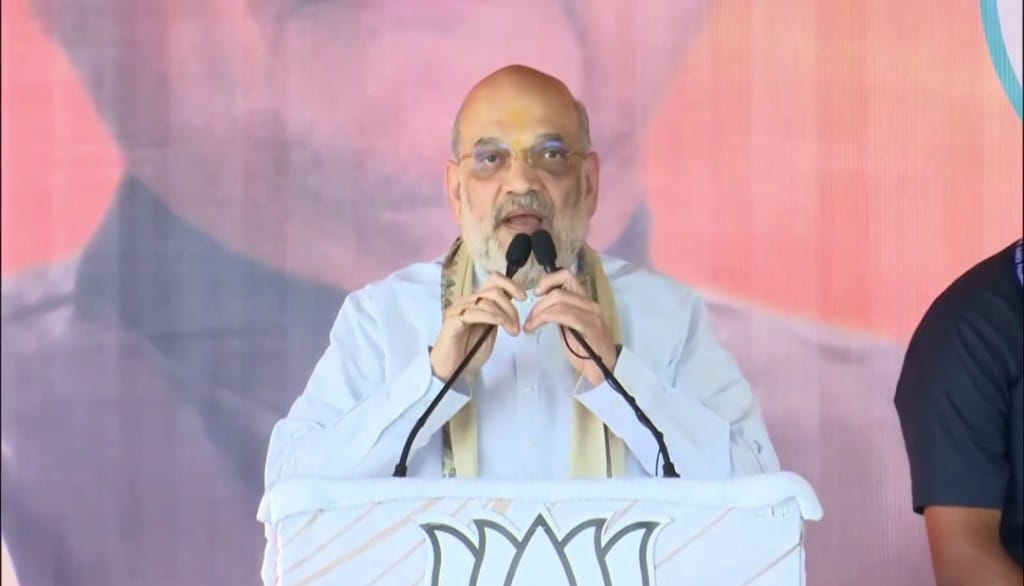
West Champaran: Amit Shah, India’s home minister, used a campaign rally in Bagaha, West Champaran, on Wednesday to mount a blistering attack on rival parties and to cast the Bihar assembly election as a referendum on crime and governance. Speaking to a large crowd, Mr Shah criticised the leadership of the Rashtriya Janata Dal (RJD) and accused former chief minister Lalu Prasad Yadav of overseeing decades of corruption and lawlessness.

“We will not allow strongmen like Shahabuddin to have a place in Bihar any more,” Mr Shah told supporters, invoking the name of a notorious criminal whose influence in parts of the state has been a recurrent theme in election rhetoric. He said no one could “dare to stop” the government’s payments of ₹10,000 to women under the Jivika scheme, and promised that, if the NDA returned to power, the assistance would be raised to Rs. 2 lakh.
Mr Shah’s speech blended welfare promises with harsh warnings about security. He repeatedly accused the RJD and its allies of encouraging “infiltration” and of tolerating criminality during previous administrations, saying the current government had taken a firmer line against militants and criminals. On the same occasion he posed a stark choice to voters: “Do you want a government that brandishes pistols, or a government that fires shells?” — a line that underlined the muscular tone of his remarks.

The home minister also rehearsed a catalogue of allegations against the RJD leadership, accusing Lalu and his family of involvement in multiple scams — from fodder fraud to alleged irregularities in flood relief and asset declarations. Mr Shah said the opposition lacked coherent leadership and presented the National Democratic Alliance (NDA), led in the state by Nitish Kumar and Narendra Modi at the centre, as the stable alternative.
The remarks came as voting in the first phase of Bihar’s assembly elections was under way. Mr Shah predicted a decisive victory for the NDA and said opposition parties would be “wiped out” on counting day — a forecast designed to rally supporters and shape the narrative ahead of the result. Election officials earlier this week published the schedule for the multi-phase poll; counting is set for 14 November.
Critics say such speeches, which weave allegations of criminality and national security into campaign rhetoric, risk hardening communal and regional faultlines and lowering the tone of political debate. Supporters, by contrast, welcomed Mr Shah’s promises on welfare and development, arguing that strong rhetoric is necessary to defeat what they describe as a return to “jungle raj”. Independent analysts note that law-and-order narratives have long been central to national parties’ electoral strategies in Bihar, especially in constituencies with histories of violent local strongmen.