Gaya: A fresh survey for the proposed Vishnupad temple corridor in Gaya has begun following a recent site inspection by chief minister, Samrat Choudhary, with the project’s scope now significantly expanded.

Local residents reported recent survey activity in the Karsilli hill area, where teams were seen marking several properties. According to members of the Shri Vishnupad Managing Committee, including Manilal Barik and Premnath Taiya, those conducting the survey identified it as part of the corridor project but did not provide formal notices to affected households.
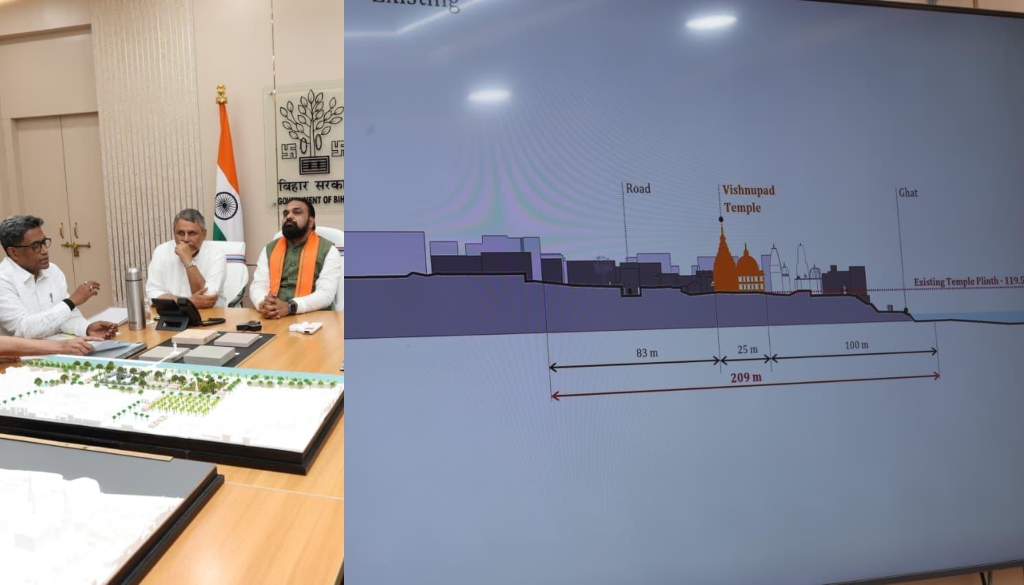
The development marks a shift from the initial plan, which proposed a 75-metre development zone around the temple. Authorities have now extended the proposed boundary to 200 metres, raising concerns among residents about the scale of land acquisition.

Barik said the lack of prior communication has created uncertainty and confusion among locals, many of whom are unsure how much of their property may be affected or what rehabilitation arrangements might follow. Questions also remain about which agency is overseeing the survey, with no clear information provided to residents.
Community representatives have called on the district administration to hold consultations with local stakeholders, including priests and members of the traditional panda community, to clarify the project’s details and reduce tensions.
According to sources, the cost of the Vishnupad temple corridor has risen sharply to an estimated Rs. 3,000 crore under the current administration, compared with an earlier projection of around Rs. 60 crore. The revised plan envisages large-scale development modelled on the Kashi Vishwanath corridor in Varanasi.
Proposals include the installation of a 108-foot-tall alloy statue of Lord Vishnu in the Falgu river, along with the construction of nearly 700 new structures. These are expected to include commercial spaces, shelters for pilgrims performing pinddaan rituals, and modern parking facilities.
Officials view the project as a major boost to religious tourism and a step towards enhancing Gaya’s national and international profile. However, its expansion has intensified debate over transparency, community consultation, and the impact on existing neighbourhoods.