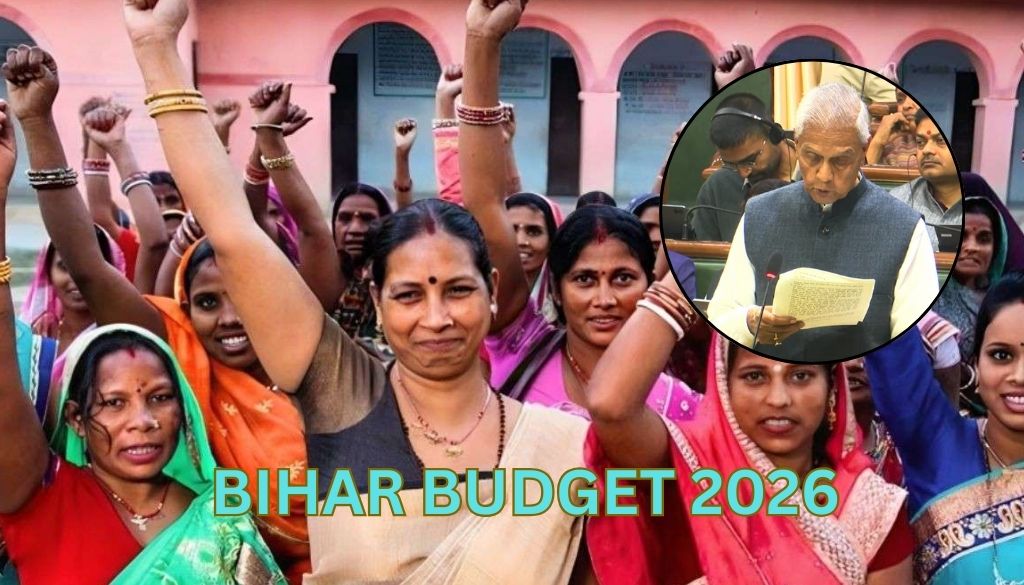
Patna: The Bihar government has placed women’s economic empowerment and job creation at the centre of its 2026 budget, unveiling a package of measures aimed at linking women directly to markets, expanding skill training and reducing migration for work.

Under the chief minister’s women’s employment scheme, the state plans to develop local markets from villages to cities to sell goods produced by women. The focus, officials say, is to move women beyond production roles and connect them straight to buyers, allowing incomes to grow more sustainably.
Government figures show that more than 15.6 million women have already received financial assistance of Rs 10,000 each under the scheme to help them enter income-generating activities. The support has strengthened small enterprises run by women associated with self-help groups, particularly in rural areas.

One of the most prominent outcomes has been the expansion of the Lakhpati Didi initiative. According to the state, 3.17 Crore women linked to Jeevika self-help groups have now been identified as “Lakhpati Didis” – earning more than Rs 100,000 annually. Officials describe this as evidence of a shift in the rural economy, with women increasingly taking on leadership roles rather than remaining in supporting positions.
Alongside this, the budget signals a major push on skill development. The government has approved the establishment of mega skill centres across the state using a hub-and-spoke model. In the first phase, one centre will be set up in each administrative division, with expansion to all districts planned in the second phase. The centres are intended to provide industry-oriented training for young people and women, with a focus on skills relevant to Industry 4.0.
The state is also seeking to strengthen the link between training and employment. Bihar currently has 152 industrial training institutes (ITIs), including 38 exclusively for women. Of these, 149 are being developed as centres of excellence. Sixty ITIs have already been upgraded, training nearly 7,900 candidates so far.
In the 2025–26 financial year, about 19,600 applicants secured jobs through job fairs, while more than 22,300 found employment via placement camps. The government is also developing an integrated e-registration and employment portal to make job placement more transparent and accessible for young people.
Officials say job fairs and placement drives have played a growing role in employment generation, with nearly 42,000 candidates placed in private-sector jobs during 2025–26 alone. The government argues that by combining skill training with direct placement mechanisms, it hopes to curb the outflow of young workers to other states and create more opportunities within Bihar itself.