
Patna: Bihar Chief Minister Samrat Chaudhary on Saturday said the state government has adopted a zero-tolerance approach to human trafficking, with a focus not only on recovering missing children and trafficking survivors but also on their rehabilitation and reintegration into society.

Speaking at the Eastern Zonal Conference-cum-Consultation on Missing Children and Human Trafficking at Gyan Bhawan in Patna, the Chief Minister said preventing trafficking, taking swift action against traffickers and ensuring a safe environment for victims remain key priorities for the government.
‘Naya Savera 3.0’ to expand prevention and rehabilitation efforts

Chaudhary said the ‘Naya Savera 3.0’ campaign will expand efforts around awareness, prevention, rescue and rehabilitation of people affected by human trafficking.
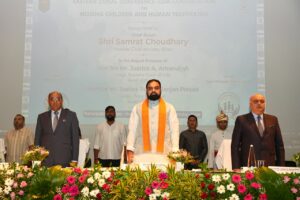
He stressed that the government’s responsibility does not end with rescuing victims. Those freed from trafficking should also receive skill development, employment opportunities and support to lead dignified and self-reliant lives, he said.
The Chief Minister also highlighted the importance of employment and skill development at the local level, saying access to safe and legitimate livelihood opportunities could reduce the risk of people falling prey to trafficking networks.
More than 1,200 missing children recovered
The Chief Minister said Bihar has introduced a real-time monitoring system to make action in cases involving missing children and persons more time-bound.
According to him, more than 1,200 missing children have been recovered through the system.
He also referred to the government’s ‘Sahyog Shivirs’, which aim to resolve public complaints within 30 days. More than six lakh applications have been received through the initiative, with over 5.50 lakh cases reportedly disposed of.
Chaudhary said accountability has been fixed for officials handling such cases. He added that he personally hears unresolved or unsatisfactory cases on the second Tuesday of every month. At the previous state-level Sahyog programme, 129 applications were placed before him, of which cases involving 100 applicants were resolved, he said.
Migration identified as a factor in trafficking risk
The Chief Minister also linked human trafficking with migration, stressing the need to create employment opportunities within Bihar.
He said increased industrial investment in the state could generate jobs and reduce migration driven by economic necessity. Chaudhary cited recent memorandums of understanding worth more than ₹51,000 crore with various steel industry groups as part of the state’s efforts to attract investment.
He said the government wants to create an environment where people can return from their “karmabhoomi” to their “janmabhoomi” while finding education, skills, employment and better opportunities within Bihar.
Special focus on vulnerable groups and policing
Chaudhary said Bihar has significant participation of women in the police force and has established Special Juvenile Police Units as part of efforts to strengthen protection mechanisms for children.
He assured representatives from different states and experts attending the conference that Bihar would extend all possible cooperation in preventing human trafficking, recovering missing persons and ensuring their rehabilitation.
Experts discuss missing children and trafficking
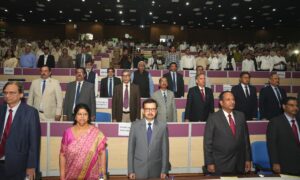
The conference brought together judicial officials, senior administrators, police officers, legal experts and representatives from different institutions to discuss missing children, human trafficking, inter-state coordination and victim rehabilitation.
A video film highlighting the consequences of human trafficking, prevention measures and the response mechanism was also screened during the programme.
Among those who addressed the gathering were Supreme Court Justice A. Amanullah, Patna High Court Justice Rajiv Ranjan Prasad, Bihar Advocate General S.D. Sanjay, and Additional Solicitor General of India Archana Pathak Dave.
Former Delhi High Court judge Mukta Gupta and other experts also shared their views on strengthening systems to prevent trafficking and protect vulnerable people.
The conference concluded with an emphasis on coordinated action among states, police, administration, judiciary and civil society organisations to improve the recovery, protection and rehabilitation of missing children and trafficking survivors.