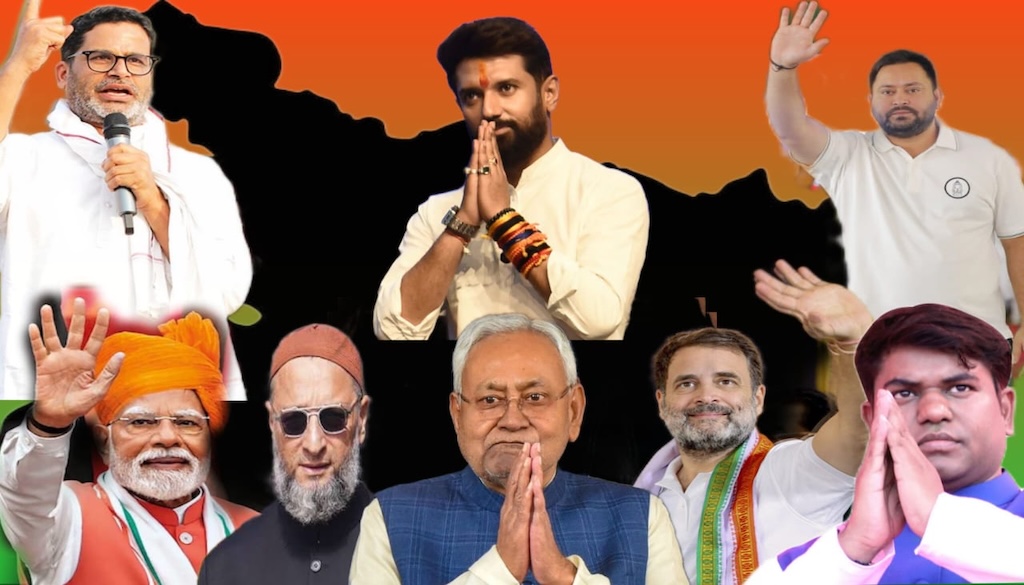
Patna: The NDA appears set to form the government in Bihar for yet another term, breaking a 20-year cycle of anti-incumbency with a decisive and region-spanning mandate. As of 2.30pm, the alliance was leading in 201 of 243 seats, marking a dramatic gain of 76 since the 2020 Assembly polls. The BJP has emerged as the single most dominant force in the state, winning 91 of the 101 seats it contested—an extraordinary 90% strike rate—and firmly assuming the role of “big brother” within the coalition. The JD (U), with 79 seats, has taken the second spot.

In contrast, the Grand Alliance has suffered a deep collapse, dropping from 110 seats to just 36. The NDA has overturned 83 GA-held seats, including five of the opposition’s 12 long-held bastions. The RJD–Congress combine, which maintained control over these constituencies for three consecutive elections, has now seen its stiffest erosion of influence.
Regional sweep across Bihar

The sweep is broad-based. In Tirhut, the NDA is leading in 56 seats, up by 20; in Magadh, it has surged ahead in 38, also up by 20. In Shahabad, where the alliance previously won just two seats, it is ahead in 20, a leap of 18. Gains are visible across Mithila, Ang Pradesh and the Seemanchal–Kosi belt as well.
In a state election often shaped by caste alignments and micro-regional patterns, the scale of the alliance’s gains across nearly all regions illustrates a consolidated vote that cuts across traditional divides.
Why the NDA won: the five decisive factors
- A women-focused welfare intervention that shifted loyalty
The NDA’s most potent electoral weapon was Nitish Kumar’s Women’s Employment Scheme, which transferred Rs 10,000 to 12.1 million women, widely dubbed “Das Hazari”. Across India, cash schemes for women have proven successful in nine of the ten states where they were deployed since 2023. In Bihar, they helped neutralise anti-incumbency that had accumulated over Nitish’s two-decade tenure.
Surveys indicate that 48.5% of women voted for the NDA, with 37% explicitly approving the scheme. Political analysts argue that the transfer was not merely financial support but a political signal to a bloc that has consistently favoured Nitish.
- The Chirag Paswan factor that restored JD (U) losses
The JD (U)’s historically poor 2020 performance—when it fell to 43 seats—was influenced heavily by Chirag Paswan’s LJP (Ram Vilas) candidates, who cut into its margins in 34 seats. This year, Chirag contested within the NDA, winning 29 seats and reversing JD (U)’s previous losses. The partnership boosted JD (U)’s tally by nearly 48%.
Analysts say the alliance reunited upper castes, non-Yadav OBCs and Mahadalits—core NDA blocs—creating a social coalition that proved difficult for the Grand Alliance to counter.
- Jungle Raj vs Vote Theft: why the NDA’s narrative won
The NDA revived the “Jungle Raj” narrative, linking the RJD to its 1990s legacy of kidnappings, extortion and criminality—an argument that continues to resonate among women, Dalits and EBCs.
The Grand Alliance, by contrast, foregrounded vote theft allegations and SIR (social and institutional reform) rhetoric. But analysts note that the message struggled to gain traction beyond core supporters. Even Tejashwi eventually moved away from the vote-theft allegation and shifted toward employment and migration.
- An opposition paralysed by seat-sharing conflicts
While the NDA announced its seat-sharing arrangement just six days after the election dates were declared, the Grand Alliance failed to release its formula publicly even weeks into the campaign. Internal fissures were evident: in eight seats, alliance partners ended up contesting against one another.
Disagreements over the chief ministerial and deputy chief ministerial faces added to the confusion. Political analysts argue that the lack of coordination undermined confidence in the coalition’s ability to govern.
- A high-octane NDA campaign led by Modi, Shah and a cast of star campaigners
Prime Minister Narendra Modi held 14 rallies and a roadshow, covering 115 constituencies—mostly in regions where the NDA sought a turnaround. Home minister Amit Shah conducted 28 rallies and undertook damage control with party rebels. Chief ministers from eight BJP-ruled states, Union ministers, and Bhojpuri cinema stars added to the momentum.
The Grand Alliance’s campaign, in comparison, rested overwhelmingly on Tejashwi Yadav alone.
The NDA’s numbers point to not just an electoral win but a structural one—built on welfare transfers, social coalitions, narrative superiority and an unmatched on-ground apparatus. With the BJP now the dominant pole in Bihar and Nitish Kumar expected to return yet again as chief minister, the state is entering a new political phase—one defined as much by the alliance’s stability as by the opposition’s drift.