New Delhi/Patna: The political stage in Bihar has officially been set. The Election Commission of India (ECI) on Monday announced that the 2025 Bihar Assembly elections will be conducted in two phases—on November 6 and November 11—with the results to be declared on November 14.

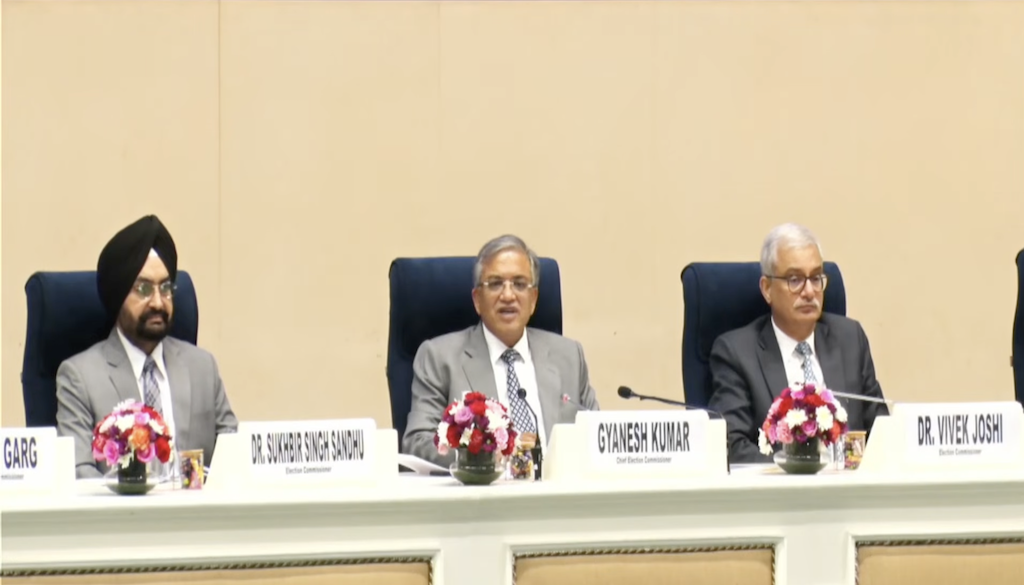
Addressing a press conference in New Delhi, Chief Election Commissioner Gyanesh Kumar said the entire electoral process would be completed by November 16, bringing an end to weeks of speculation about the poll schedule.
“This year’s election will mark a historic moment for Bihar — one that combines the state’s deep democratic traditions with several modern, voter-friendly innovations,” Kumar said, calling Bihar elections ‘Mother of All Elections’.

With the announcement of dates, the model code of conduct has come into force, officially signalling the start of the electoral battle in the politically charged state.
Two Phases, 243 Seats, 7.43 Crore Voters
Over 7.43 crore voters will decide the fate of candidates across 243 assembly constituencies, of which two are reserved for Scheduled Castes and two for Scheduled Tribes.
According to the Election Commission, Bihar’s voter roll includes 39.2 million men, 35 million women, and 1,725 transgender voters. Notably, the state also has 450,000 elderly voters and 1.4 million first-time voters.
Polling will be conducted across 90,712 polling stations—each accommodating up to 1,200 voters—with 76,801 booths in rural areas and 13,911 in urban centres. The Commission has also announced 1,044 all-women-managed polling booths and 1,350 model booths as part of its inclusivity efforts.
🗓️#SCHEDULE for the GENERAL ELECTION TO THE LEGISLATIVE ASSEMBLY OF BIHAR 2025 – Two Phases
Details 👇#Bihar #BiharElections2025 pic.twitter.com/ZeTBbpX32O
— Election Commission of India (@ECISVEEP) October 6, 2025
New Initiatives for a Modern Election
The Chief Election Commissioner said 17 new practices will debut in Bihar’s elections, several of which could later be adopted nationwide. Among the most notable changes is the introduction of designated spaces for voters to deposit mobile phones before casting their votes — an effort to maintain privacy and transparency at polling booths.
Other improvements include polling volunteers, help desks, and voter facilitation centres at every booth. Ramps, wheelchairs, and separate restrooms for men and women will also be provided.
“Those unable to visit polling stations due to age or disability can now vote from home by filling out Form 12D,” Kumar said, adding that polling stations will be equipped with drinking water, electricity, and sanitation facilities.
Political Stakes High, Alliances Yet to Finalise Seats
While the ECI’s announcement has electrified Bihar’s political atmosphere, major alliances are still negotiating their seat-sharing formulas.
The ruling NDA, led by Chief Minister Nitish Kumar’s Janata Dal (United) and the Bharatiya Janata Party, has yet to declare candidates, even as senior BJP leaders—including Union Minister Dharmendra Pradhan—continue internal reviews and meetings in Patna.
On the opposition side, the Grand Alliance (Mahagathbandhan)—comprising RJD, Congress, and VIP Party—has also not finalised its seat distribution. RJD leader Tejashwi Yadav remains the alliance’s likely chief ministerial face, while Prashant Kishor’s Jan Suraaj plans to contest independently, positioning itself as a “people’s movement” rather than a conventional political front.
Between Democracy and Tradition
The timing of the election—just a fortnight after Chhath Puja, Bihar’s most sacred festival—carries both symbolic and logistical weight. The festival of sunlight and faith will segue into the festival of democracy, as the state’s political fate is determined by millions of its citizens.
For the Election Commission, Bihar’s elections have always been a testing ground for democratic innovation. This year, with digitally mapped polling stations, enhanced accessibility, and stricter oversight, the Commission hopes to make the process smoother and more inclusive.
As Bihar heads into another high-stakes electoral showdown, the coming weeks promise an intense contest of narratives and numbers — between legacy and reform, power and promise, and above all, between hope and history.