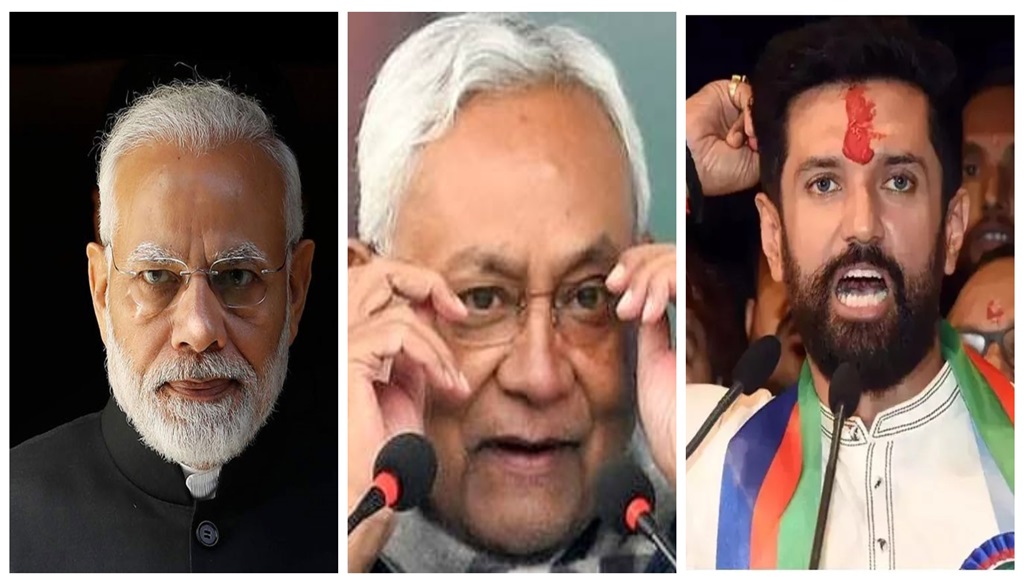
Patna: The National Democratic Alliance (NDA) on Sunday finalized its seat-sharing agreement for the upcoming Bihar Assembly elections, marking a first in the coalition’s history — both the Bharatiya Janata Party (BJP) and the Janata Dal (United) will contest an equal number of seats.

The agreement, finalized in Delhi, divides 101 seats each between the BJP and JD(U), with the remaining constituencies shared among Chirag Paswan’s Lok Janshakti Party (Ram Vilas), Jitan Ram Manjhi’s Hindustani Awam Morcha (HAM), and Upendra Kushwaha’s Rashtriya Lok Morcha (RLM).
Equal footing for BJP and JD(U)
For the first time, there will be no “elder brother” or “younger brother” within the NDA in Bihar. The seat-sharing formula is modeled on the Lok Sabha agreement, where the BJP had contested 17 seats and JD(U) 16. Based on that, the BJP’s assembly share was calculated at 104 seats and JD(U)’s at 97 seats.

After rounds of negotiations, the BJP agreed to contest three fewer seats than its Lok Sabha-based quota, while JD(U) received four more, bringing both to 101 each.
Senior political analyst Arun Kumar Pandey said, “The BJP has now achieved parity with the JD(U) in Bihar politics. It may not be the dominant partner numerically, but symbolically, this is a statement of equality.”
Decline in JD(U)’s electoral share over the years
The JD(U)’s share of seats has steadily decreased over the past 15 years. When the party first contested elections in 2005, it fielded candidates in 138 constituencies. The number peaked at 141 in 2010 but has now dropped to 101 — a decline of nearly 29 percent.
In comparison, the BJP’s seat count has remained stable. The party contested 101 seats in 2005 and will contest the same number in 2025.
In the 2020 elections, JD(U) had contested 115 seats and BJP 110. This year, both parties have reduced their numbers by 14 and nine respectively, underscoring the NDA’s effort to maintain coalition balance.
Chirag Paswan becomes the biggest bargainer
Chirag Paswan’s Lok Janshakti Party (Ram Vilas) — which contested five Lok Sabha seats earlier — has been allotted 29 Assembly seats this time. Within the NDA, Paswan has emerged as the strongest negotiator.
In 2020, he broke away from the NDA and contested 135 seats independently, winning only one but damaging JD(U)’s prospects in over 30 constituencies.
This time, Chirag stayed firm in his seat demands and secured the desired number, strengthening his position as the NDA’s Dalit face.
“Chirag Paswan has proven to be the NDA’s most influential Dalit leader,” journalist Arun Kumar Pandey noted. “With Dalits making up around 19 percent of Bihar’s population and Chirag consistently securing 6 percent of the vote share, his inclusion is critical.”
Manjhi’s influence wanes, gets only six seats
Former Chief Minister Jitan Ram Manjhi, who had demanded 15 to 20 seats for his Hindustani Awam Morcha, managed to secure only six.
Political observer Sanjay Singh explained, “Manjhi’s influence is limited to Gaya and nearby districts. Most of his candidates come from his family. The NDA kept him in the alliance mainly to retain Dalit support and prevent a regional split in the Gaya belt.”
Despite his reduced tally, Manjhi continues to hold a ministerial position at the Centre, while his son Santosh Suman serves as a minister in the Bihar government.
Kushwaha stays in despite weak bargaining power
Upendra Kushwaha’s Rashtriya Lok Morcha, the weakest NDA constituent, also received six seats. Kushwaha’s political relevance has waned since his defeat in the 2024 Lok Sabha elections from Karakat and his absence from the Assembly for nearly a decade.
Still, his inclusion is considered strategic. “The Kushwaha community, about 4.2 percent of Bihar’s population, influences results in Magadh and Shahabad regions,” said Sanjay Singh. “The NDA cannot afford to alienate him, especially after the Grand Alliance made inroads among Kushwaha voters.”
Kushwaha had initially demanded 10 seats and expressed displeasure before the final announcement, but the alliance accommodated him with six, preserving symbolic unity within the NDA.
What this means for the NDA
The 2025 seat-sharing agreement signifies a recalibrated partnership between Bihar’s two major allies — BJP and JD(U) — with both contesting on equal footing for the first time. The arrangement also consolidates Chirag Paswan’s growing clout, balances smaller allies, and sends a strong message of unity ahead of a high-stakes election.
Political observers say the NDA’s biggest challenge now will be managing grassroots coordination and preventing internal rebellion from disgruntled aspirants as ticket distribution begins.