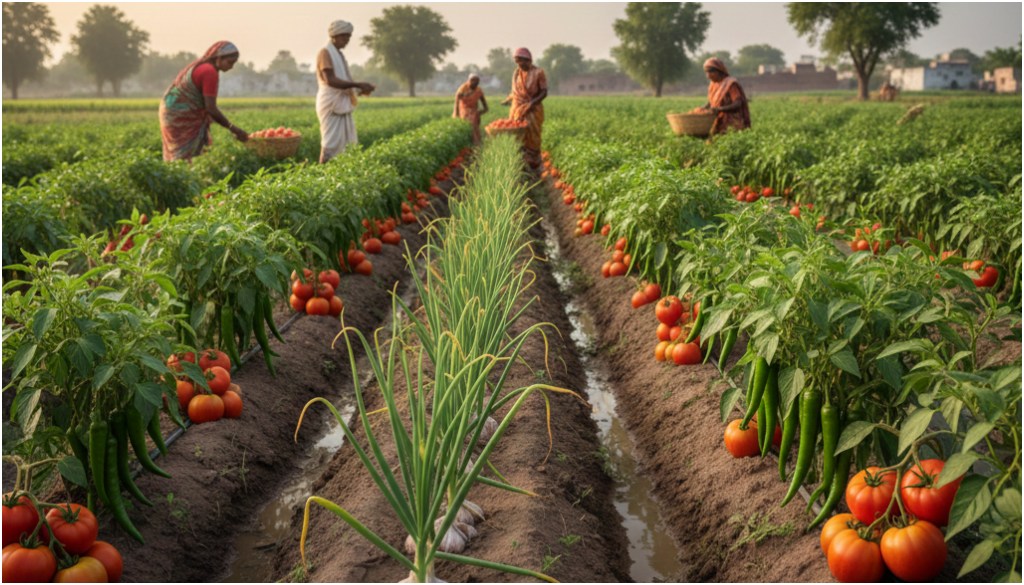
Patna: The Bihar government has announced plans to establish 15-acre agricultural clusters in every panchayat, focusing on the cultivation of cash crops such as tomatoes, chillies and garlic, in an effort to increase farmers’ incomes and expand the state’s presence in inter-state trade and exports.

The agriculture minister, Ram Kripal Yadav, said the cluster-based model would encourage farmers to grow similar crops collectively rather than in isolation, improving productivity, quality and access to markets. The initiative is aimed particularly at small and marginal farmers, who make up the majority of Bihar’s agricultural workforce.
Under the scheme, each panchayat will develop a structured cultivation zone of around 15 acres, where farmers will be supported to grow high-demand horticultural crops. Officials say tomatoes, chillies and garlic offer quicker returns and higher profits compared with traditional cereal crops, making them attractive options for income diversification.

“These are direct cash crops,” Yadav said, adding that net earnings from such produce can be several times higher than those from conventional grain farming when measured against cultivation costs. The state government, he said, is prioritising this model to help farmers become economically self-reliant.
The programme is being implemented in the 2025–26 financial year under the Prime Minister’s National Agricultural Development Scheme, with joint support from the central and state governments. It is open to both tenant and non-tenant farmers. According to the minister, Bihar’s fertile soil, favourable climate and labour-intensive farming practices provide a strong foundation for the initiative.
Farmers participating in the clusters will receive access to improved and climate-resilient seeds, scientific guidance, and facilities for processing and storage. The government is also linking growers to organised markets through farmer producer organisations, with the aim of ensuring more stable and transparent pricing.
To monitor implementation, the scheme will use direct benefit transfers, geo-tagging and regular verification processes to ensure assistance reaches eligible farmers.
State officials say the cluster-based approach could mark a shift in Bihar’s agricultural strategy, positioning the state as a significant hub for horticulture-led cash crop production in the coming years.