Varanasi/Patna: As Bihar moves closer to its assembly elections, the shadow economy of alcohol — banned in the state since 2016 — is once again asserting itself. This week, railway officials at Varanasi’s Cantt station uncovered a consignment of liquor concealed in parcel bookings, exposing the elaborate methods smugglers are adopting to meet surging poll-season demand.

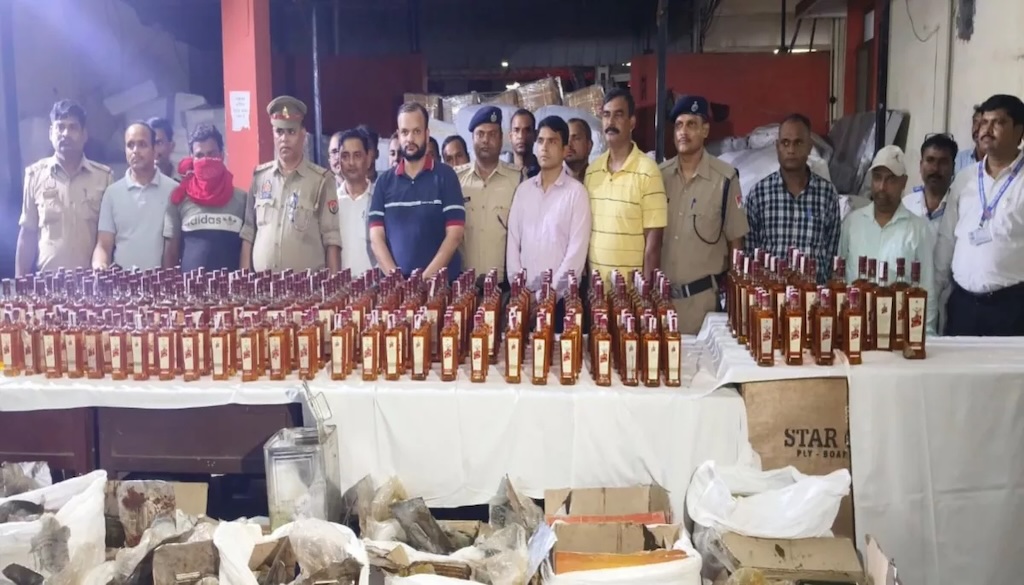
On Thursday evening, 16 parcels destined for Patna were found to contain 32 canisters filled with 288 bottles of Haryana-made Royal Stag whisky. Valued in lakhs, the haul was discovered when railway parcel staff grew suspicious during routine handling and called in the GRP and RPF for inspection. Krishna Gupta, a resident of Phulwari, was arrested, while the consignment was traced back to Vinod Gupta of Saran, Bihar, through his aide Shatrugdha Rai.
The case has highlighted both the ingenuity of smugglers and the limitations of current enforcement. Officials admitted the liquor-laden parcels had initially gone undetected by scanning machines, raising questions over security lapses. “An investigation will be conducted as to why the liquor was not visible in the scanning machine,” said Arpit Gupta, station director.

Police sources believe that the prohibition law, coupled with the inflated demand during elections, has fuelled a network of cross-border smuggling from eastern Uttar Pradesh. Royal Stag bottles that retail for about Rs 700 in UP are said to fetch nearly Rs 2,000 in Bihar’s underground market. Customers rarely need to be sought out — suppliers are approached directly and, in some cases, home deliveries are arranged.
The railway bust follows earlier seizures in districts such as Ballia, Ghazipur and Chandauli, with Banaras now emerging as a hub for transit consignments. In 2023, police had also dismantled a racket that disguised liquor bottles as pickle and jam containers, run by an “uncle-nephew gang” operating across state lines.
For enforcement agencies, the challenge is as much about technology as manpower. As the elections near, officials are bracing for more attempts to flood Bihar with alcohol — a prohibited commodity that, paradoxically, has only grown more profitable in its absence.