
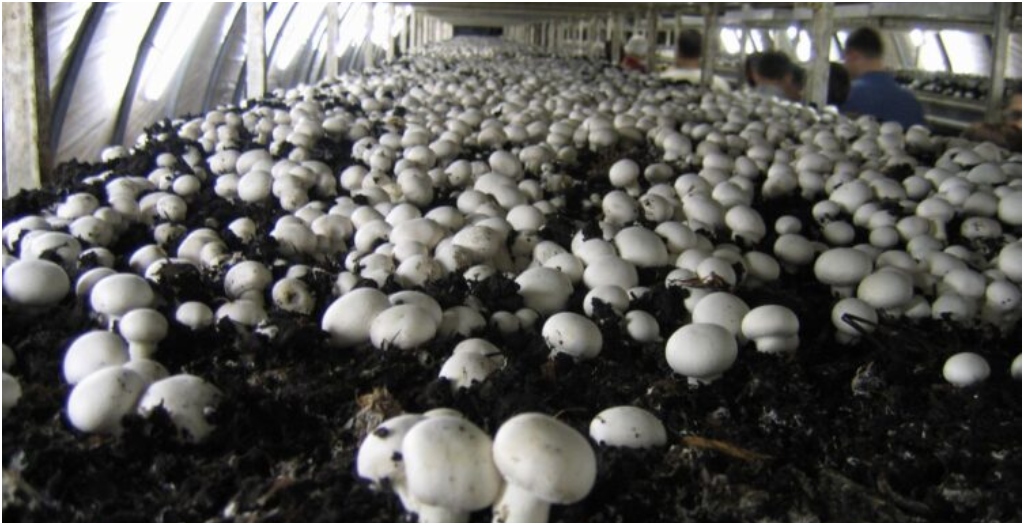
Patna: Bihar has emerged as a leading producer of mushrooms in India, with production rising sharply over the past decade. According to a recent report by the Indian Council of Agricultural Research (ICAR), output increased from 0.06 thousand tonnes in 2013-14 to 42.19 thousand tonnes.

The mushroom market is also projected to expand at a growth rate of 12.84%, highlighting the potential for further growth in cultivation, processing and marketing.
Mushroom Cultivation And Rural Livelihoods

Mushroom cultivation is increasingly providing an income opportunity for low-income households because it requires limited land and relatively low initial investment.
Unlike crops that depend heavily on fertile agricultural land, mushrooms can be grown indoors using materials such as straw, compost and spawn. Production can be carried out on racks inside huts or enclosed rooms, making it accessible to small-scale growers.
The model has also created opportunities for women’s economic participation, while contributing to household incomes and nutritional security.
Bihar’s Position In Mushroom Production
Bihar became India’s leading mushroom-producing state in 2022 and has retained that position, according to the information provided in the ICAR report.
The state’s share of India’s mushroom production has increased from 10.82% in 2020 to 12.02%, reflecting its growing contribution to the national sector.
India is currently the world’s fourth-largest mushroom producer, although its share of global mushroom exports remains comparatively modest.
Makhana And Mushroom: Two Different Agricultural Models
Makhana remains one of Bihar’s most prominent agricultural products. India accounts for about 80% of global makhana production, while Bihar contributes around 80% of India’s output.
Mithila Makhana received a Geographical Indication (GI) tag in 2022, strengthening its identity and export potential. The state has also set a target of expanding makhana cultivation to 70,000 hectares by 2030.
Makhana cultivation, however, is largely concentrated in ponds and waterlogged areas and involves labour-intensive production methods. Mushroom cultivation requires neither large tracts of fertile land nor specific weather conditions.
Expanding Market Potential
Market research cited in the report estimates that India’s makhana market was worth around Rs 9,290 crore in 2025. It is projected to reach Rs 19,950 crore by 2034, growing at a compound annual growth rate of 8.85%.
The mushroom market was valued at approximately Rs 11,992 crore in 2024 and is projected to reach Rs 24,753 crore by 2030, representing an estimated growth rate of 12.84%.
The contrasting models give Bihar opportunities across different parts of the agricultural economy. Makhana has established itself as a major commercial and export-oriented crop, while mushrooms offer a low-cost form of indoor cultivation with potential benefits for small producers.
Infrastructure And Market Linkages Key To Growth
Further expansion of Bihar’s mushroom sector will depend on improvements in processing, storage, marketing and market access.
Better infrastructure and stronger links between growers and markets could help producers capture more value from cultivation and support the development of a broader mushroom-based rural economy.