Kochas/Patna: When their mother died after a prolonged illness in 2023, childhood ended early for Khushi, Sapna and their younger brother. Their father, Jitendra Kumar Singh, a daily-wage labourer, did what millions of parents in rural India do when grief collides with necessity: he went back to work. The family survived on his wages, thin but steady, stitched together by routine and resilience.

Then, on February 24, 2025, a Scorpio struck him on NH-319. Jitendra Kumar Singh did not survive.
In the space of two years, three children became orphans.

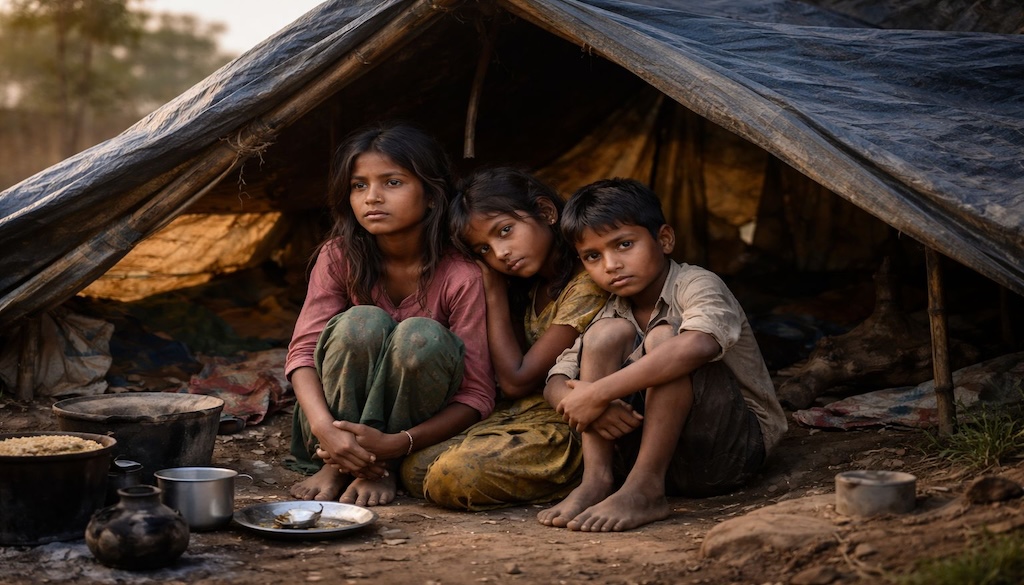
Today, the siblings live on a one-decimal plot of land in Sheikh Bahuara village in Rohtas district, under a tarpaulin that barely holds against wind or rain. Neighbours offered sympathy in the days after the accident. Officials came too, with words that sounded like relief: a Circle Officer promised two decimals of land; the Block Development Officer spoke of compensation under the accidental death scheme. For a while, hope filled the gap their parents had left behind.
Then time passed.
The small savings their father had left ran out. Government food grains arrived, but without firewood or oil, the grain often stayed uncooked. Many nights, the children slept hungry. Eventually, hunger pushed them out of their makeshift shelter and onto the streets, knocking on doors, asking for food, sometimes for work, often for nothing more than acknowledgment.
They still go, from time to time, to the block office. Khushi, the eldest at 14, knows the route by heart now. “After Babuji died, the CO and BDO sahebs told us we would get land and a house under PM Awas Yojana,” she says. “They said other government help would also come. But nothing came. We are still here, under this tarpaulin, on one decimal land in Babuji’s name.”
Sapna, 12, speaks more quietly. “Sometimes people help us,” she says. “But how long can that last?” Their brother is just 10.
Officials, when asked, point to procedure. Circle Officer Vineet Vyas says a proposal for land allotment has been sent to the Deputy Collector Land Reforms in Sasaram. Action will begin, he says, once orders are received. Why the file remains stuck is unclear. Block Development Officer Chandrabhushan Gupta says no application for accidental death compensation was submitted at the time, which is why the grant could not be processed.
The explanation raises uncomfortable questions. The children are minors. They lost both parents. Is it reasonable to expect them to navigate forms, deadlines and offices on their own? Under existing provisions, up to Rs 4 lakh can be granted as compensation in accidental death cases. For these children, that amount could mean food, schooling and a roof that does not flap in the wind.
There are no easy villains in their story, only a familiar inertia. In villages like Sheikh Bahuara and Kochas, social workers and organisations exist, at least on paper. Yet the burden of survival has fallen squarely on three children who should have been worrying about homework, not hunger.
At night, when the village quietens, their tarpaulin shelter glows faintly from within, lit by borrowed lamps or nothing at all. “We work when we can,” Sapna says. “If the government helps us, we will keep working. May the gods take pity on us.”
For now, pity is all they have. The paperwork is still waiting.