
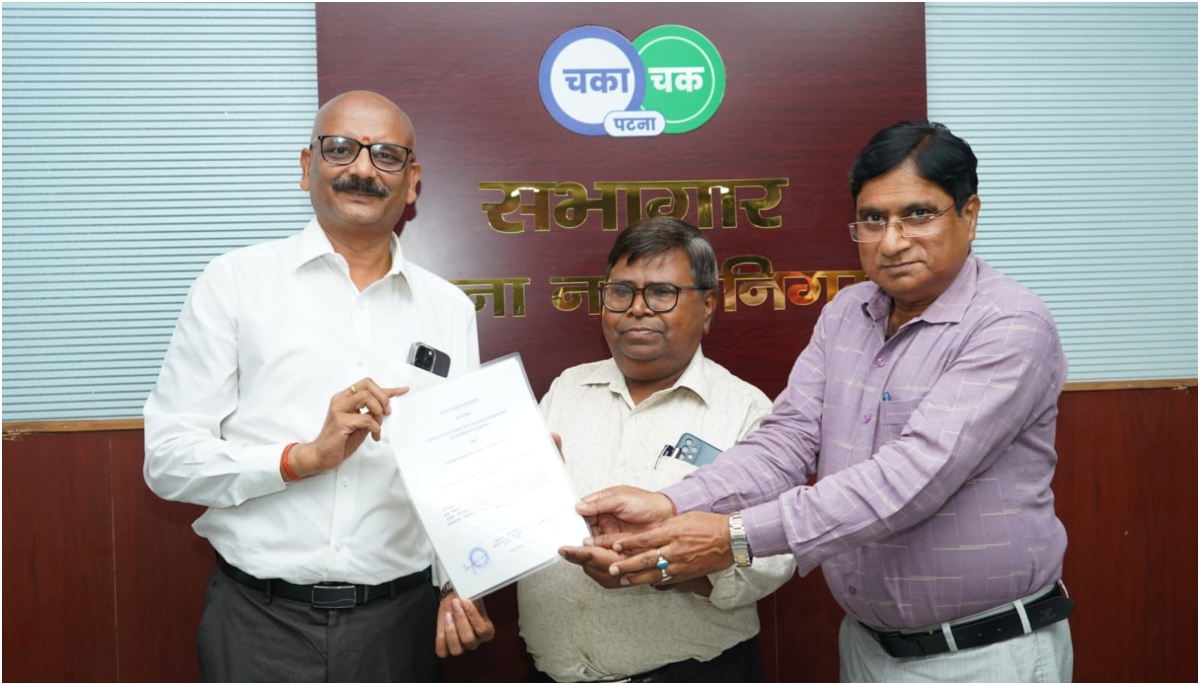
Patna: The Bihar government on August 6 signed a tripartite concession agreement to develop an integrated solid waste management system and a 15 MW waste-to-energy plant for 13 urban local bodies in the Patna cluster. The project, estimated to cost Rs 514.59 crore, will be implemented under the Public-Private Partnership (PPP) model.

The agreement was signed at the Patna Municipal Corporation headquarters between the Urban Development and Housing Department, Patna Municipal Corporation (PMC), and Magadh Resource Recovery Sustainable Solutions Limited, a Special Purpose Vehicle (SPV) formed for the project’s implementation.
The signatories included Ranjan Kumar Chaudhary, Deputy Secretary of the Urban Development and Housing Department, Bindu Rajak, Chief Municipal Engineer of Patna Municipal Corporation, and Sanjeev Kumar, representing the SPV.

Project to Serve 13 Urban Local Bodies
The integrated waste management system will cater to 13 urban local bodies in and around Patna. These include Patna Municipal Corporation, Danapur Nizamat Nagar Parishad, Fatuha Nagar Parishad, Khagaul Nagar Parishad, Phulwari Nagar Parishad, Bakhtiyarpur Nagar Parishad, Masaurhi Nagar Parishad, Bihta Nagar Parishad, Sampatchak Nagar Parishad, Maner Nagar Parishad, Naubatpur Nagar Panchayat, Punpun Nagar Panchayat and Khusrupur Nagar Panchayat.
According to the Urban Development and Housing Department, an Inter-Urban Local Body Agreement was signed on July 20, under which Patna Municipal Corporation was designated as the lead agency for implementing the project.
Modern Waste Processing Complex Planned
A centralised Integrated Solid Waste Processing Complex will be developed at Ramchak Bairia in Patna to process segregated municipal waste collected from all participating urban local bodies.
The facility will include a 15 MW waste-to-energy plant, a 100-tonnes-per-day bio-methanation plant, three 250-tonnes-per-day Material Recovery Facility (MRF)-cum-Refuse Derived Fuel (RDF) centres, an additional 50-tonnes-per-day MRF, a 700-tonnes-per-day composting plant, and an engineered sanitary landfill with a 325-tonnes-per-day disposal capacity.
Officials said the project aims to maximise resource recovery, generate renewable energy from suitable waste, and minimise the volume of waste sent to landfill.
Construction Timeline and Operations
Construction of the integrated facility is expected to be completed within two and a half years. After commissioning, the selected private agency will operate and maintain the project for a period of 20 years under the concession agreement.
The project has received approval from the Department of Economic Affairs under the Ministry of Finance and the Ministry of Housing and Urban Affairs, Government of India.
Focus on Sustainable Urban Development
The Urban Development and Housing Department said the project is designed to support scientific waste management in accordance with the Solid Waste Management Rules, 2026.
The department said the initiative is expected to reduce landfill dependence, lower greenhouse gas emissions, promote recycling and resource recovery, and contribute to cleaner urban environments while generating renewable energy.
Officials said the project reflects the Bihar government’s strategy of strengthening urban sanitation infrastructure through modern technology, institutional coordination and long-term public-private partnerships.