Patna: The Bihar government is preparing to upgrade government schools across the state, with plans to develop at least one school in each of the 38 districts as a Centre of Excellence.

According to Education Minister Mithilesh Tiwari, the Education Department has prepared a detailed roadmap to transform selected government high and higher secondary schools into model institutions equipped with modern educational facilities.
The initiative will focus on upgrading established and well-performing schools, with an emphasis on technology-driven education, sports, arts, culture and vocational skills.

Smart Classrooms, Digital Libraries and High-Speed Internet
A major component of the proposed initiative is the development of modern digital infrastructure.
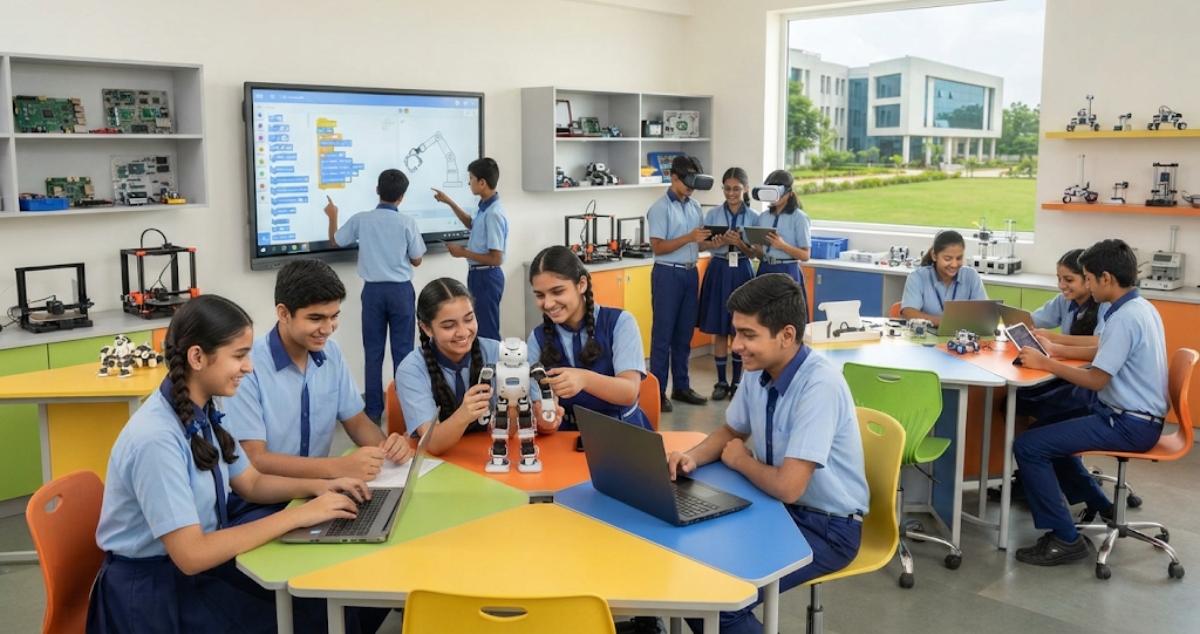
The Centres of Excellence are planned to have smart classrooms equipped with interactive panels and smart boards, along with modern computer and Information and Communication Technology (ICT) laboratories.
The proposed facilities also include high-speed internet connectivity and digital libraries.
Students will be taught through digital content and audio-visual learning tools alongside conventional classroom instruction.
The objective is to provide students in government schools with access to modern teaching methods and digital learning resources.
AI, Robotics and Coding Labs Proposed
The proposed schools will also focus on emerging technologies and innovation.
Innovation and robotics laboratories, including facilities similar to Atal Tinkering Labs, are planned to encourage students to experiment, develop ideas and build practical skills.
Students will be introduced to coding, artificial intelligence and astronomy kits as part of the initiative.
The programme is intended to familiarise schoolchildren with technologies that are increasingly relevant to higher education and future careers.
Modern Science Laboratories and Study Rooms
The Education Department also plans to upgrade academic infrastructure across the selected schools.
Laboratories for physics, chemistry, biology, mathematics and computer science will be equipped with modern instruments.
Libraries will offer both printed books and digital resources, while dedicated study rooms are proposed to provide students with a quiet environment for learning.
These facilities are expected to support practical learning and strengthen students’ understanding of academic subjects.
Sports Facilities, Indoor Games and Fitness Centres
The proposed Centres of Excellence will not be limited to classroom education.
The plan includes improved playgrounds and indoor sports facilities for football, cricket, basketball, volleyball, badminton and tennis.
Swimming pools are also proposed at selected major centres.
Yoga and fitness centres are planned to promote physical activity and overall student development.
Regular sports competitions, quizzes and cultural events will also be organised to encourage participation in extracurricular activities.
Focus on Girls’ Safety and Campus Facilities
The initiative also places emphasis on providing students, particularly girls, with a safe and hygienic learning environment.
Proposed improvements include better toilets, drinking water facilities and campus security arrangements.
Special nutrition programmes are also being considered on a pilot basis at some schools.
The facilities are intended to improve campus conditions and make schools more accessible and comfortable for students.
Students to Receive Digital and Leadership Skills
Alongside academic education, students will be encouraged to develop communication, leadership and digital skills.
The programme aims to prepare students for future employment and higher education by combining classroom learning with practical and extracurricular activities.
The proposed model is designed to give government school students access to a broader range of educational opportunities within their own districts.
Infrastructure and Trained Teachers Remain Key Challenges
Despite the ambitious plans, implementing the initiative across Bihar will involve several challenges.
Many older government schools lack adequate space and basic infrastructure, which could make the construction of laboratories, smart classrooms and sports facilities difficult.
Available figures cited in the report indicate that only around 24% of schools in the state have computer facilities, while approximately 85% have internet connectivity.
The availability of trained teachers and technical experts will also be crucial.
Specialists in robotics, artificial intelligence, coding and ICT will be needed, while existing teachers will require regular training to adapt to new teaching methods and technologies.
Adequate funding, effective management and the geographical and social conditions of rural areas will also influence the implementation of the programme.
Government Aims to Modernise School Education
The proposed initiative aims to establish at least one modern government school in every district, bringing technology, academic learning, sports and skill development together.
If implemented effectively, the Centres of Excellence could expand access to modern educational facilities for students across Bihar.
The detailed plan has been prepared by the Education Department, with the availability of infrastructure, trained personnel and funding expected to play an important role in its implementation.