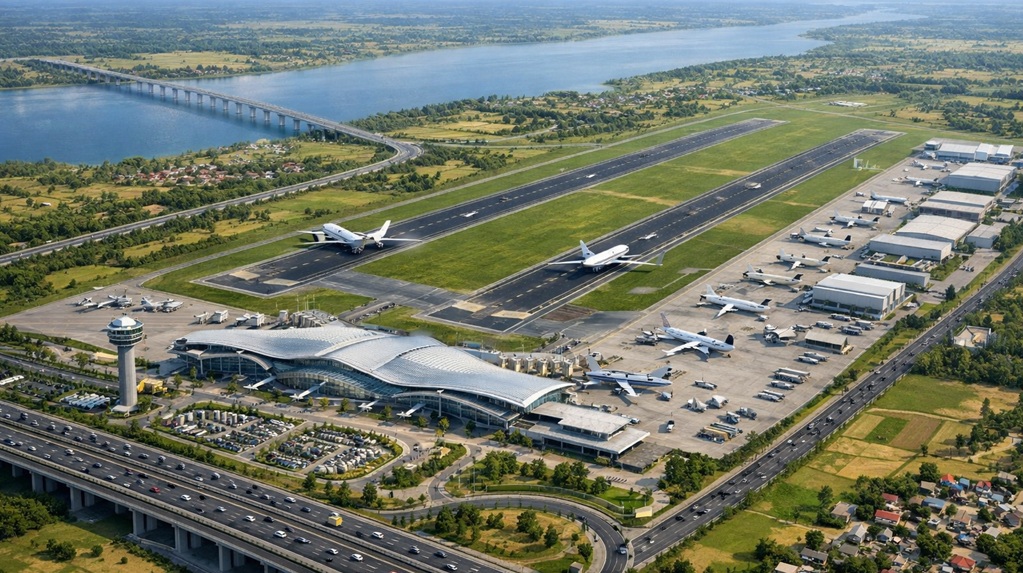
Patna: A major aviation infrastructure push is on the horizon for Bihar, with the state government accelerating plans to develop eastern India’s largest civilian airport in Saran district’s Sonepur. Spread over nearly 4,228 acres, the proposed Sonepur Greenfield Airport will be developed on the lines of the Noida International Airport and the Navi Mumbai International Airport, with a target completion year of 2030.

The airport is proposed to come up in the Dariyapur Chawar area between Hajipur and Dumaria, north of the Sonepur–Chhapra four-lane NH-19 and east of the Gandak river. Following approval in the Union Budget, the Bihar government has expedited the process. An amount of Rs 1,302 crore has been sanctioned for land acquisition. Sources in the civil aviation department indicated that key announcements related to construction may be made in the next Cabinet meeting.
Two 4,200-metre runways planned

One of the most significant features of the Sonepur airport will be its two proposed runways, each 4,200 metres long. The extended runway length will enable all categories of aircraft to operate, including some of the world’s largest passenger planes such as the Airbus A380. The airport will be developed in line with international standards.
Once completed, it is expected to become the fifth largest airport in India after major hubs in Delhi, Hyderabad, Navi Mumbai and Noida (Jewar). In terms of greenfield projects, 23 greenfield airports have been developed across the country so far, making Sonepur the 24th such airport.
Bihar currently operates four airports: Jay Prakash Narayan International Airport (Patna), Gaya Airport, Darbhanga Airport and Purnia Airport. The runway length at Patna is 2,050 metres, Darbhanga has a 2,700-metre runway, and Gaya has a 3,400-metre runway.
Except Patna, other major airports in Bihar operate from Indian Air Force-controlled airfields, leading to operational restrictions. For instance, regular flights from Darbhanga are not permitted after 5 pm. At Purnia, weekend flight operations were allowed following intervention from the Prime Minister’s Office.
Improved connectivity with 12-lane bridge
Connectivity between Patna and Sonepur is expected to improve significantly with multiple bridge projects over the Ganga river. A 12-lane connectivity plan is underway, including a six-lane bridge parallel to the existing Jay Prakash Setu. The Sherpur–Dighwara bridge project is in its final phase, and a parallel structure alongside the Mahatma Gandhi Setu is also under construction. By the time the airport becomes operational, enhanced road connectivity is expected to substantially reduce travel time between Patna and Sonepur.
Additionally, approval has been granted for the Sonepur–Bettiah four-lane road project to improve connectivity with north Bihar districts and help manage Gandak river overflow during monsoon.
Why Sonepur airport is considered necessary
The state government cites three primary reasons for developing the greenfield airport in Sonepur.
First, expansion of runways at Patna and Bihta is constrained. The runway at Patna is only 2,050 metres long and cannot be extended due to the presence of the Patna Zoo on one side and dense habitation on the other. The Bihta airport runway can be extended only up to around 2,500 metres because of surrounding settlements and a cemetery. Large aircraft used for international operations typically require a runway of around 3,000 metres or more, making the proposed 4,200-metre runway at Sonepur significantly more capable.
Second, passenger traffic is rising steadily. In 2025, Patna airport handled around 40 lakh passengers. According to civil aviation sources, with an annual growth rate of about 10 percent, even the new terminal capacity may become inadequate within the next decade.
Third, air traffic services (ATS) control at Bihta remains with the Indian Air Force, meaning it cannot function like a full-fledged 24-hour civilian airport.
Officials say the Sonepur Greenfield Airport is being planned to meet Bihar’s long-term aviation needs, allowing round-the-clock operations and accommodating all types of aircraft without operational constraints.