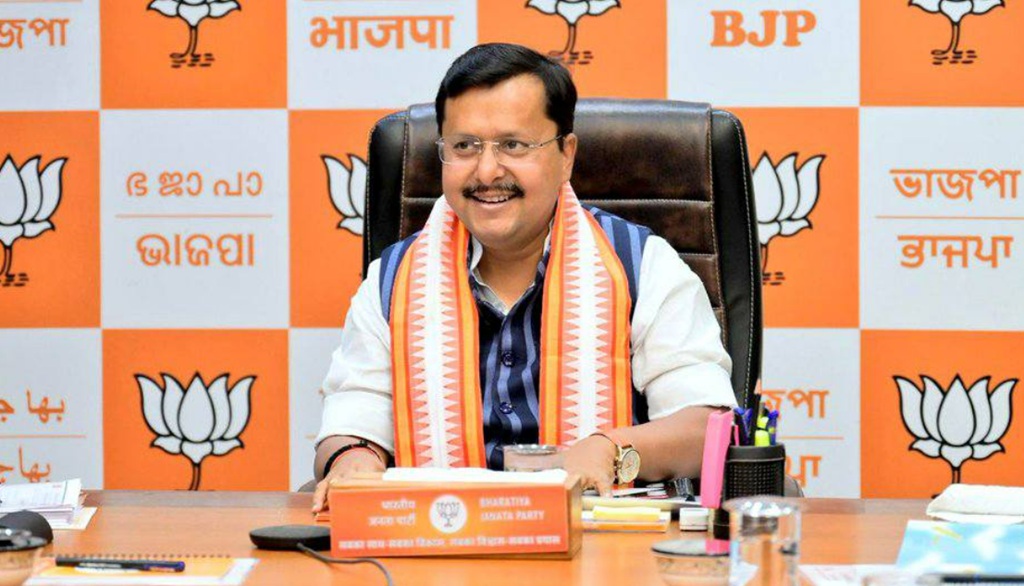
Patna: The Bharatiya Janata Party (BJP) on Tuesday turned the arrival of its newly appointed National Working President Nitin Nabin into a major show of strength in Bihar, signalling a clear political message on party unity, organisational expansion and future electoral strategy.

Nabin’s first visit to Bihar after assuming the post began with a six-kilometre-long roadshow through Patna, followed by a grand felicitation programme at Miller High School Ground. He later held a meeting with BJP Legislature Party leaders at the state party headquarters.
Although this was his maiden visit after taking charge, Nabin used the occasion to outline his priorities and convey firm messages to party leaders and workers. Political observers see the event as more than a welcome programme, interpreting it as an assertion of authority and direction by the central leadership.

No place for factionalism in the party
One of the strongest signals from the day-long programme was the leadership’s intent to end factionalism within the Bihar BJP. From Nabin’s arrival at Patna airport to the state headquarters meeting, senior leaders including Union ministers Nityanand Rai and Giriraj Singh, former deputy chief minister Nand Kishore Yadav, Samrat Choudhary, Sanjay Jaiswal and other MPs, MLAs and ministers were present together.
Political analysts say the show of unity was deliberate, aimed at countering growing internal power centres that had emerged following recent organisational decisions. The appointment of Darbhanga Sadar MLA Sanjay Saraogi as state BJP chief, bypassing caste equations, and Nabin’s elevation to a key national post are seen as part of a broader effort to reinforce discipline and central authority.
Political analysts said the message was clear: the BJP in Bihar will function as a cadre-based party where no faction or individual group dominates.
Focus shifts from cities to villages
Addressing party workers at the felicitation programme, Nabin stressed the need to strengthen the organisation at the grassroots, especially ahead of the upcoming panchayat elections. He said the BJP must fight the panchayat polls with full strength, adding that true political dominance would come only when the party’s flag flies from the panchayat level to Parliament.
Bihar is scheduled to hold panchayat elections in November–December 2026, nearly a year from now. The polls will cover around 2.5 lakh posts, including over 8,000 mukhiyas, more than one lakh ward members, around 20,000 panchayat samiti members and over 1,000 zila parishad seats. More than 50 percent of these seats are reserved for women.
Although panchayat elections in Bihar are held without party symbols, they are widely viewed as a training ground for future political leadership. With nearly 88 percent of Bihar’s population residing in rural areas, according to census and caste survey data, the BJP’s renewed focus on villages is seen as a strategic shift to broaden its mass base beyond urban centres.
Generational change within BJP leadership
The programme also highlighted an ongoing generational shift within the BJP. At the Miller High School Ground, despite the presence of senior leaders such as Sanjeev Chaurasia, Rituraj Sinha and Rajesh Verma, the stage proceedings were conducted by Jamui MLA and Sports Minister Shreyasi Singh, reflecting a conscious move to promote younger leadership.
In his speech, Nabin underlined that politics offers no shortcuts and requires patience and long-term commitment. He said dedicated workers are elevated from booth-level roles to the central leadership through sustained effort and discipline.
Analysts believe Nabin’s rise at the age of 45 symbolises the BJP’s attempt to balance experience with youthful energy, particularly to appeal to younger voters and ensure long-term political stability in the state.
Bengal message from Bihar platform
While the event centred on Bihar, references to West Bengal politics featured prominently. From slogans raised at the venue to speeches by senior leaders, the BJP’s eastern expansion strategy was clearly articulated.
Nabin asserted that the party would receive public support not only in Bihar but also in West Bengal and Kerala in the coming years. Leaders on the stage framed Bihar as a crucial base for strengthening the BJP’s presence in neighbouring states.
Political observers note that Nabin’s Kayastha background could play a role in outreach efforts in West Bengal, where the community holds significant political and social influence. In addition, the sizeable population of Bihari migrants in cities such as Kolkata, Asansol and Siliguri is also viewed as a key voter segment in the BJP’s broader eastern strategy.
Meeting with Chief Minister
During his visit, Nabin also met Chief Minister Nitish Kumar, accompanied by senior BJP leaders including Sanjay Saraogi, Vijay Kumar Sinha and Samrat Choudhary, adding to the political significance of the tour.
Overall, Nitin Nabin’s Bihar visit sent a multi-layered message on organisational discipline, grassroots expansion, generational change and regional ambition, marking the beginning of a new phase in the BJP’s political strategy in the state.