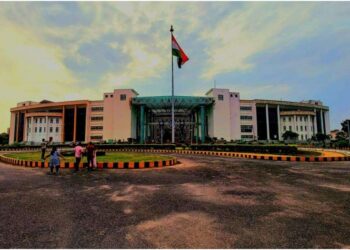

Darbhanga: Construction of a new terminal building at Darbhanga Airport is progressing, with around 71.1% of the work reportedly completed as the airport undergoes a major expansion aimed at strengthening air connectivity across Mithilanchal and North Bihar.

According to the Airports Authority of India (AAI), the new terminal is being developed over around 62,800 square metres. The project is expected to substantially increase passenger-handling capacity and provide improved facilities compared with the existing terminal.
AAI has listed the development of the new civil enclave at Darbhanga as an ongoing project. Tender documents show that the main engineering, procurement and construction component was estimated at Rs 631.71 crore, excluding GST, with a scheduled construction period of 24 months.
New Terminal To Handle 30 Lakh Passengers Annually
The new terminal is planned to handle around 30 lakh passengers every year.
It will have 40 check-in counters and five aerobridges, along with facilities designed to improve passenger movement during busy periods.
The terminal is also planned as a green building with a five-star GRIHA rating.
The inauguration is expected around November 20, 2026, although the date remains tentative unless formally confirmed by the authorities.

Second-Floor Check-In And Direct Access To Aircraft
The terminal has been designed to streamline the movement of departing and arriving passengers.
Departing passengers will use the second floor for check-in and boarding procedures before reaching aircraft through aerobridges. This is expected to reduce the need for passengers to walk across the open apron while boarding.
Arriving passengers will exit through the ground floor.
The proposed 40 check-in counters and five aerobridges are expected to improve passenger movement and make boarding and disembarkation more efficient during peak periods.
The expansion comes as Darbhanga Airport continues to serve as an important air link between North Bihar and major Indian cities.
AAI had earlier developed an interim civil enclave at the airport under the Regional Connectivity Scheme, with initial connectivity planned to Delhi, Mumbai and Bengaluru.
90 Acres Being Acquired For Runway Extension
The airport expansion also includes a proposed runway extension. According to Darbhanga District Magistrate Kaushal Kumar, the process of acquiring around 90 acres of land for the runway extension is at an advanced stage.
The estimated payment for the land is around Rs 290 crore, with most of the amount reportedly already paid.
Once the remaining payment is completed, the land will be handed over to AAI. The authority will then undertake further work, including construction of the boundary wall and other infrastructure required for the runway extension.
The proposed extension is expected to increase the airport’s capacity for larger-scale operations.
50 Acres Identified For Logistics Park
A separate land acquisition process has also been initiated for a proposed logistics park near the airport.
Around 50 acres has been identified for the project. According to the district administration, the process moved forward following Cabinet-level approval, with arrangements being made for land payments.
The logistics park could provide additional infrastructure for the storage and movement of agricultural produce and other goods from the region.
For Mithila and North Bihar, improved cargo infrastructure could support the movement of products such as Shahi litchi, makhana and Maldah mangoes to wider markets.
Airport Expansion To Support Tourism, Trade And Jobs
The planned terminal, runway extension and logistics park are intended to strengthen more than passenger infrastructure.
Improved air connectivity could support tourism, business activity, investment and employment in Darbhanga and neighbouring districts. Better air cargo infrastructure could also help agricultural producers access markets beyond Bihar.
Road connectivity to the new civil enclave is also being strengthened, including work related to an approach road connecting the airport with NH-27.
Together, the projects are expected to transform Darbhanga Airport from its existing interim civil aviation facilities into a larger passenger and logistics hub.
From Maharaja’s Private Airport To Public Aviation Facility
Darbhanga’s aviation history dates back several decades and is closely associated with the Darbhanga Raj family and Maharaja Kameshwar Singh.
After the Second World War, the Darbhanga Raj operated a private airline known as Darbhanga Aviation.
Historical accounts state that the airline operated Douglas DC-3/C-47 aircraft and provided passenger and cargo services. It began operations around 1950 and continued until 1962.
The aircraft were used for passenger and cargo operations, as well as travel by members of the royal family and their guests. Historical records also refer to cargo services between Kolkata and Dhaka.
Darbhanga Aviation And Its Aircraft
Darbhanga Aviation operated aircraft acquired after the Second World War, with historical records referring to a fleet associated with the Darbhanga Raj.
The airline’s history also includes several accidents. One aircraft, VT-DEM, crashed during take-off from Calcutta in March 1954. Another, VT-AYG, crashed near Rajshahi in present-day Bangladesh on May 24, 1962.
Historical accounts also refer to another accident involving the airline in 1955.
These incidents formed part of the developments that preceded the eventual end of Darbhanga Aviation.
Maharaja’s Aircraft And Rajendra Prasad’s Journey
One aircraft associated with Maharaja Kameshwar Singh was reportedly reserved for his personal use and was also used by his guests.
Historical records include a letter dated July 4, 1962, in which India’s first President, Dr Rajendra Prasad, thanked Maharaja Kameshwar Singh for providing an aircraft for his journey from Patna to Hyderabad.
The letter was reported by The Times of India in 2008, based on a copy held by the Kalyani Foundation.
Airfield Came Under Air Force Control In 1962
During the 1962 India-China war, the Darbhanga airfield came under the use of the Indian Air Force.
Historical accounts state that the airfield and associated aviation assets were subsequently brought under government control.
The airport is now associated with the Indian Air Force, while AAI operates the civil enclave. AAI documentation describes Darbhanga Airport as belonging to the IAF and records the development of the civil enclave for commercial operations.
Commercial Flights Resumed In 2020
After a long gap, demand for the restoration of civilian air services from Darbhanga grew steadily.
The foundation stone for the civil enclave was laid on December 24, 2018. AAI subsequently developed an interim terminal and associated facilities under the
Regional Connectivity Scheme.
Regular commercial flight operations from Darbhanga began on November 8, 2020.
AAI had initially planned connectivity to Delhi, Mumbai and Bengaluru under the UDAN framework.
The resumption of commercial flights provided an additional air connection for passengers from Darbhanga and surrounding districts, linking the region with major Indian cities.
From Royal Aviation To Agricultural Cargo
The revival of civilian air services has also increased focus on air cargo and the movement of agricultural products from North Bihar.
Products associated with the region, including Shahi litchi, makhana and Maldah mangoes, could benefit from improved air connectivity and supporting cargo infrastructure.
The proposed logistics park could further strengthen this ecosystem by providing facilities for storage, transportation and movement of goods.
From Aviation Heritage To Modern Infrastructure
Darbhanga’s aviation story has evolved from the private aircraft of the Darbhanga Raj to a modern civil airport serving passengers from across the region.
The area once had a private airline operating passenger and cargo services. Today, the same airfield is being expanded with a larger passenger terminal, additional aerobridges and more check-in facilities.
Plans for runway expansion and a logistics park are also progressing.
The ongoing projects are expected to strengthen connectivity for Darbhanga and the wider Mithila and North Bihar region. Their impact on tourism, trade, agricultural supply chains and employment will depend on the completion and operationalisation of the planned infrastructure.
For Darbhanga, the airport’s expansion marks a transition from an airfield associated with royal aviation to a growing public transport and logistics hub serving the wider region.