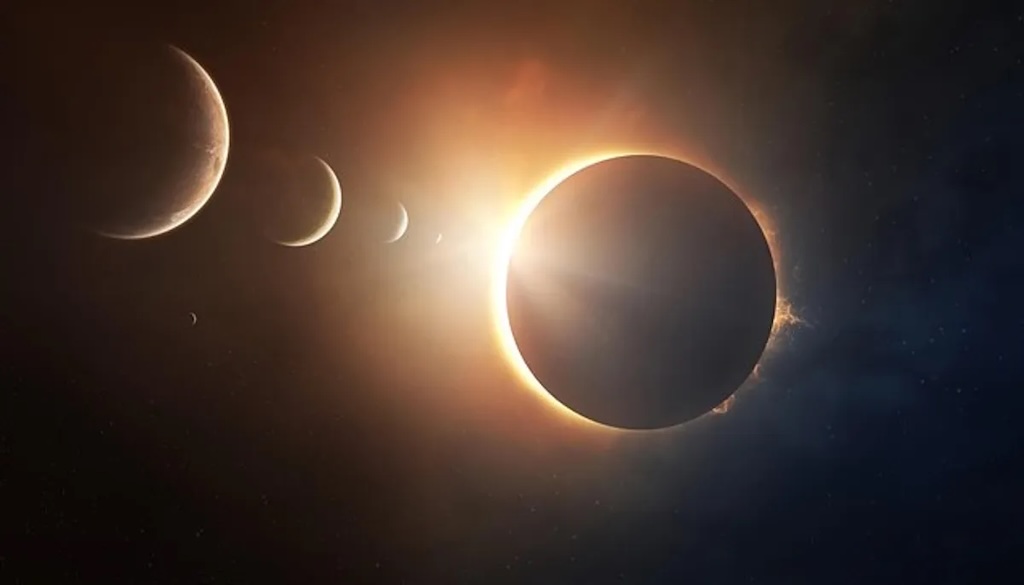
New Delhi/Patna: The first solar eclipse of 2026 will occur on Tuesday, February 17, coinciding with the new moon day of Phalgun, and is expected to produce a striking annular “ring of fire” in parts of the southern hemisphere.

While the celestial event is drawing global attention, it will not be visible in India, and therefore the traditional Sutak period will not be observed, according to experts.
When and where will it be visible?

The annular solar eclipse will begin at 3:26pm Indian Standard Time and conclude at 7:57pm, lasting approximately four hours and 32 minutes. The peak phase is expected around 5:42pm IST.
The eclipse will be visible primarily in southern Argentina, parts of southern Africa and Antarctica. In these regions, the Moon will cover about 96% of the Sun, leaving a thin, luminous ring visible for approximately two minutes and 20 seconds — the phenomenon popularly known as the “ring of fire”.
Why is it called a ‘ring of fire’?
An annular solar eclipse occurs when the Moon passes between the Earth and the Sun but is too far from Earth to completely block the Sun’s disc. As a result, a bright ring remains visible around the Moon’s silhouette.
Scientifically, a solar eclipse takes place when the Moon moves between the Earth and the Sun, partially or fully obscuring sunlight from reaching Earth.
No visibility in India
A Patna-based astrologer said there has been confusion among people regarding its impact in India. “This eclipse will not have a negative impact in India as it will not be visible here,” he said.
He noted that astrologically the eclipse is considered significant because the Sun will be in conjunction with Rahu in Aquarius — a planetary alignment that last occurred in 1962. During the eclipse, the Moon will be positioned in Shatabhisha Nakshatra.
Astrological interpretations
According to interpretations drawn from the Durga Saptashati, when a new moon falls on a Tuesday with the Moon in Shatabhisha Nakshatra, it is regarded as favourable for art, writing, spiritual practice and meditation.
However, astronomers stress that the eclipse is a natural celestial event governed by orbital mechanics, visible only in specific parts of the globe depending on geographical alignment.
For observers in India, the day will pass without any direct astronomical visibility — but elsewhere, skies will briefly blaze with a rare and dramatic solar halo.