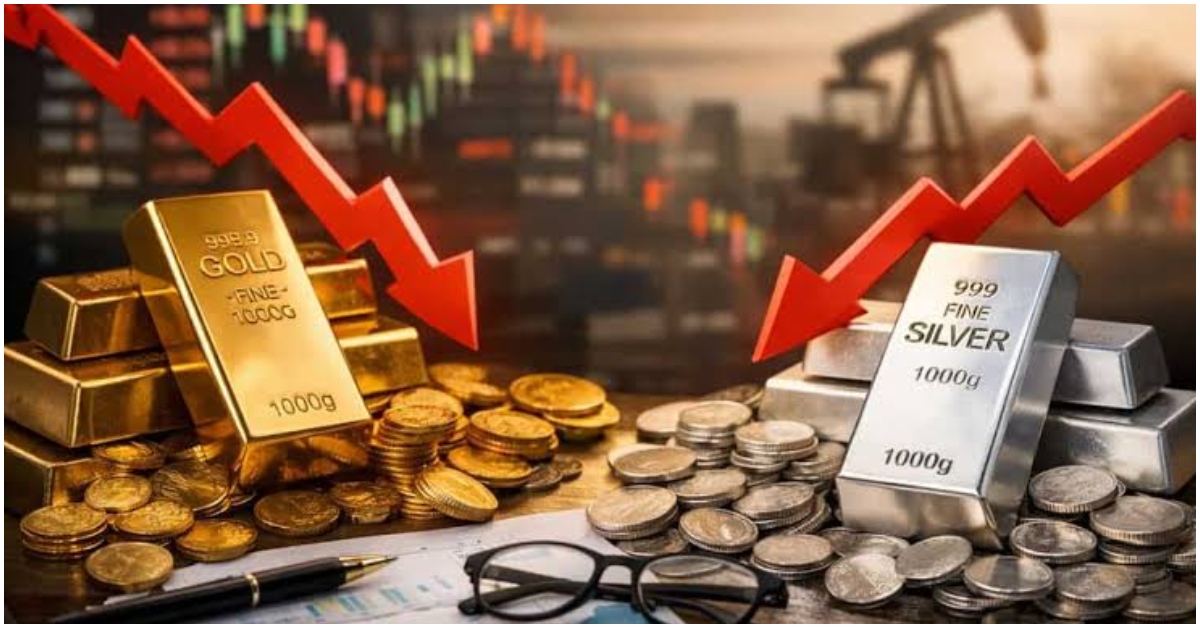
Patna: Gold and silver prices fell sharply on March 4, reversing part of their recent rally after weeks of volatility. According to the India Bullion and Jewellers Association (IBJA), 24-carat gold dropped by Rs 6,149 to Rs 1.61 lakh per 10 grams, down from Rs 1.67 lakh on Monday.

Silver recorded an even steeper fall. The price of one kilogram declined by Rs 23,417 to Rs 2.66 lakh, compared with Rs 2.89 lakh earlier in the week. Traders attributed the decline largely to profit booking following record highs. Markets remained shut on Wednesday for the Holi festival, limiting immediate trading activity.
The correction comes after a turbulent start to the year. Gold, which stood at Rs 1.33 lakh per 10 grams on December 31, 2026, surged to a peak of Rs 1.76 lakh on January 29 before easing. Silver followed a similar trajectory, climbing from Rs 2.30 lakh per kg at the end of December to an all-time high of Rs 3.86 lakh on January 29. In the weeks since, silver has fallen by Rs 1.19 lakh, reflecting heightened volatility in global commodity markets.

Analysts say the near-term direction of bullion prices will depend on global developments. Jatin Trivedi, vice-president and research analyst at LKP Securities, said upcoming US manufacturing and unemployment data would offer clues about the Federal Reserve’s policy stance. “Technically, as long as gold holds above Rs 1,64,000, strength remains intact. A break above Rs 1,72,000 could trigger further gains,” he said. Ponmudi R, chief executive of Enrich Money, described gold as being in a consolidation phase but maintaining a positive trend, adding that silver could revisit Rs 3.20 lakh to Rs 3.30 lakh if it sustains current levels.
Market watchers also point to geopolitical risks, particularly tensions involving the United States and Iran, as a key driver. Escalation in the Middle East or a fresh spike in crude oil prices could push investors back towards safe-haven assets such as gold and silver. Conversely, stronger-than-expected US economic data could strengthen the dollar and weigh on bullion prices.
Price variations across Indian cities reflect additional local factors. Transportation and security costs, especially for cities located far from import hubs, can raise retail rates. Regions with high consumption, such as parts of south India, benefit from bulk purchasing discounts. Local jewellery associations, including bodies such as the Madras Jewellers Association in Tamil Nadu, often influence city-level pricing based on demand and supply. The purchase price of existing stock also determines how competitively jewellers can sell.
Consumers are advised to exercise caution while buying precious metals. Gold should carry a hallmark from the Bureau of Indian Standards (BIS), confirming its purity, and prices should be cross-checked against reliable sources such as IBJA. For silver, simple checks such as magnet, ice and cloth tests are often used to assess authenticity.
Despite recent corrections, Indian households continue to hold vast quantities of gold. A report by Morgan Stanley estimates that families collectively own around 34,600 tonnes, valued at more than $5tn (Rs 450 lakh crore) – exceeding the country’s GDP of $4.1tn. With international prices hovering above $4,500 per ounce, bullion remains deeply embedded in India’s financial and cultural landscape.