
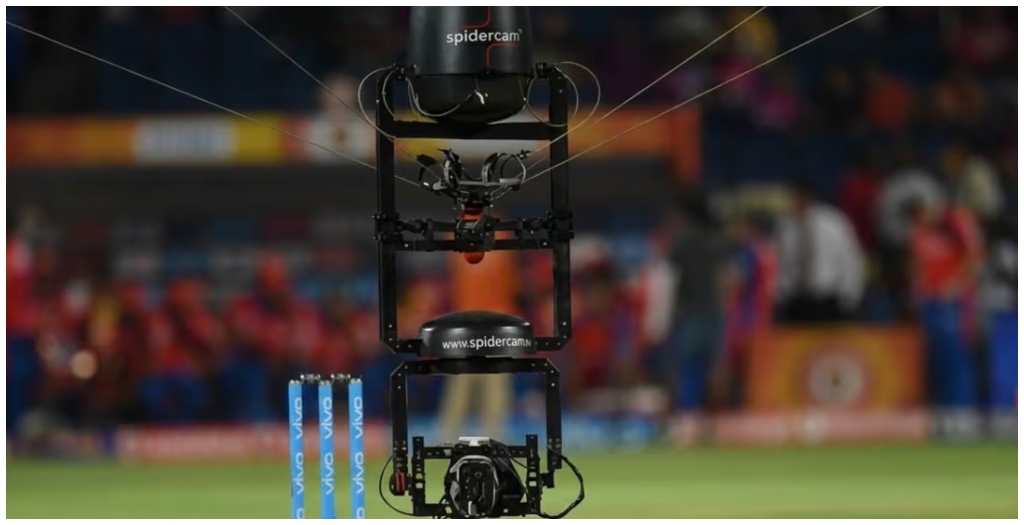
Patna: The camera seen gliding high above players during matches in the Indian Premier League has become one of the most recognisable parts of television coverage, though many viewers rarely notice the technology itself. Known as the Spidercam, the system captures overhead shots of players, field placements and crowd reactions in real time, giving broadcasters angles that were once impossible in live sport.

Spidercam is not a drone. It is a camera rig suspended by cables fixed to high points around a stadium. The system allows the camera to move across the field smoothly, including above the pitch and near boundary lines. Broadcasters use it to create wide panoramic shots, close-up movement tracking and aerial sequences during key moments of the match.
How The System Works

The camera is operated using motorised winches and fibre-optic cables. These cables control the direction and speed of movement, while transmitting live footage directly to broadcast systems. The camera also uses gyroscopic stabilisation, which reduces shaking and keeps footage steady even when it changes direction rapidly.
The operation requires more than one specialist. One technician controls the movement of the Spidercam across the ground, while another manages camera functions such as zoom, tilt, focus and framing. This coordinated operation allows broadcasters to switch between live action and aerial visuals without interrupting the match.
How Far It Can Travel
The Spidercam does not have a fixed distance limit. Its movement depends on the size of the stadium and the cable setup installed for a specific venue. In larger grounds, the system can cover nearly the entire playing area, moving from one boundary to another and positioning itself directly above the centre pitch.
This flexibility has made it a regular feature in large cricket venues, especially in tournaments such as the IPL, where broadcasters aim to provide immersive coverage from multiple angles.
Safety And Match Rules
Officials maintain the Spidercam at a controlled height to avoid interfering with players or play. Broadcasters are required to ensure the camera remains outside the direct line of action and does not distract players during a match.
Under cricket rules, if the ball strikes the Spidercam or its supporting cables during play, the umpire generally declares a dead ball and the delivery is replayed. Such incidents have led to debate in past matches, especially when the ball’s altered path affected catches or boundary outcomes. The rule exists to ensure fairness when external equipment impacts the game.