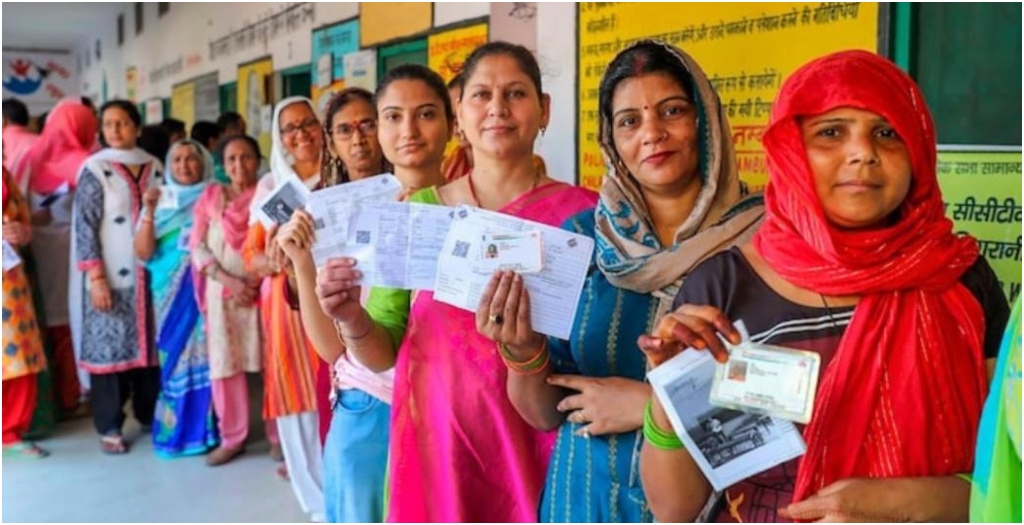
Patna: The noise of election campaigning for the Bihar Assembly elections fell silent on Sunday evening as political parties wrapped up their rallies and roadshows. On Tuesday, voters across half of Bihar will decide the fate of candidates in 122 assembly constituencies, with the counting scheduled for November 14.

This election stood out for several reasons — from Lalu Prasad Yadav’s near-absence despite being out of jail to Prashant Kishor’s debut as a challenger reshaping Bihar’s political equations. It was also an election marked by violence, fiery speeches, and the introduction of large-scale “freebie politics.”
1. PM Modi Defines “Jungle Raj” from the Stage
In 16 rallies held between October 24 and November 8, Prime Minister Narendra Modi invoked the phrase “Jungle Raj” over 300 times — making it the core of the NDA’s campaign narrative. For the first time, Modi explained the term publicly, associating it with “Katta (country-made gun), cruelty, corruption, and bad manners.” His speeches also included local terms like “Du-Nali,” “Chharra,” and “Nachaniya,” evoking imagery of Bihar’s turbulent political past.

2. Rahul Gandhi Takes a Dip with Fishermen
Congress leader Rahul Gandhi’s campaign adopted a grassroots approach. In Begusarai, he joined Mukesh Sahni, leader of the fishermen community, for a symbolic dip in a village pond and helped catch fish with a net. He accused Prime Minister Modi of being a “drama queen” and claimed Nitish Kumar was “under the control” of Modi and Shah, attempting to link the NDA’s “Jungle Raj” accusation back to the Centre.
3. Prashant Kishor Makes It a Three-Cornered Contest
Political strategist-turned-leader Prashant Kishor added a new dimension to Bihar politics. His party, Jan Suraaj, fielded candidates in all 240 constituencies. His solo campaign across districts and the massive turnout at his rallies positioned him as a serious third force, making the Bihar contest triangular for the first time in two decades.
4. Murder and Arrests Shake Campaign Trail
The election turned violent when RJD leader and strongman Dular Chand Yadav was murdered in Mokama on October 30. JD(U) candidate and strongman Anant Singh was subsequently arrested and sent to Beur Jail. Police alleged that Yadav was shot and then crushed under a vehicle. The incident triggered outrage and exposed Bihar’s enduring nexus of crime and politics.
5. Dispute Over CM Face in Both Alliances
Confusion over the chief ministerial face dominated both alliances. In the Grand Alliance, tensions between CM and Deputy CM contenders escalated until Rahul Gandhi intervened — declaring Tejashwi Yadav the CM candidate and Mukesh Sahni the Deputy CM face. The NDA, meanwhile, maintained that the elections would be fought under Nitish Kumar’s leadership, though internal dissent reportedly lingered.
6. Corruption Charges Overshadow “Jungle Raj” Attacks
While NDA leaders continued attacking the RJD over the “Jungle Raj” era, the focus shifted to corruption allegations within the ruling alliance. Prashant Kishor accused several NDA ministers of graft — from BJP state president Dilip Jaiswal’s alleged land grab to JD(U) minister Ashok Choudhary’s ₹200 crore property purchase. Deputy CM Samrat Choudhary was accused of forging age certificates. Most leaders denied the charges, except Jaiswal, who maintained silence.
7. Record Voter Turnout in First Phase
The first phase of voting on November 6 saw an impressive 65 percent turnout — the highest since independence. Muzaffarpur led with 71.4 percent, while Patna recorded the lowest at 58.4 percent. The high participation is being viewed as a sign of growing voter engagement and possible anti-incumbency sentiment.
8. Rise of Freebie Politics
For the first time, Bihar witnessed large-scale populist promises from all major parties.
Nitish Kumar announced ₹10,000 for women under the Chief Minister Women Employment Scheme, increased pensions to ₹1,100, and offered 125 units of free electricity.
In response, Tejashwi Yadav promised ₹2,500 per month for women under the Mai Behan Scheme, one government job per family, and permanent status for contract employees. He even promised to disburse ₹30,000 lump-sum payments to eligible women by January 14 if elected.
9. Controversial Statements That Stirred Bihar
The campaign was also marked by a barrage of controversial statements:
- Lallan Singh urged blocking opposition voters from leaving home; Tejashwi Yadav hit back saying, “This is not your father’s rule.”
- Tejashwi Yadav called Asaduddin Owaisi an extremist; Owaisi retorted, “We bow before Allah, not jackals.”
- Amit Shah warned against the return of Lalu’s rule; Tejashwi replied, “Bihar fears no jackal threats.”
- Amit Shah accused Bihar of harboring infiltrators; Owaisi countered, “Send Modi’s Bangladeshi sister in Delhi back first.”
- PM Modi mocked the “zero development” under Lalu’s rule; Rahul Gandhi responded, “The real Jungle Raj is in Delhi — the rule of fear and agencies.”
- Giriraj Singh’s remark about women wearing burqas triggered outrage; Tejashwi condemned it as communal polarization.
10. Leaders’ Predictions Ahead of Polling
- Amit Shah: NDA will secure 160 seats.
- Rahul Gandhi: “Grand Alliance will form a government beyond caste or religion.”
- Tejashwi Yadav: “A 20-year-old government will fall; Bihar wants change.”
- Asaduddin Owaisi: “If a boatman’s son can be Deputy CM, why can’t a Muslim’s son be CM?”
- Yogi Adityanath: “The bulldozer that cleaned UP will act against Bihar’s mafia too.”
As Bihar heads into polling on Tuesday, the stage is set for one of the most unpredictable and intense elections in recent memory — a battle between legacy, reform, and rebellion, all playing out under the watchful eyes of a politically charged electorate.