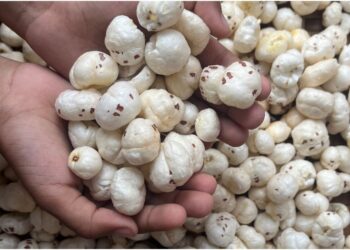

Patna: Makhana cultivation, traditionally associated with Bihar’s Mithila region, could expand to Jammu and Kashmir, with agricultural scientists from Darbhanga working with local experts to explore its potential in the region.

The initiative follows an agreement between the ICAR–National Research Centre for Makhana in Darbhanga and Sher-e-Kashmir University of Agricultural Sciences and Technology. The collaboration aims to promote joint research on aquatic crops, including makhana, lotus and water chestnut, focusing on production, processing and value addition.
Under the initiative, scientists from Darbhanga will help local agricultural experts assess the suitability of makhana cultivation under Jammu and Kashmir’s environmental conditions and provide technical guidance to farmers.

Scientists From Darbhanga to Share Farming Techniques
The agreement between the two institutions was signed on October 7, 2025. Since then, scientific cooperation has been directed towards exploring cultivation opportunities and sharing technical knowledge.
As part of this effort, senior scientist Dr IS Singh from the National Research Centre for Makhana visited the Krishi Vigyan Kendra at Bandipora-1 in Jammu and Kashmir. He held technical discussions with local scientists on the possibilities of cultivating makhana in the region.
Further plans include training farmers in cultivation methods and crop management, helping them understand the requirements of the aquatic crop.
Four-Member Expert Team May Visit in November or December
Following a request from the Jammu and Kashmir Agriculture Department, a four-member team of experts led by senior scientist Dr Manoj Kumar is expected to visit the region in November or December.
During the proposed visit, the team will provide farmers with technical guidance on makhana cultivation, water and soil conditions, crop management and production practices. Agriculture department officials will also be briefed on the crop’s potential and the conditions required for its successful cultivation.
The proposed visit is expected to help identify suitable locations for trials and assess the feasibility of introducing makhana farming in the region.
Swarna Vaidehi Variety May Be Tested in Kashmir
The Swarna Vaidehi variety, developed by the National Research Centre for Makhana in Darbhanga, could play an important role in the initiative.
The improved variety was developed for cultivation in areas with standing water, waterlogged land and marshy conditions. However, its suitability for Jammu and Kashmir will need to be established through scientific trials.
Factors such as soil composition, water availability, temperature and local climatic conditions will determine whether the variety can grow successfully in the region.
Field demonstrations and research will therefore be essential before wider cultivation can be considered.
Makhana Research Expanding Beyond Bihar
The National Research Centre for Makhana in Darbhanga has been working to extend improved cultivation and processing techniques to farmers beyond Bihar. Its efforts include promoting better production practices, quality planting material and farmer training.
Bihar remains India’s leading makhana-producing state, with the Mithila region recognised as a major centre of cultivation and related research.
If trials in Jammu and Kashmir prove successful, makhana could offer local farmers an additional crop option and opportunities to diversify their agricultural activities. The collaboration could also help extend farming techniques developed in Bihar to other parts of the country.
For now, the focus remains on scientific assessment and field-level testing to determine whether Mithila’s makhana can adapt to the agricultural conditions of Jammu and Kashmir.