
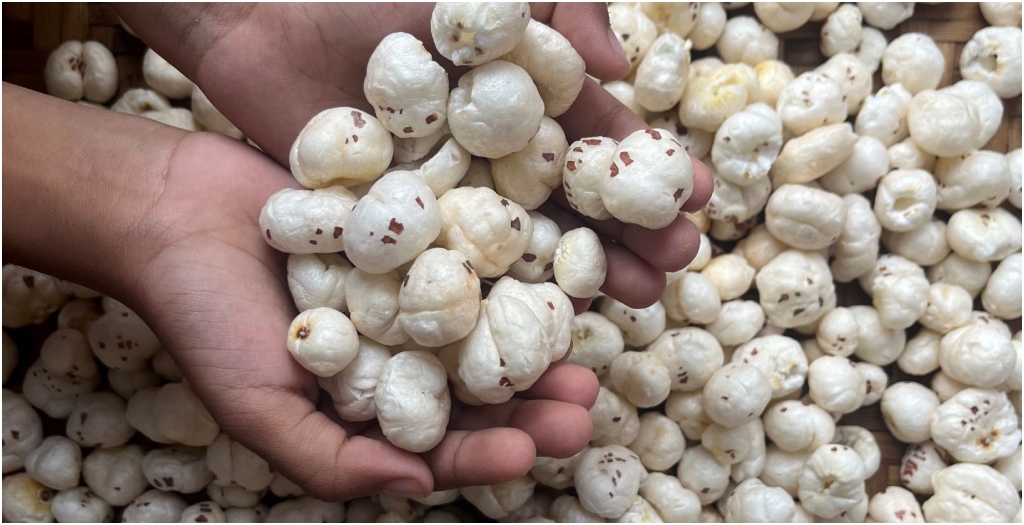
Darbhanga: Mithila’s makhana (fox nut), a crop closely associated with Bihar, is being considered for cultivation in Jammu and Kashmir, traditionally known for its apples and saffron. The initiative follows an agreement between the Darbhanga-based National Research Centre on Makhana and the Sher-e-Kashmir University of Agricultural Sciences and Technology of Kashmir (SKUAST-K).

The memorandum of understanding (MoU) was signed on October 7 last year during the National Makhana Festival. It aims to strengthen scientific collaboration and facilitate the transfer of makhana cultivation technology between the two institutions.
The agreement was signed by SKUAST-K Vice-Chancellor Prof. Nazir Ahmad Ganai and National Research Centre on Makhana Director Dr Nachiket Kotwaliwale.

Expert Team To Support Cultivation Plans
As part of the collaboration, Dr I.S. Singh, a senior scientist at the Darbhanga research centre, visited Krishi Vigyan Kendra (KVK) Bandipora-I in Kashmir to discuss cultivation prospects with local agricultural scientists.
The discussions are expected to help shape future plans for introducing the crop in the region. At the request of the Jammu and Kashmir Department of Agriculture, a four-member expert team led by senior scientist Dr Manoj Kumar is scheduled to visit the region in November or December.
The proposed initiative includes training local farmers in makhana cultivation techniques, soil and water requirements, crop management and the region’s suitability for production. Agricultural officials and other personnel will also be made aware of the cultivation process.
Training And Support For Farmers Across States
The Darbhanga research centre is working to expand makhana cultivation across 10 states through farmer training, technical support and the distribution of agricultural inputs.
Farmers and entrepreneurs from Assam, Madhya Pradesh, Uttar Pradesh, West Bengal and Jharkhand have recently received training in makhana production and processing.
Visiting farmers have also been taken to the Jale Krishi Vigyan Kendra and rural farming areas to understand cultivation practices and related technologies.
In Bihar, the centre periodically provides training and agricultural inputs to farmers, including those from Scheduled Castes, in major makhana-producing districts. These include Madhubani, Purnia, Katihar, Saharsa, Supaul, Araria, Madhepura and Sitamarhi.
Improved Swarna Vaidehi Variety To Be Tested
The research centre plans to make its improved makhana variety, Swarna Vaidehi, available for testing and demonstration under local conditions in regions being considered for expansion.
Dr Manoj Kumar said there was considerable potential to increase makhana production in different parts of the country. The institute is prioritising areas with suitable soil, climatic conditions and water availability, with plans to support cultivation through improved technology, quality planting material, technical guidance and farmer training.
According to the institute’s assessment, scientifically and sustainably utilising suitable aquatic areas and water resources could expand the area under makhana cultivation across India to four lakh hectares over the next decade.
Expansion Could Create Rural Employment
An increase in cultivation could diversify agricultural activity, improve farmers’ incomes and create employment opportunities in rural areas. Greater production could also support processing and value addition, helping strengthen the domestic supply chain.
The expansion drive is intended to improve the availability and competitiveness of Indian makhana in domestic and international markets while extending cultivation to regions with suitable growing conditions.