
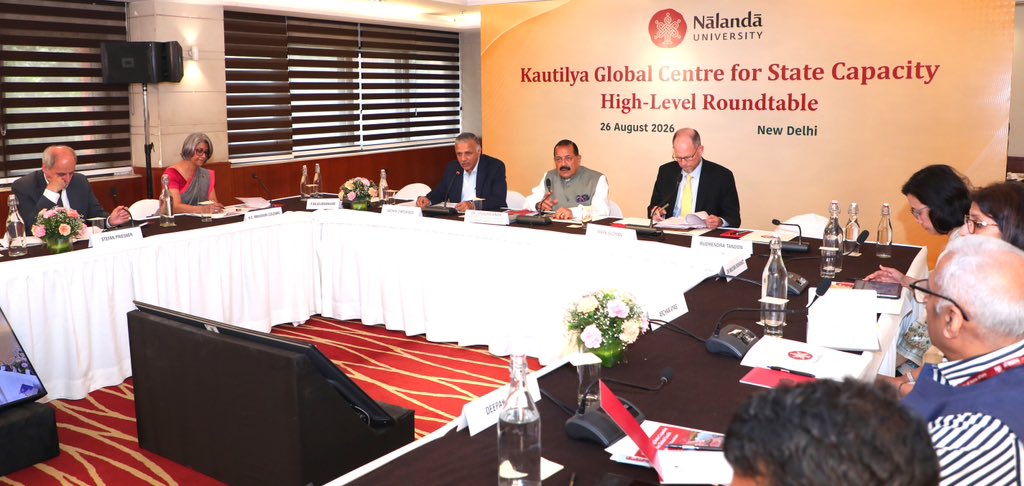
Rajgir/New Delhi: Nalanda University hosted a high-level roundtable on the Kautilya Global Centre for State Capacity at the India Habitat Centre in New Delhi on Wednesday, bringing together senior policymakers, diplomats, multilateral institutions and philanthropic organisations to discuss institutional capacity and South–South cooperation.

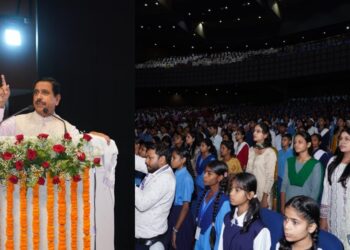
Union minister of state for Science and Technology, Earth Sciences, Jitendra Singh attended the roundtable as chief guest.
The discussions focused on how the proposed Kautilya Global Centre for State Capacity can connect India’s and Asia’s long traditions of governance and public service with contemporary public administration, institutional reform and development practice.

Participants emphasised the importance of peer learning among countries of the Global South and developing governance and capacity-building approaches that are locally relevant.
Nalanda’s global legacy to inform modern governance
Nalanda University vice-chancellor Sachin Chaturvedi presented the vision behind the establishment of the centre, linking it to Nalanda’s historic tradition of international scholarship, intellectual exchange and public service.
He highlighted the centre’s potential to address contemporary governance and development challenges through research, knowledge exchange and institutional engagement.
Union Minister Singh said capacity building should extend beyond technical skills to include the development of the mind, particularly as India navigates rapid technological and social change.
He stressed the importance of continuous learning, adaptability and innovation and called for capacity building to become a collective, whole-of-society effort involving institutions across organisational boundaries.
Singh also highlighted the need to align capacity-building efforts with global benchmarks and strategies.
He said institutions involved in capacity building could be connected into a larger ecosystem and noted the potential of the Kautilya Global Centre to bridge India’s historical and traditional knowledge with contemporary approaches to state capacity.
According to Singh, the model could also provide a platform for capacity building across the wider Global South.
Focus on South–South cooperation
The roundtable highlighted South–South cooperation, peer learning, institutional capacity building, responsible innovation and locally grounded approaches to development.
Participants also discussed potential avenues for engagement with the United Nations and organisations across the wider UN system, including thematic dialogues and platforms focused on South–South cooperation.
The meeting brought together Hemang Jani, senior adviser at the World Bank Group; Mark Suzman, CEO of the Gates Foundation; former Indonesian finance minister Sri Mulyani Indrawati; Stefan Priesner, UN Resident Coordinator for India; Sri Lankan ambassador to India Mahishini Colonne; Siti Kamariah Ahmad Subki, trustee and managing director of Yayasan Hasanah, Malaysia; Deepali Khanna, head of Asia at the Rockefeller Foundation; Deepak Bagla, mission director of Atal Innovation Mission; and Jagjeet Sareen, regional director for Asia-Pacific at Dalberg Advisors, among other senior representatives.
Nalanda University and Gates Foundation sign MoU
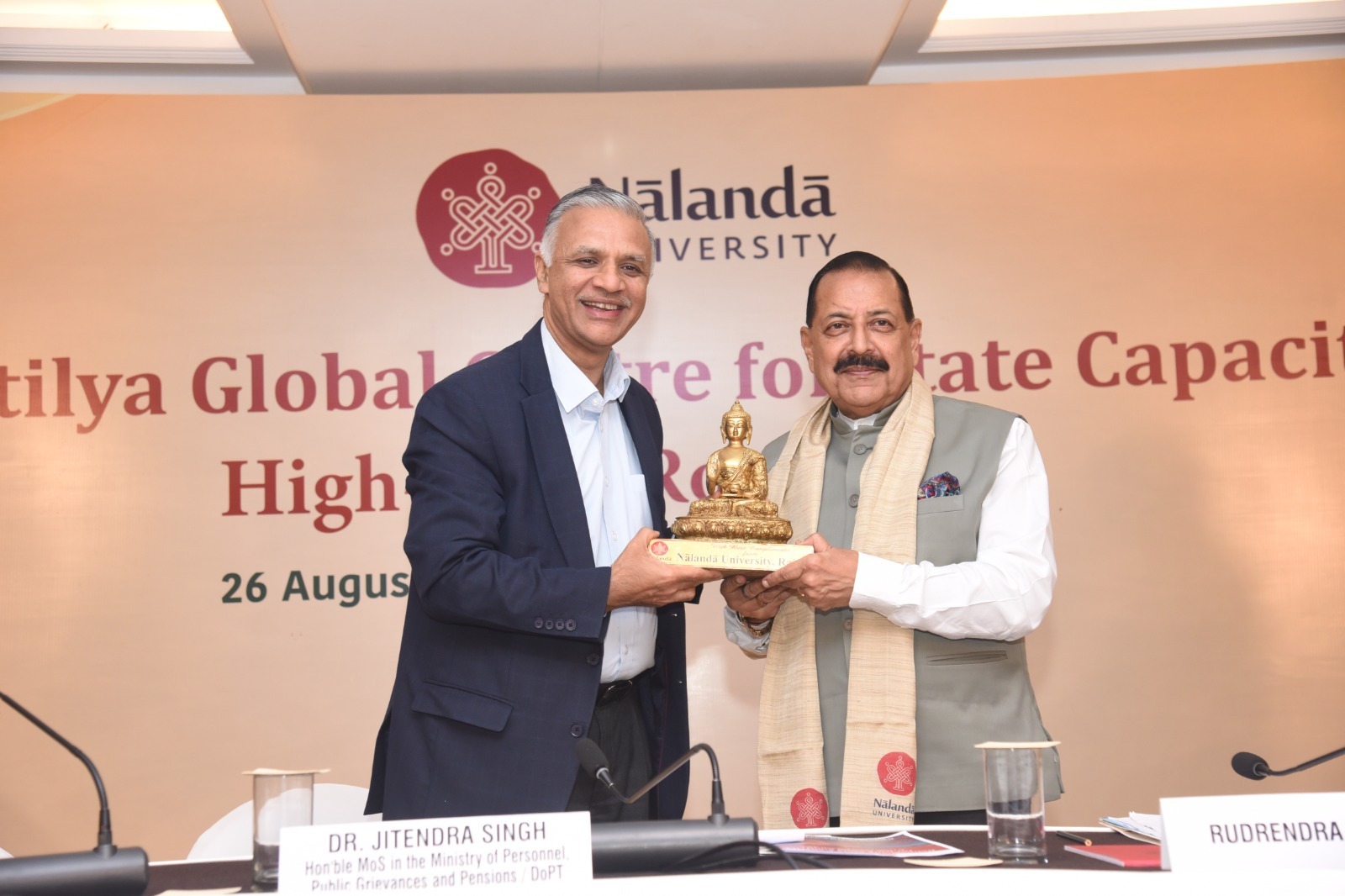
A key outcome of the engagement was the signing and exchange of a Memorandum of Understanding between Nalanda University and the Gates Foundation for academic collaboration through the Kautilya Global Centre for State Capacity.
The MoU was exchanged in the presence of Jitendra Singh, Rudrendra Tondon, secretary (East) in the Ministry of External Affairs, and other senior representatives.
Chaturvedi represented Nalanda University, while Suzman represented the Gates Foundation during the exchange, alongside senior representatives from both institutions.
The partnership will focus on academic engagement, research and capacity-building initiatives relevant to India and the wider Global South.
The two institutions will seek to facilitate greater exchange of knowledge and institutional experience among developing countries, with an emphasis on locally appropriate, sustainable and context-sensitive solutions.
The collaboration also strengthens the emerging role of the Kautilya Global Centre for State Capacity as a platform connecting universities, governments, multilateral organisations, philanthropic institutions and other stakeholders to promote knowledge exchange and strengthen institutional capabilities.