Rajgir/Patna : Nalanda University on Wednesday concluded the four-day 25th Annual Conference of the Indian Association of Social Science Institutions (IASSI), with scholars and policymakers emphasising the need for evidence-based research, inclusive development and interdisciplinary collaboration in public policy.

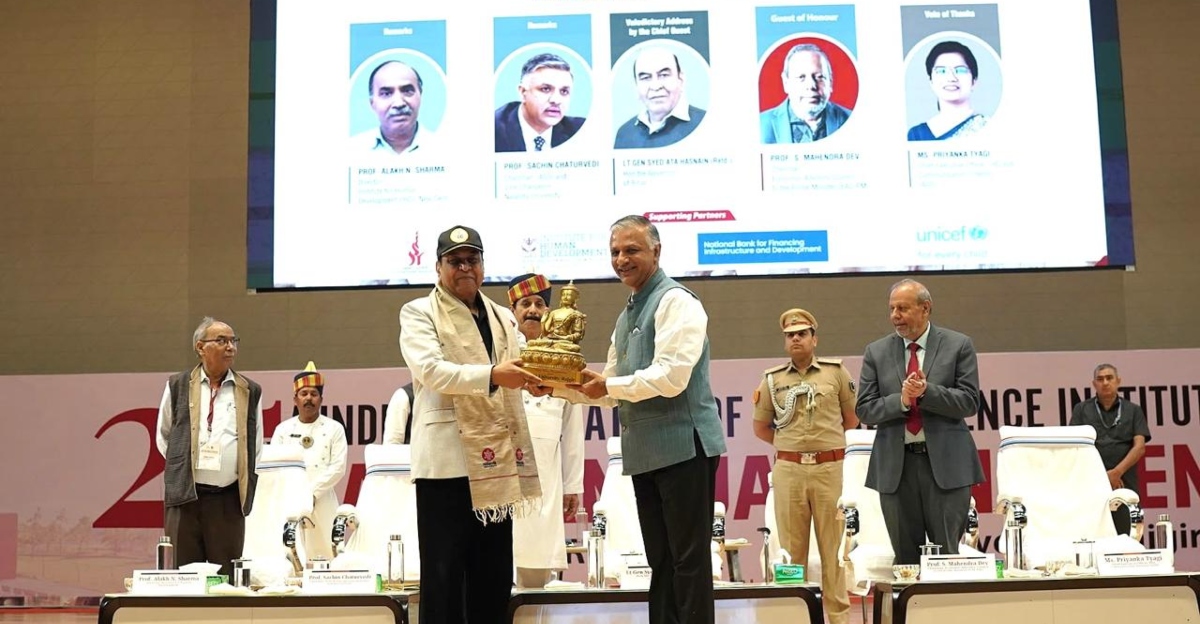
The valedictory session was attended by Bihar Governor Lt. Gen. (Retd.) Syed Ata Hasnain as the chief guest. Other prominent participants included Professor S. Mahendra Dev, Chairman of the Economic Advisory Council to the Prime Minister; Professor Sachin Chaturvedi, Vice Chancellor of Nalanda University and Chairman of IASSI; and Professor Alakh N. Sharma, Director of the Institute for Human Development, New Delhi.
The conference brought together researchers, academics, policymakers and representatives of educational institutions to discuss India’s development priorities and the growing role of social sciences in shaping public policy.

Governor Highlights Social Sciences’ Role in Governance and Disaster Management
In his valedictory address, Governor Syed Ata Hasnain said social science research must deepen understanding of people’s needs and help improve their lives. Drawing on his experience in military service and disaster management, he highlighted the links between social understanding, public trust and national security.
He noted that effective institutions require more than resources and operational capabilities; they must also understand people’s concerns, aspirations and everyday realities.
Referring to Bihar’s development challenges, the Governor highlighted the links between geography, migration, livelihoods and regional disparities. He cited recurring floods in North Bihar as an example of why disaster preparedness must go beyond engineering solutions and forecasting systems.
He called for greater attention to community behaviour, local knowledge, livelihood protection and the long-term consequences of displacement. He also stressed the importance of collaboration among social scientists, engineers, administrators and other specialists, with affected communities actively involved in the process.
Call for Stronger Research and Policy Communication in Bihar
The Governor called for strengthening research capacity at universities across Bihar, expanding mentorship and fieldwork opportunities for young scholars, and making research findings more accessible to the public.
He emphasised the need to translate academic research into practical policy recommendations through tools such as policy briefs and communication in Hindi and other relevant languages.
Hasnain also highlighted Nalanda’s continuing relevance as a centre of dialogue and interdisciplinary learning. He pointed to the importance of evidence, civilisational understanding, digital access and the responsible use of artificial intelligence in addressing contemporary challenges.
Economic Adviser Stresses Inclusive and Sustainable Development
Professor S. Mahendra Dev highlighted the conference’s wide-ranging discussions on culture, development and digital futures, emphasising the importance of diverse perspectives in strengthening social science research.
He said inclusive and sustainable development would remain central to the global agenda beyond 2030 and noted that India could contribute through its scale, data, policy experience and development initiatives.
Dev also underscored the continuing relevance of India’s intellectual traditions, particularly Nalanda’s legacy of interdisciplinary learning, to contemporary research. He encouraged IASSI to expand its institutional reach, strengthen academic exchanges and promote collaborative research while engaging with emerging challenges such as artificial intelligence and digital transformation.
Nalanda University Calls for a Broader Understanding of Development
Professor Sachin Chaturvedi said development should not be measured solely through material progress but should also account for culture, values, social relationships and human well-being.
He emphasised the importance of community knowledge and lived experiences in setting development priorities, while calling for better coordination in the implementation of public policies, particularly in regions facing development imbalances.
Chaturvedi said social science institutions have an important responsibility to connect reliable evidence with policymaking and society. Discussions on health, nutrition, education, social and cultural statistics, responsible research and digital technologies reinforced the need for an integrated approach to development.
He said the conference should lead to collaborative research, stronger academic partnerships and better-informed public policies.

Researchers Advocate Interdisciplinary Approach to Social Challenges
Professor Alakh N. Sharma stressed that complex social challenges cannot be adequately addressed through isolated academic disciplines. He called for stronger cooperation across social sciences and closer engagement between social scientists and researchers in other fields.
Sharma also highlighted the need to strengthen institutional capacity in Bihar, create more opportunities for young researchers and develop a stronger research culture.
The conference examined a broad range of development issues, including culture, education, health and nutrition, public policy, social transformation, technology and responsible research. Participants emphasised evidence-based policymaking, critical thinking and interdisciplinary scholarship.
The discussions also examined the social, cultural and ethical implications of artificial intelligence and digital technologies.
Conference Emphasises Research Partnerships for India’s Development
Hosted by Nalanda University, the 25th IASSI Annual Conference reaffirmed the role of social science institutions in connecting research, governance and society.
The event highlighted the need for sustained academic partnerships, stronger research opportunities for emerging scholars and collaboration across disciplines to address India’s development priorities.
Its central message was that inclusive and sustainable development requires policies informed not only by data and technical expertise but also by social realities, community knowledge and human well-being.