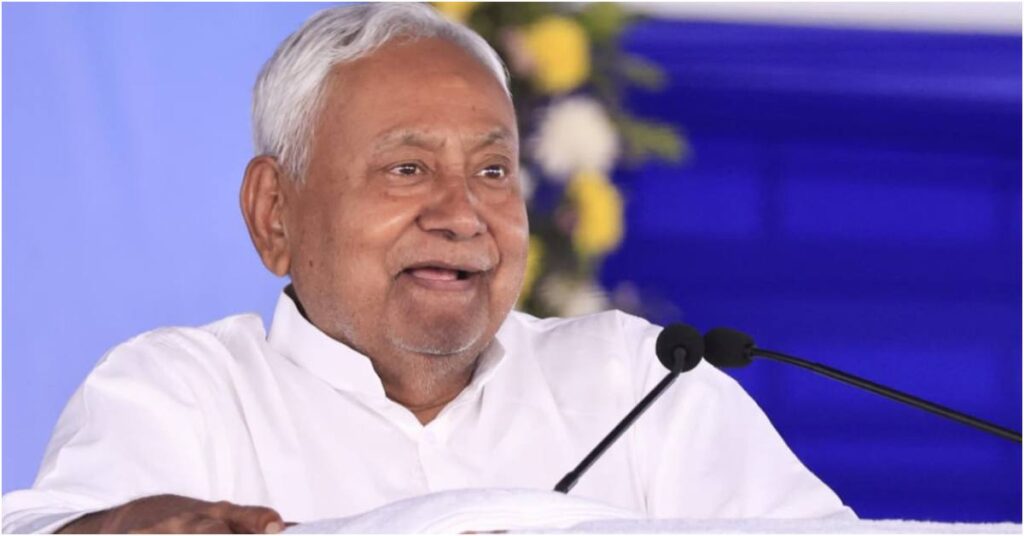
Patna: A remarkable political moment unfolded in the Bihar Legislative Assembly on Friday, where former chief minister and JD(U) leader Nitish Kumar remained the focal point of proceedings despite not being present in the House.

During a debate that lasted over 90 minutes, legislators invoked Kumar’s name more than 50 times, underscoring his continuing influence on Bihar’s political discourse and governance narrative.
Chief Minister Samrat Choudhary made a notable intervention, crediting Kumar for his own rise in politics. He said it was “due to Nitish Kumar’s determination and willpower” that he currently holds the office of chief minister, describing the JD(U) veteran as a “guardian figure” in Bihar’s political landscape.

Choudhary also attributed the state’s model of governance to Kumar’s leadership, saying that the foundations of “good governance” in Bihar were laid during his tenure. He referred to key policy decisions and administrative reforms introduced under Kumar’s leadership.
Deputy Chief Minister Vijay Kumar Choudhary echoed similar sentiments, saying the absence of Kumar was being felt in the House, describing him as a “guiding light”. He added that the development benchmarks set during Kumar’s tenure would be difficult to surpass, and pledged continuity in his policy direction.
JD(U) legislative party leader Shrawon Kumar stated that the party’s legislators were acting in accordance with Kumar’s directive to support the government’s vote of confidence, reinforcing his continued authority within the party structure.
Leaders from the AIMIM, Left parties, and other regional groups also referenced Kumar during their speeches, reflecting on his long tenure and administrative legacy.
While some members hailed him as Bihar’s “brand ambassador”, others highlighted his role in maintaining social harmony across the state during his years in office.
However, opposition leaders raised questions over the current government’s mandate, arguing that the electoral support it received was significantly tied to Kumar’s political presence and public image, further reinforcing the perception of his centrality in Bihar’s political equation.