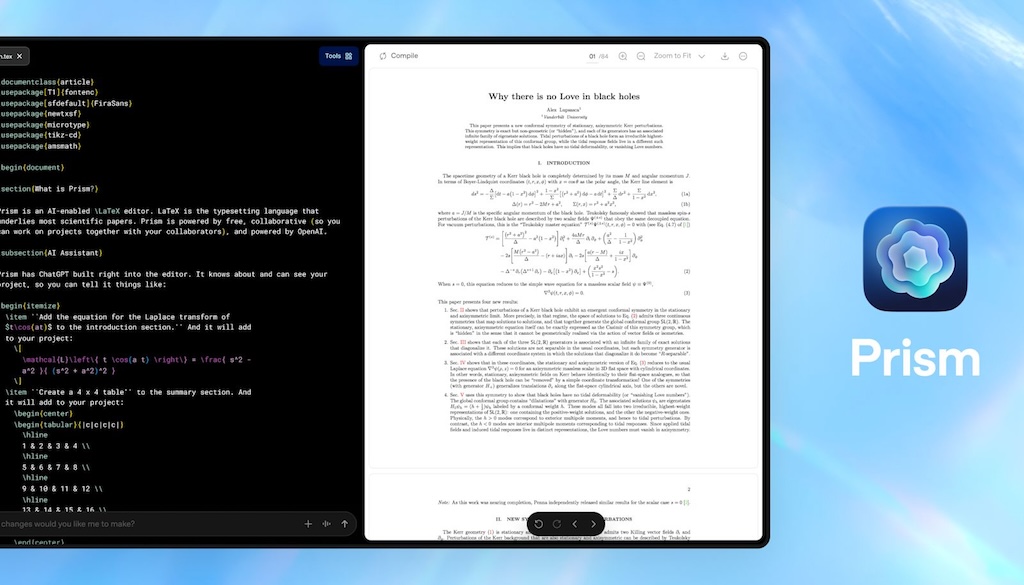
New Delhi: OpenAI has introduced Prism, a new AI-native workspace within ChatGPT aimed at scientists and researchers, marking its latest push to embed artificial intelligence more deeply into academic work.

Powered by the GPT-5.2 model, Prism is designed to support scientific writing and collaborative research from initial drafting to publication-ready manuscripts. OpenAI said the tool brings writing, editing and submission preparation into a single workflow, reducing the need to juggle multiple files, emails or external platforms.
At the core of Prism is a fully cloud-based LaTeX workspace, allowing researchers to write and revise papers collaboratively in real time. Changes requested by users are applied directly within the document, a feature OpenAI says helps minimise version conflicts, manual merging and technical overheads that often slow down academic collaboration.

Introducing Prism, a free workspace for scientists to write and collaborate on research, powered by GPT-5.2.
Available today to anyone with a ChatGPT personal account: https://t.co/9mTLAbxPdH pic.twitter.com/GJOIipU3hx
— OpenAI (@OpenAI) January 27, 2026
The platform supports unlimited research projects and an unrestricted number of collaborators per project. Another feature, voice-based editing, allows users to make small changes by issuing spoken commands, helping maintain momentum during writing or review.
OpenAI said the launch reflects the growing adoption of AI tools in science over the past year. Advanced language models, including GPT-5, have already been used to tackle complex mathematical problems, analyse immune-cell data and accelerate experiments in molecular biology. While the company acknowledged that AI remains at an early stage, it said such tools were likely to become integral to future scientific progress.
Prism is built on OpenAI’s cloud-based LaTeX platform, Crixet, which underpins its collaborative features. The workspace is currently free and available to all personal ChatGPT users, with plans to roll it out later to Business, Enterprise and Education accounts.
Users can access the new tool through prism.openai.com, OpenAI said, positioning Prism as an early step towards more integrated, AI-assisted scientific workflows.