Om Prakash
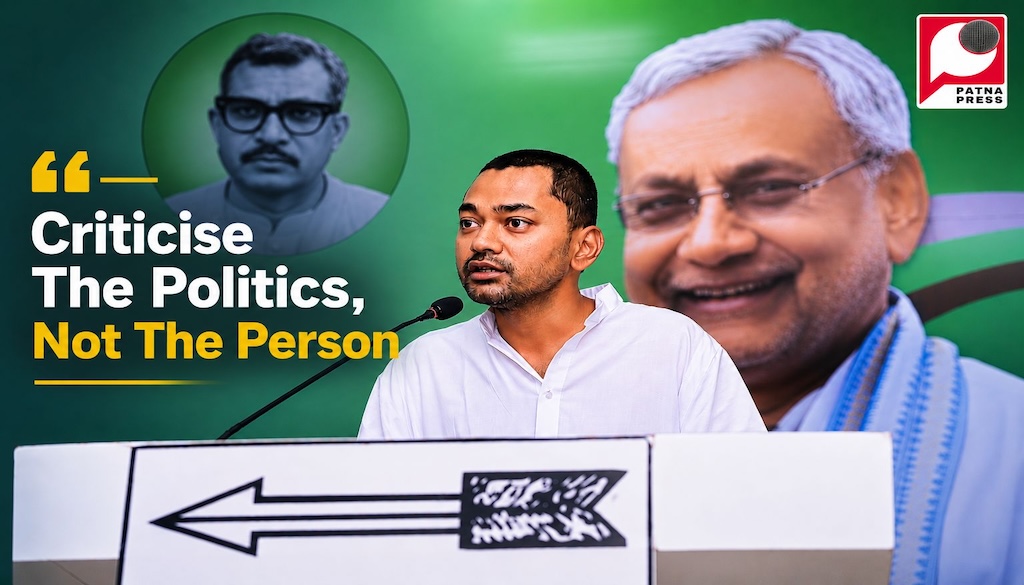
The entry of Nishant Kumar into Bihar politics was always going to invite scrutiny. As the son of former Chief Minister Nitish Kumar and now Bihar’s Health Minister, his rise naturally raises political questions—about dynastic succession, leadership legitimacy and the future of Janata Dal (United) (JD(U)). Those questions are valid. In a democracy, they should be asked openly and critically.

But what is unfolding on social media today goes far beyond political criticism.
Over the past few weeks, Nishant Kumar has become the subject of widespread online mockery. Clips of his speeches, mannerisms and public appearances are being circulated with insulting commentary. Some users are openly speculating about his mental health. Others are calling him a drug addict without evidence. Reels and memes are being amplified not to debate his politics or policies, but to ridicule him personally.

The pattern appears too coordinated to be entirely organic. The speed, repetition and similarity of content suggest a structured social media campaign aimed at damaging his image at the very beginning of his political career. That possibility should concern everyone, irrespective of political affiliation.
Because once public discourse shifts from criticism to dehumanisation, democracy itself becomes poorer.
The Legitimate Questions
There is no denying that Nishant Kumar’s rise reflects dynastic politics.
For decades, Nitish Kumar positioned himself as a leader opposed to personality cults and family-based succession. Unlike several regional parties where political inheritance is openly institutionalised, JD(U) projected itself differently. That is precisely why Nishant Kumar’s sudden elevation—entering politics and becoming a minister within months—has triggered public debate.
He does not yet appear to possess a strong independent political base. Nor does he presently display the ease, instinct or spontaneity associated with seasoned politicians. His public appearances often appear cautious and rehearsed. Many observers see his entry as an attempt to preserve Nitish Kumar’s political legacy and ensure continuity within the party after the gradual withdrawal of the former chief minister from active politics.
These are fair political observations. They deserve examination.
Regional politics across India increasingly revolves around succession within families. From one state to another, parties that once emerged from ideological movements have gradually become personality-centric institutions. Leadership is often transferred not through organisational contest, but through inheritance. JD(U) now appears to be moving along a similar path.
This deserves criticism—not because Nishant Kumar is uniquely responsible for it, but because dynastic politics weakens internal democracy and narrows political opportunity.
Where Criticism Crosses A Line
Yet political criticism cannot become a licence for personal humiliation.
Mocking someone’s mental health, body language or physical appearance is not political analysis. It is social cruelty disguised as commentary. Labelling a person a drug addict without evidence is not accountability—it is defamation amplified through digital culture.
India has made significant progress in opening conversations around mental health, yet moments like these reveal how shallow that sensitivity still remains. Mental health continues to be used casually as an insult in public discourse, particularly in politics, where vulnerability is treated as weakness and mockery becomes entertainment.
This reflects a deeper problem within social media ecosystems. Political disagreement increasingly seeks not to challenge ideas, but to destroy personalities. The objective is no longer persuasion; it is humiliation.
The danger of such politics is not limited to one individual. Once society normalises ridicule based on mental health or personal demeanour, the standard eventually applies to everyone.
Leadership Cannot Be Inherited Automatically
There is another important distinction often lost in this debate: political position and public leadership are not the same thing.
A person may inherit access to power through family connections. They may become a minister, MP, MLA or party leader because of political lineage. But mass leadership cannot be inherited automatically. It must be earned through public acceptance, political skill and electoral legitimacy.
Indian politics offers countless examples where children of powerful leaders inherited parties but failed to build meaningful public support. Dynasty may create entry points, but it does not guarantee political success.
Ultimately, voters—not social media campaigns—will decide Nishant Kumar’s political future. Over the next few years, he will be judged on governance, administrative performance, political communication and electoral credibility. That is how democracy is supposed to function.
A Test For Political Culture
Criticism of Nishant Kumar’s dynastic rise is both legitimate and necessary. But criticism loses moral force when it descends into personal attacks.
Political leaders should be questioned on policy decisions, ethics, governance and accountability. They should not become targets of ridicule based on body language, appearance or unverified claims about their health.
Democracy requires sharp criticism. It also requires basic dignity.
The real test of a mature political culture is not whether it can praise leaders, but whether it can oppose them without losing its humanity.
(The author is a senior political consultant and media advisor. The views expressed are personal. He can be reached at x.com/omprakash_iimc.)