
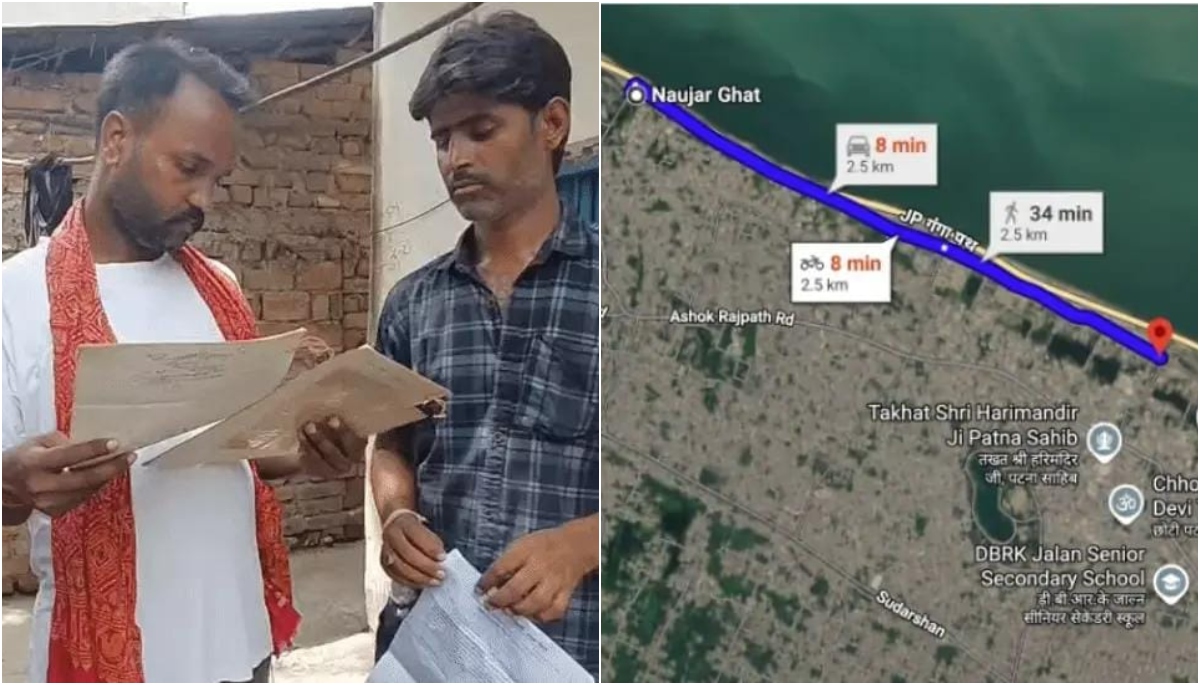
Patna: Around 290 families and shopkeepers living along the Ganga in Patna have received notices to vacate their homes and establishments following directions from the Supreme Court to remove unauthorised structures along the riverbank.

The notices have triggered anger and distress among residents, many of whom claim they purchased the land, built houses and established livelihoods there over several years without being informed that the plots were government land.
The Supreme Court, in an order passed on July 21, directed the Bihar government to remove unauthorised structures, constructions and encroachments between Nauzar Ghat and Nurpur Ghat in Patna within six weeks. The bench of Justices J B Pardiwala and K V Viswanathan also sought a compliance report before the next hearing.

The court’s direction followed proceedings in a case concerning encroachments along the Ganga. Earlier, the state had identified 213 encroachments between Digha Ghat and Nauzar Ghat, of which 58 had been removed, according to information placed before the court.
Residents Question Eviction Notices
Residents affected by the latest notices say they were never informed about the status of the land when they purchased their plots.
Pramila Devi, who received an eviction notice, said she purchased the land for Rs 5 lakh three years ago and spent another Rs 10 lakh constructing her house. Her husband sells chhola-puri from a cart near a railway station, and the family used those earnings to build the house.
“We built this house just a year ago, and now we’ve received a notice,” she said. “If we had been told that it was government land, we would not have bought it.”
The notices have come as a particular shock to families who say they have invested their savings in construction and local businesses.
‘Where Will We Go?’
Babita Devi, a resident of the Kangan Ghat area, questioned why residents had been asked to leave while a local gurdwara on the same stretch had, according to her, not received a similar notice.
Her husband drives an auto-rickshaw, she said, and the family depends on his earnings. She said losing their home would leave them without the means to arrange alternative accommodation or continue supporting their children.
Sarita Devi said her family had lived in the area for years and that she had recently built a new house. The eviction notice arrived before the family could perform its housewarming ceremony.
“I have three children. If our house is demolished, where will we go?” she said.
Residents Raise Jurisdiction Objections
Some residents have also questioned the police-station numbers mentioned in their notices.
Santosh Kumar said his property falls under Thana No. 110, while the notice he received referred to Thana No. 170. He said the family had approached their local MLA and councillor but had not received a satisfactory response.
“My father built this house, and I was born here too,” Kumar said. “There are young children in my family. Where are we supposed to go now?”
Dilip Kumar, another resident, raised a similar objection, saying his family lived under Thana No. 110 while the notice referred to Thana Nos. 169-170.
He said the family had saved money through cart and rickshaw work to purchase the land and construct a home.
Three Generations Claim Long-Term Residence
Ganita Devi said three generations of her family had lived in the area.
She said her family had saved money by making and selling cow-dung cakes before purchasing the land and building a house. According to her, no one had previously asked the family to vacate.
“We were not told it was government land when we bought it,” she said. “We cannot afford to build another house now.”
Gulab, who said he has lived in the area for about 40 years, also questioned why residents had been allowed to obtain basic services if their occupation of the land was unauthorised.
He said his family bought the land using proceeds from the sale of ancestral property and later obtained water and electricity connections.
“We are paying for electricity and water, and now we are being told that this is government land and that we must leave,” he said.
Supreme Court Order Sets Six-Week Deadline
The Supreme Court’s July 21 order directs Bihar to clear all unauthorised structures and encroachments between Nauzar Ghat and Nurpur Ghat within six weeks. The court said the direction must be followed despite interim orders that may have been passed by High Court or district courts restraining earlier removal action.
The case stems from proceedings involving Ashok Kumar Sinha, who had sought action against encroachments along the Ganga. The court has sought a compliance affidavit from a competent authority before the next hearing.
For the residents now facing eviction, however, the legal direction has translated into an immediate question of shelter and livelihood.
Many say they are prepared to challenge the eviction rather than leave their homes, while appealing to the administration to consider their circumstances and provide clarity on the ownership and status of the land before demolition action is taken.