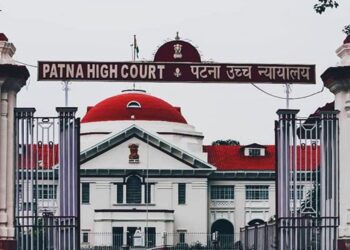
Patna: The Patna High Court on Tuesday heard an anticipatory bail plea filed by Dharmendra Kumar Singh, an accused in a major banking fraud case, and observed that economic offences must be treated with heightened seriousness due to their wider public impact.

A single-judge bench of Justice Purnendu Singh directed that the matter be placed before the chief justice, noting that it involved issues of broad public interest.
Court Stresses Public Interest

The court said that economic offences form a distinct category of crime, where public interest must take precedence over individual liberty.
Observing the gravity of the case, which involves the alleged embezzlement of around Rs 1.89 crore, the bench underscored the need for judicial intervention.
Allegations Of Systematic Fraud
According to the case details, Singh, a former employee of Uttar Bihar Gramin Bank, is accused of siphoning off funds over several years by issuing fraudulent fixed deposit certificates to rural customers.
Investigations revealed that while entries were made in customers’ passbooks, no corresponding accounts existed in the bank’s core banking system.
In one instance, a deposit of Rs 15 lakh was reportedly not reflected in official bank records.
Fraud Went Undetected For Years
The court observed that the alleged fraud was organised and technically sophisticated, allowing it to remain undetected for nearly a decade.
The irregularities came to light only when customers attempted to withdraw their funds.
Wider Implications
Describing such offences as “white-collar crimes”, the court said they undermine public trust in financial institutions and pose risks to economic stability.
It further clarified that time limitations under internal policies cannot be invoked to shield individuals in cases involving fraud or criminal misconduct.
Directions To Authorities
The court directed that a copy of its order be sent to the Reserve Bank of India, the Ministry of Home Affairs and the Ministry of Finance, seeking an action taken report.
Further proceedings in the matter are expected after it is placed before the chief justice.