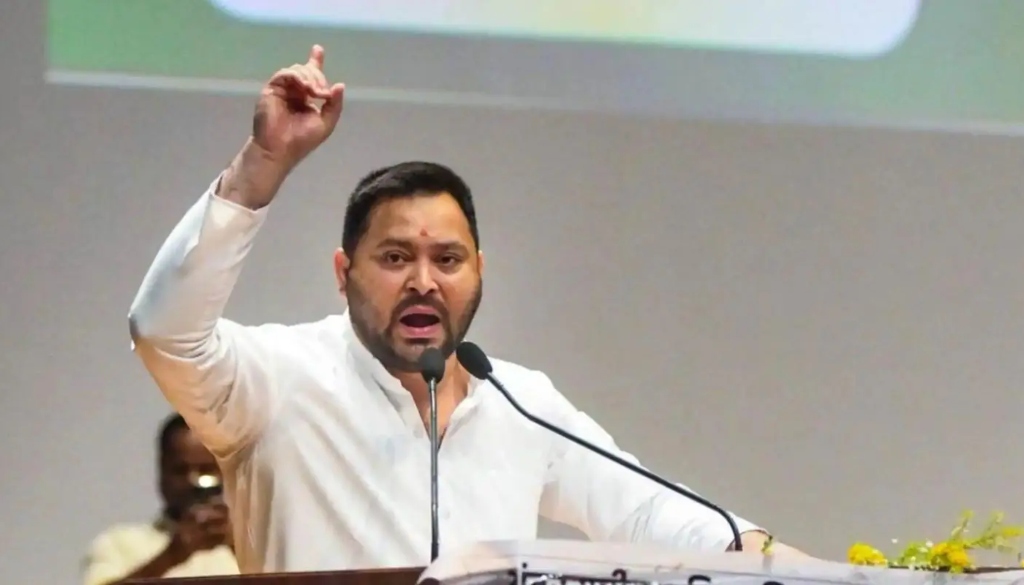
Patna: In a high-stakes move ahead of the Bihar Assembly elections, Rashtriya Janata Dal (RJD) leader Tejashwi Yadav on Tuesday announced two major promises aimed at women voters — a key electoral constituency that has consistently tilted results in the state.

The first announcement was the launch of the ‘Mai Behen Yojana’, under which women will receive a lump sum payment of ₹30,000 every year on January 14 — totaling ₹1.5 lakh over five years. The second was the regularization of Chief Mobilizer Jeevika Didis, who will be given a monthly salary of ₹31,000.
Tejashwi’s latest declaration builds upon an earlier Grand Alliance manifesto promise, which had proposed a monthly stipend of ₹2,500. The shift to a yearly lump sum, analysts say, reflects an attempt to simplify and amplify the scheme’s appeal.

The announcement immediately set off political debates: Will Tejashwi’s ₹30,000 promise outshine Nitish Kumar’s ongoing ₹10,000-a-year women’s employment initiative?
Nitish Kumar’s Women’s Employment Scheme
Under the Chief Minister’s Women’s Employment Scheme, the Nitish Kumar government is already transferring ₹10,000 directly into women’s bank accounts to encourage entrepreneurship. The state promises further assistance of up to ₹2 lakh after evaluating the progress of their work.
The government has clarified that the money is not a loan, and repayment is not required. So far, over 1.2 crore women have received ₹10,000, and the remaining beneficiaries are expected to be covered by December 2025.
Political observers note that this early rollout gives Nitish a crucial advantage — establishing credibility before the Grand Alliance’s promises can materialize.
Can Tejashwi’s ₹30,000 Promise Be a Game Changer?
To assess the scheme’s potential impact, two data points from the 2020 Bihar elections are significant:
- Vote gap among women voters was just 1%. According to Lokniti-CSDS, 38% of women voted for the NDA, while 37% supported the Grand Alliance.
- Overall vote margin was merely 0.03%. The NDA won 125 seats against the Grand Alliance’s 110, with a difference of just 11,250 votes statewide.
Given these razor-thin margins, analysts say even a small swing in women’s votes could decisively alter the outcome.
Nationally, cash transfer schemes for women have emerged as powerful electoral tools. Between November 2023 and October 2025, 13 states went to polls — and in 10 of them, political parties promised or implemented such schemes. In 9 of those 10 states, the party announcing or implementing the cash scheme either won or retained power.
The Timing Factor: Delivery vs Promise
When both the ruling and opposition parties announce similar welfare schemes, timing becomes critical.
Data from recent state elections show that governments that disbursed at least one or two installments before polls gained voter trust. In Jharkhand, for instance, the Hemant Soren government credited two installments of the Maiya Samman Yojana ahead of the 2024 elections, helping it retain power.
Senior Bihar journalist Indrabhushan notes that Nitish Kumar’s government has already “settled the matter” by transferring money to women’s accounts.
“Tejashwi knows this is his make-or-break election,” Indrabhushan said. “He is trying to consolidate women’s support, but the timing favors Nitish, who has already delivered on his promises.”
Interestingly, in states such as Delhi, Chhattisgarh, and Rajasthan, BJP’s promises were trusted more than incumbent governments, even though it was not in power there — largely because of its proven track record of implementing similar schemes elsewhere.
Why Cash Schemes for Women Work
Experts identify four major reasons why such schemes are politically effective:
- Economic Relief Amid Financial Strain
- Post-pandemic financial stress has deepened across households. Nearly 9.4 million families in Bihar are below the poverty line, earning less than ₹6,000 a month. In such conditions, ₹2,000–₹2,500 monthly support can increase a family’s income by 25%.
- “Even ₹50 a day changes the comfort level of poor families,” says Abhay Kumar Dubey, professor at Ambedkar University, Delhi.
- Rise of the Women Voter as a Political Force
- Studies by Lokniti-CSDS show that 69% of women voters believe their vote can change governance. In Bihar, women’s turnout in 2020 (59.7%) exceeded men’s (54.6%) — a trend that has helped Nitish in past elections.
- BJP’s ‘Women Vote Bank’ Strategy
- The BJP has actively cultivated women’s support through central and state-level schemes:
- ₹3 lakh crore allocated for women’s welfare in the 2024 budget.
- 11 lakh new Lakhpati Didis recognized within 100 days of Modi 3.0.
- 70% of PM Awas Yojana homes registered in women’s names.
- 10 crore gas cylinders distributed under Ujjwala Yojana.
- 33% reservation for women in Parliament and Assemblies enacted in 2023.
- These measures have reinforced the BJP-NDA’s credibility among women voters.
- New Schemes Bring Fresh Political Rewards
- Election analyst Amitabh Tiwari says, “Cash transfer schemes remain potent as long as they’re new. When the novelty fades, gratitude turns into expectation.”
- He adds, “Inequality in India has risen sharply — so direct cash support has become both a political and social necessity.”
The Road Ahead
As Bihar heads into elections with voting scheduled on November 6 and November 11, both alliances are betting heavily on women-centric welfare politics.
For Nitish Kumar, early delivery is his strongest defense against anti-incumbency.
For Tejashwi Yadav, ambitious promises are his biggest hope to bridge the generational gap and recast RJD’s image.
Whether Bihar’s women voters will reward promises or performance remains the question that could decide the 2025 election outcome.