Patna: As the campaign for the Bihar Assembly elections came to an end, the political atmosphere in the state reached fever pitch with fiery exchanges between top leaders. Prime Minister Narendra Modi launched a sharp attack on the RJD-Congress alliance, claiming, “RJD and Congress can never develop Bihar. These people ruled Bihar for many years. Where guns and cruelty reign, the law fails.”

In contrast, AIMIM candidate Tausif Alam triggered outrage with his inflammatory statement: “If the son of a fodder thief points a finger at Owaisi, I’ll cut it off. If he points an eye, I’ll gouge it out.” These remarks drew strong reactions from across the political spectrum — from Modi, Nitish Kumar, Asaduddin Owaisi, Giriraj Singh, and Samrat Chaudhary — all targeting RJD leader Tejashwi Yadav.
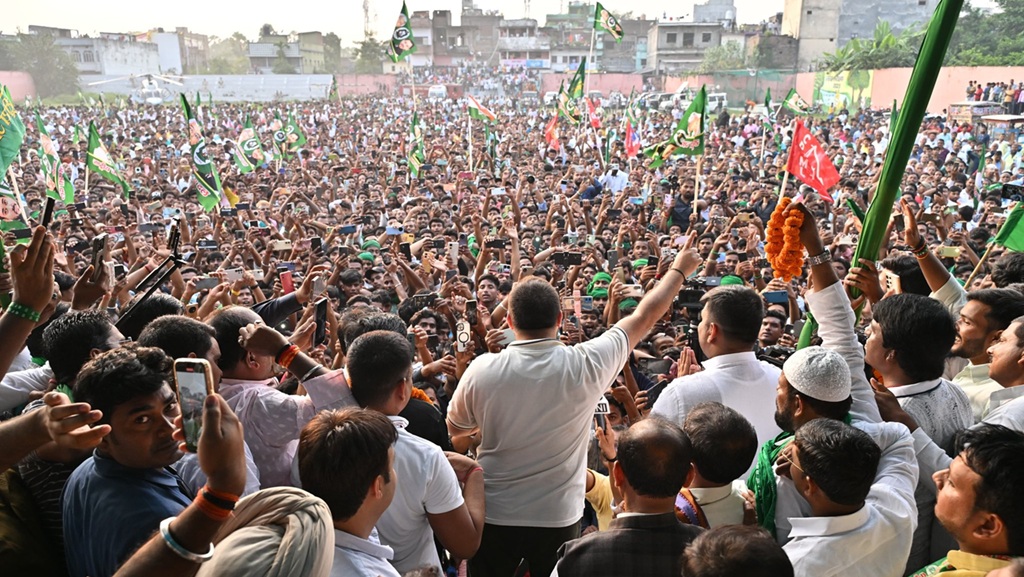
Yet, Tejashwi remained unmoved. Avoiding direct confrontation or personal remarks, he stuck to his core message — employment, education, and governance — repeating his signature phrase at rallies: “Quietly, the lantern print.” Over the past three days alone, he addressed 51 rallies, pushing his campaign’s 10-point strategy that he hopes will swing the verdict in favor of the Grand Alliance.

1. Jobs for Every Household
The cornerstone of Tejashwi’s campaign is employment. Promising one government job per family within 20 months of forming the government, he has sought to tap into the aspirations of Bihar’s youth — nearly 40% of the electorate. His agenda includes transparency in recruitment exams, permanent jobs for contract workers, and a fair domicile policy.
In a bid to connect with young voters, Tejashwi traded his traditional kurta-pyjama for colorful T-shirts during rallies — a calculated shift to project a youthful image.
2. Women-Centric Welfare Promises
In a direct challenge to Chief Minister Nitish Kumar’s strong female vote base, Tejashwi unveiled cash-benefit schemes like the Mai-Behan Maan Yojana (₹2,500 monthly), a lump-sum grant of ₹30,000 on Makar Sankranti, 200 units of free power, and scholarships. He also pledged to restore the Old Pension Scheme (OPS).
Political observers view these as attempts to outflank Nitish’s welfare politics that brought women into the JD(U) fold through prohibition and reservation policies.
3. High Voter Turnout as ‘Wind of Change’
Calling the record 64.46% turnout in the first phase a “wind of change,” Tejashwi projected it as proof that voters were leaning toward the Grand Alliance. His messaging aimed to sustain the psychological momentum into the final phases of polling.
4. Aggressive Ground Campaign
In his relentless schedule, Tejashwi addressed up to 18 rallies a day. Following a “momentum carry-forward” approach, he held public meetings, press interactions, and live sessions to energize cadres and reach undecided voters.
5. Alliance Cohesion and Unified Face
By declaring him the Chief Ministerial face, the Grand Alliance presented rare unity. Tejashwi also curtailed internal seat disputes and secured Mukesh Sahni’s support for RJD’s Afzal Khan in Gaurabauram — a symbolic show of control and alliance strength.
6. Beyond Muslim-Yadav Politics
Breaking from RJD’s traditional Muslim-Yadav base, Tejashwi widened his outreach to EBCs, Dalits, and OBCs. Ticket allocation reflected this shift — 51 Yadavs, 19 Muslims, 11 Kushwahas, and 14 upper-caste candidates. His promise to raise EBC reservation from 20% to 30% further underscored his inclusivity pitch.
7. Reply to ‘Jungle Raj’ Allegation
Tejashwi hit back at the NDA’s “Jungle Raj” jibe with a hardline response: “If even my shadow does something wrong, I will punish them.” His manifesto included farm loan waivers, free power for irrigation, MSP assurance, teacher transfer reforms, and the OPS — blending governance and welfare populism.
8. Digital-First Campaign
Harnessing social media’s reach, Tejashwi turned Facebook (3.8 million followers) and X into campaign weapons. From rally livestreams to meme-based outreach, his digital strategy amplified offline efforts, especially among young voters and first-time participants.
9. Maintaining Restraint Amid Provocation
Unlike his rivals, Tejashwi avoided incendiary rhetoric. He refused to respond to Tausif Alam’s violent remarks or his brother Tej Pratap Yadav’s controversial comments, signaling discipline. In Mahua, he even campaigned against Tej Pratap — emphasizing that “party is bigger than family.”
10. Calibrated Muslim Outreach
While safeguarding his Muslim base, Tejashwi avoided making explicit promises that could alienate Hindu voters. Instead, he adopted a balancing tone — “Everyone will be taken care of in the future.”
Expert View
Veteran journalist Irshadul Haq observed, “Tejashwi has turned the election into ‘Tejashwi vs Others.’ Even when provoked by the BJP, he avoids hate speech, which may work in his favor.”
Senior journalist Praveen Bagi added, “By centering jobs as a key issue, Tejashwi forced all parties to follow his narrative. However, his challenge remains consistency — Bihar needs him to stay visible after the elections too.”
Analysis
Tejashwi Yadav’s campaign blended youthful energy, welfare promises, and digital engagement — a sharp departure from RJD’s old politics. Whether this mix can overcome BJP-JD(U)’s organizational muscle and caste arithmetic will be known only after the votes are counted, but one thing is clear — Tejashwi has managed to make this election about himself.