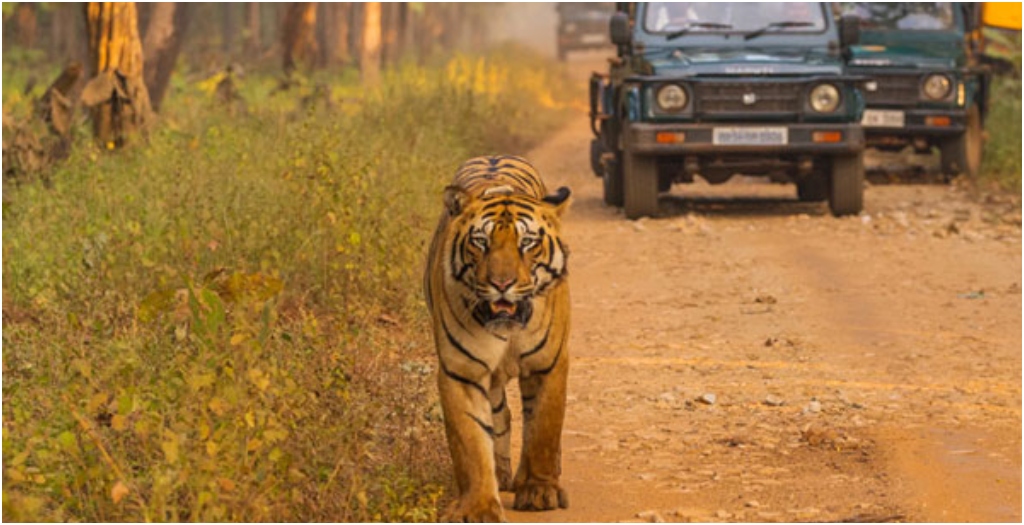
Bagaha: Fear has gripped villages adjoining the Valmiki Tiger Reserve (VTR) in Bihar’s West Champaran district after three people were killed in suspected tiger attacks within about 20 days. Two victims died at the spot, while another succumbed to injuries during treatment.

The latest death was that of Vijay Haldar, who was killed on August 15 while collecting fodder near the forest. Villagers who went looking for him said they found blood and hair at the spot before hearing a tiger nearby.
Prakash Haldar, one of the six villagers who joined the search, said they had been armed with sticks and spears when they went towards the fields where Vijay had gone to work.

According to Prakash, the group found both fresh and dried bloodstains and hair in a field, with flies hovering over them. While they were searching the surrounding area, they heard a tiger panting nearby.
The villagers then saw the animal moving towards the forest and tried to chase it away, but it escaped. When they returned to the area, they found Vijay lying dead in a field. He had suffered a fatal injury to his neck.
The incident has intensified concerns over human-wildlife conflict in villages located close to the VTR.
Three deaths in 20 days
The recent incidents began on July 30, when 65-year-old Aklu Yadav was attacked by a tiger while grazing goats near Bisaha village. He was rescued by villagers after they raised an alarm and beat the tiger with sticks. Yadav suffered severe injuries to his leg and was taken to hospital before being referred to Gorakhpur. He later died during treatment.
The tiger believed to have attacked Yadav was found dead in the forest soon afterwards. Forest officials said the animal appeared weak and had multiple injuries, with preliminary findings suggesting it may have been involved in a territorial fight with another tiger.
Later the same day, about 35 km away, Umrawati Devi, a resident of Naurangia, was allegedly attacked while working in an agricultural field. According to her family, she was bent down while removing weeds when a tiger attacked her from behind and dragged her towards a sugarcane field.
The animal allegedly attacked her neck. When her husband and other villagers reached the area after hearing about the incident, they found her dead. The incident was also reported by multiple media outlets at the time.
On August 15, Vijay Haldar became the third person to die in a suspected tiger attack in the area within three weeks. His brother had returned home after collecting fodder, assuming Vijay had already left. When Vijay did not return, villagers went looking for him and eventually found his body.
Why are tigers moving towards villages?
The VTR covers a large forest landscape, but experts cited in the account say increasing tiger numbers and limited space within the reserve may be pushing some animals towards forest-edge areas.
According to the expert assessment provided by local sources, the reserve has around 75 tigers across an area of roughly 900 square kilometres. This creates competition for territory, particularly among adult male tigers.
As tigers move through areas adjoining the reserve, their paths increasingly overlap with agricultural fields where villagers work and livestock are grazed. This increases the possibility of encounters between people and wildlife.
However, wildlife experts caution that a tiger does not automatically become a man-eater simply because it has attacked a person. Factors such as injury, age, illness, availability of natural prey and human activity near forest boundaries can influence tiger behaviour.
The death of the tiger involved in the July 30 attack also points to the role of animal health and territorial conflict. Forest officials said the animal was old, weak and had multiple injuries.
Forest department steps up vigilance
Following the attacks, forest teams have intensified monitoring and patrolling in areas adjoining the reserve. Officials have also been advising residents to remain alert, avoid moving alone near forest edges and travel in groups when visiting agricultural fields.
Forest officials had earlier issued similar advisories after the July 30 attack, urging villagers to move in groups during the day and avoid forest-edge routes at night.
The forest department has also provided compensation to the family of Aklu Yadav. His family received a total of ₹10 lakh after his death following the tiger attack.
With another fatal attack reported in August, residents living around the VTR are now demanding stronger measures to prevent further encounters between tigers and people.
The allegations and accounts of the villagers regarding the circumstances of the attacks have been reported based on their statements. The exact circumstances behind each incident and the identity or condition of the tiger involved in the latest attack would require confirmation from forest authorities.