Patna: The Telecom Regulatory Authority of India (TRAI) has released the findings of its Independent Drive Test (IDT) for the Bihar licensed service area, offering a snapshot of real-world mobile network performance across highways, rail routes and urban centres during November.

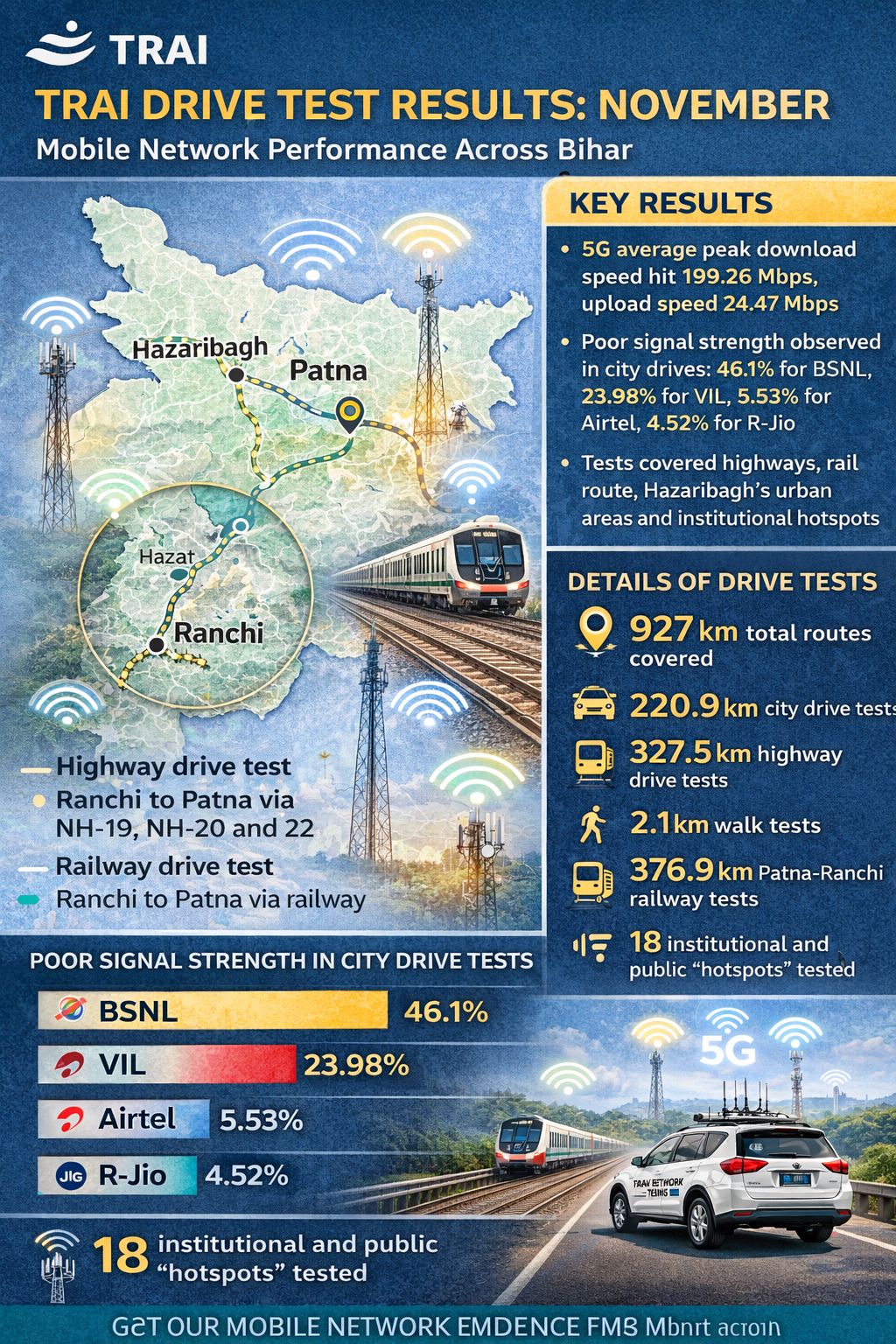
Conducted under the supervision of TRAI’s regional office in Kolkata, the tests ran between November 20 and 28 and covered extensive city routes in Hazaribagh district and adjoining areas, the Ranchi–Patna highway corridor along NH-19, NH-20 and NH-22, and the Patna–Ranchi railway route. The exercise aimed to capture the experience of everyday users across residential neighbourhoods, business districts, institutional hotspots and while travelling by road and rail.
In total, the regulator assessed performance over 220.9 km of city drive tests, 18 hotspot locations, 2.1 km of walk tests, 327.5 km of highway routes and 376.9 km of railway corridors. Networks were evaluated across 2G, 3G, 4G and 5G technologies, reflecting usage on a range of handset capabilities. TRAI said the detailed findings have already been shared with the telecom service providers concerned.

What was measured
The assessment covered both voice and data services. Voice parameters included call setup success rate, dropped call rate, call setup time, call silence rate, speech quality (mean opinion score) and coverage. Data metrics ranged from download and upload throughput to latency, jitter, packet drop rate and video streaming delay.
The headline performance came from 5G services, which delivered a maximum average download speed of 199.26 Mbps and an average upload speed of 24.47 Mbps across the overall test routes.
Coverage gaps persist
Despite high peak speeds, the report points to notable coverage issues in auto-selection mode (switching between 5G, 4G, 3G and 2G) during city drives. Poor signal strength was observed over 5.53% of the urban test route for Airtel, 46.10% for BSNL, 4.52% for Reliance Jio Infocomm Limited (RJIL) and 23.98% for Vodafone Idea Limited (VIL), highlighting uneven network reliability within city limits.
In and around Hazaribagh district, tests spanned a wide geography including Hadri, Kariyatpur, Harli Peto, Daru, Amnari, Kesura, Hurhuru, Nawada, Barkagaon, Pakri Barwadih, Jamuari and Nawabganj, among others. Static tests were also carried out at institutional and public locations such as post offices, universities, courts, bus stands, hospitals and educational campuses across Bihar and Jharkhand, while walk tests covered sites including Hazaribagh Town railway station.
TRAI said the independent drive tests are intended to provide an objective picture of user experience and help operators address gaps in coverage and quality. The November findings suggest that while next-generation networks are delivering high speeds on key corridors, consistency of signal—particularly in urban areas—remains a challenge that service providers will need to tackle.