Patna: It’s exactly 1 p.m. at 10 Circular Road — the residence of Tej Pratap Yadav, elder son of RJD chief Lalu Prasad Yadav and former Chief Minister Rabri Devi. The green latticed gate, adorned with a heavy iron trident, immediately reveals the occupant’s religious and spiritual leanings.

Moments later, dressed in a crisp white kurta-pyjama, Tej Pratap himself opens the gate and steps out. His first stop isn’t the media team waiting to meet him, but a Tulsi plant standing near the stairs. A small lamp flickers beside it. He bows reverently, eyes closed in prayer — the unmistakable sign of a man who begins his political day with devotion before confrontation.
Prayers Before Politics
Inside his modest office, portraits of Lalu Prasad and Rabri Devi hang on the wall. Asked if he considers them his political gurus, he smiles and replies lightly, “They’re my parents. Everyone keeps their parents’ pictures at home.”

Outside, a small crowd of party workers awaits. After brief conversations and selfies, Tej Pratap climbs into his white SUV, part of a five-car convoy heading toward Motihari.
The road ahead is filled with campaign stops, impromptu interactions, and a series of unpredictable moments — the kind only Tej Pratap can create.
The Journey: Sattu, Songs, and Sharp Opinions
On the way, local journalists intercept his convoy. Tej Pratap rolls down the window, half-amused, half-irritated by their persistence. When asked about his breakfast, he answers simply, “I drank Sattu.”
But when the questions turn political, his tone hardens. On parting ways with the RJD — the party founded by his father — he says with visible emotion, “Those who expelled me should also feel bad. I have made a sacrifice. I have consumed poison.”
Yet, he dismisses any suggestion of resentment toward his younger brother Tejashwi Yadav. “No, no… I am not angry with anyone. My nature has always been like this — a bit moody.”
As the car speeds through dusty Bihar roads, he recalls childhood memories with Tejashwi. “We played cricket together. When I got him out, he’d say he wasn’t out. He was beaten by me. I’ve been beaten many times for my mistakes,” he laughs.
“I Play the Flute, He Dances”
When asked about his unconventional image — from fashion shows to flute performances — he shrugs. “There was a fashion show somewhere, they invited me, so I went. Wherever people invite me, I go.”
And about Tejashwi’s viral dance video? “If it’s okay, then dance. No problem. I also play the flute,” he quips.
Inside the car, patriotic songs from The Legend of Bhagat Singh fill the air — “Mera Rang De Basanti Chola” playing on loop. Tej Pratap hums along softly, pointing to a pile of books beside him — titles on Bhagat Singh, Nehru, and India’s freedom struggle. “These are all my favourites,” he says, his voice rising with the tempo.
“We Want to Create a Human Religion”
Midway to Motihari, Tej Pratap spots a supporter and abruptly stops the car to greet him. Turning to the reporter, he says earnestly, “We want to create a human religion — where no one has caste or creed. Cut anyone’s hand, the blood will be red. Whether Hindu or Muslim, the blood is the same. We are all one.”
His tone sharpens when the conversation shifts to old slogans like “Clean the brown hair,” used in the 1990s against upper-caste communities. “That was BJP-RSS propaganda. My father never said such a thing,” he insists.
“Politics Is Not Poison”
When a journalist calls politics “poison,” Tej Pratap interrupts. “Don’t give wrong examples,” he says. “If politics doesn’t exist, the country can’t function.”
His criticism of current Chief Minister Nitish Kumar is blunt. “He was fine in the beginning, but now he’s spoiled. He’s molested women. He’s mentally ill,” he alleges, adding that strategist-turned-politician Prashant Kishor is “a businessman, not a leader.”
Sunset at Motihari: The Orator Returns
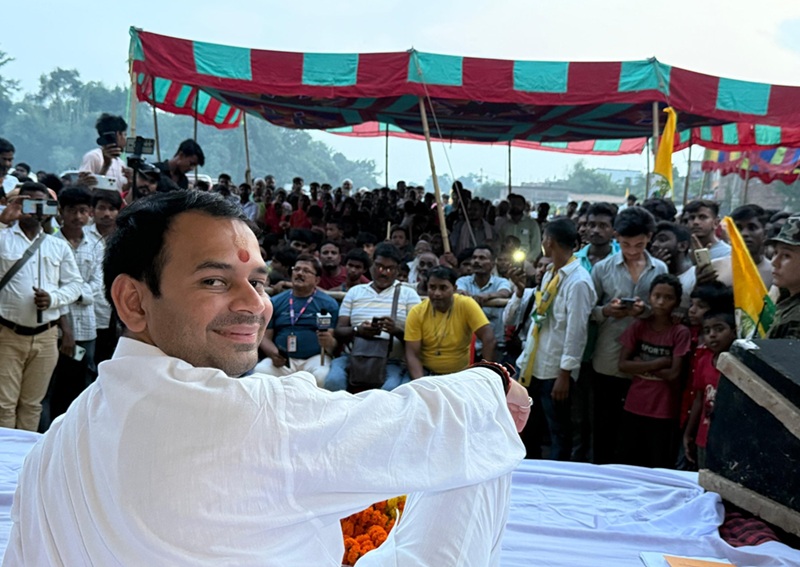
By 6 p.m., the convoy reaches Motihari. The setting sun casts an orange hue over the fields as Tej Pratap steps out of his ₹1-crore SUV and begins walking through the farmland toward Ramayanpur village.
A crowd of nearly 3,000 has gathered. As chants of “Netaji Zindabad” echo, he climbs the stage and launches a fierce attack — not just on the BJP and JDU, but also on his former party, the RJD.
He speaks passionately, weaving together religion, revolution, and social justice — his own blend of idealism and defiance.
The Night Doesn’t End
By the time the rally ends and the team returns to Patna, it’s close to midnight. Most would call it a day, but Tej Pratap doesn’t. At his residence, party workers are waiting. Within minutes, another meeting begins — the conversation shifting from public speeches to booth-level strategy.
The day that began with a Tulsi prayer ends with a political meeting — a perfect metaphor for Tej Pratap Yadav himself. A leader torn between spirituality and struggle, idealism and rebellion, family legacy and individual identity.
In him, Bihar’s most unpredictable politician continues to blend religion, revolution, and relentless ambition — a rare mix in a state where politics is both theatre and test.