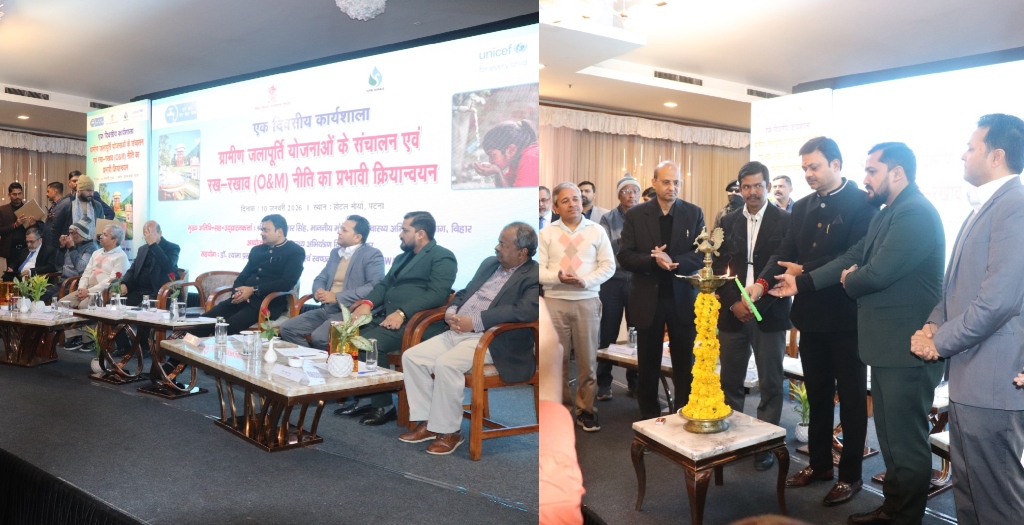
Patna: The Bihar government, along with UNICEF, carried out a detailed review of the state’s rural drinking water programme during a day-long workshop attended by senior officials, engineers and field-level workers. The meeting focused on understanding everyday problems in water supply, improving maintenance systems and ensuring that village tap water services match national standards. Officials said the presence of UNICEF experts helped bring global and national best practices into the discussion.

Sanjeev Kumar, Special Secretary of the Public Health Engineering Department (PHED), said the Centralised Grievance Redressal System has become a trusted platform for citizens across Bihar. He explained that more villagers are now coming forward to register complaints, showing increased faith in the system. Better use of data and stronger coordination between departments, he said, has helped officials respond more quickly to issues such as water shortages, pipeline damage and quality complaints.
Engineer-in-Chief-cum-Special Secretary Nityanand Prasad said that placing all rural piped water supply schemes under PHED has improved planning and execution. This step, he noted, has made it easier to track problems and take timely action. Prasad clearly stated that all issues are being handled according to standard operating procedures, adding that there would be no negligence and that accountability would be fixed in every case of failure.

The workshop included technical sessions on Bihar’s operations and maintenance policy and shared experiences from districts facing water quality challenges as well as those with fewer problems. Discussions highlighted practical issues such as billing, use of funds and shortage of manpower. These sessions helped bridge the gap between policy planning and ground-level realities.
Later sessions gave space to field workers and local representatives, including engineers, pump operators, contractors and water committee members, to share their experiences. Topics such as MIS-based monitoring, IoT technology, control rooms, electricity dues, honorarium payments and repair systems at the gram panchayat level were discussed in simple terms. Officials said the exercise would lead to practical improvements, helping deliver a more reliable rural water supply to households across Bihar under the Har Ghar Nal Ka Jal scheme.