
Rajgir: Vishwarang Nalanda 2026 was inaugurated at Nalanda University on October 7, with the two-day programme focusing on strengthening dialogue between North-East India and South-East Asia through language, literature, culture and the arts.

The programme, organised jointly by the Vishwarang Foundation, Bhopal, Rabindranath Tagore University, Bhopal, and Nalanda University, seeks to examine historical and contemporary links between India and Asia while creating opportunities for academic and cultural engagement.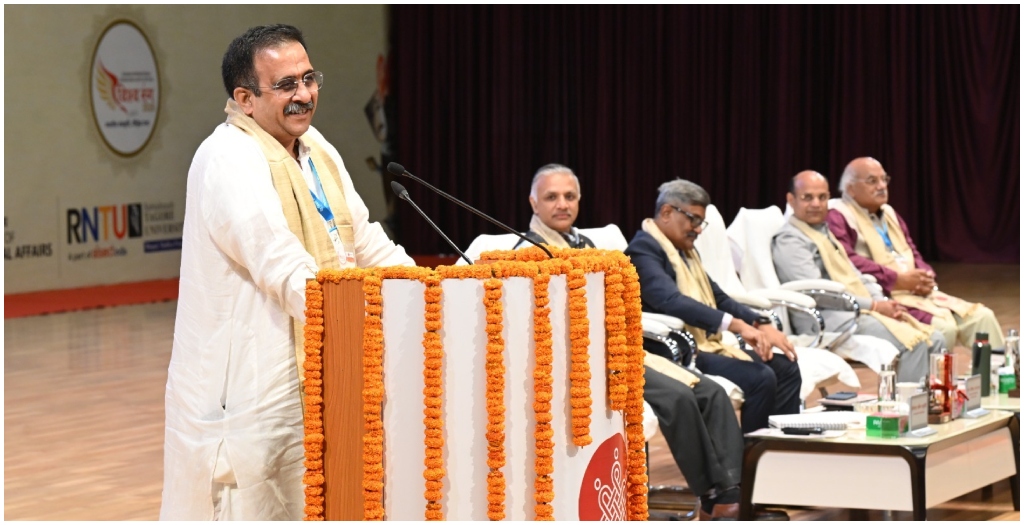
Nalanda As A Knowledge Bridge

Nalanda University Vice-Chancellor Professor Sachin Chaturvedi said the programme reflected the spirit of Nalanda by bringing together knowledge traditions, their contemporary applications and future possibilities.
He said the university was working with Bhashini to use technology to overcome linguistic barriers, including efforts to provide real-time translation of Hindi-language addresses into English and Sanskrit for display.
Professor Chaturvedi also highlighted the work of the university’s Centre for South-East Asian Studies in developing academic, cultural, scientific and historical links with institutions across the region.
He said stronger connections between Asia required more than physical infrastructure and should also involve people, knowledge traditions and cultural understanding.
North-East India’s Regional Role
Dr Rajesh Ranjan, Deputy Director General of the Indian Council for Cultural Relations, said North-East India had an important cultural role in connecting India with South-East Asia.
He highlighted interactions between languages such as Bodo, Assamese, Manipuri, Khasi and various Naga languages with Sanskrit, Pali, Burmese and Thai.
Dr Ranjan also pointed to literature, songs and student mobility as important channels of cultural exchange. He said ICCR scholarships and international academic engagement had helped students from other countries explore Indian culture, philosophy and values.
Focus On Linguistic Diversity
Dr Santosh Choubey, Director of Vishwarang, emphasised the principles of Vasudhaiva Kutumbakam and dialogue in his address.
He said India’s languages and cultural expressions may be diverse but remain connected through shared civilisational traditions. He stressed the importance of recognising the dignity and cultural contribution of every language.
Dr Choubey described the centuries-old linguistic and cultural exchanges between North-East India and South-East Asia as part of this continuity and said Vishwarang could help carry the dialogue forward.
North-East As A Link With South-East Asia
Chief guest Katikithala Srinivas, Secretary, Ministry of Development of North Eastern Region, said Nalanda represented India’s long tradition of sharing knowledge and cultural heritage with the world.
He described the North-East as an important link between India and South-East Asia and highlighted the role of language in preserving culture, traditions, ethical values and collective memory.
Srinivas also connected cultural engagement with the Act East approach, saying institutions such as Nalanda University, Vishwarang and ICCR could contribute to wider economic, cultural and civilisational engagement.
He stressed the need to digitally preserve India’s knowledge traditions and cultural heritage and present them effectively in the global digital landscape.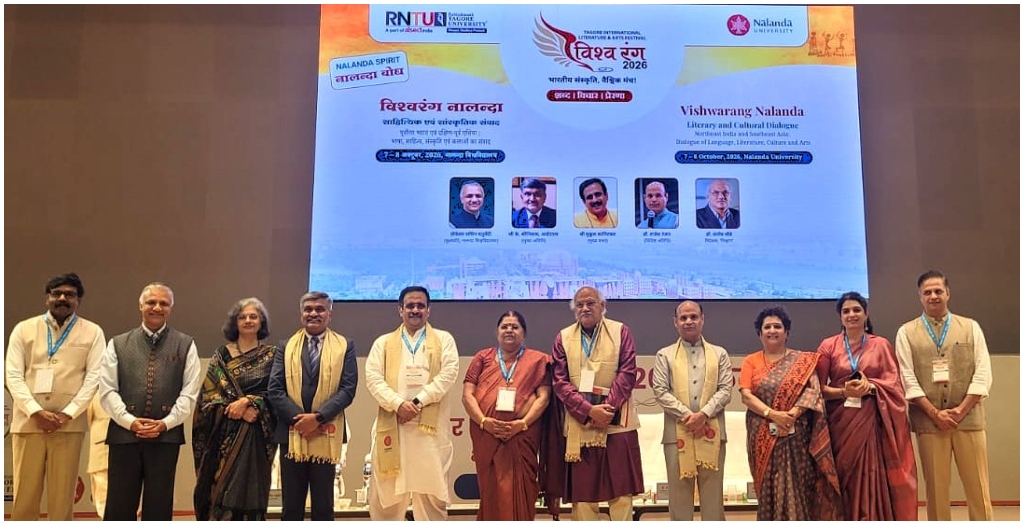
Preserving Knowledge Traditions
Keynote speaker Mukul Kanitkar linked the revival of Nalanda with the restoration of its tradition of sharing knowledge with the world.
He highlighted knowledge, diversity, inclusiveness and Vasudhaiva Kutumbakam as important elements of the Nalanda tradition. He also stressed the importance of preserving linguistic diversity and cultural plurality amid advances in technology and artificial intelligence.
Kanitkar said the two-day programme should be viewed as an opportunity to strengthen shared belonging and Vishwa-Bandhutva, rather than only as an academic conference.
Academic Sessions And Cultural Events
The programme includes discussions on cultural links between South Asian and Indian languages, translation and language coordination, economic and cultural consciousness in North-East and South-East Asian countries, and Nalanda’s knowledge tradition and the universities of the future.
An exhibition featuring photographs and literature related to Rabindranath Tagore was also inaugurated.
A Rabindra Sangeet evening is scheduled as part of the programme. Vishwarang Nalanda 2026 will conclude on October 8 with academic sessions, multilingual poetry recitations and musical performances.