Supaul/Madhubani: As Nepal moves towards forming a new government after its recent parliamentary elections, people living along the India–Nepal border in Bihar are closely following the political developments. Residents say decisions taken in Kathmandu often have a direct impact on trade, social ties and everyday life in border districts.

“We belong to the same Tarai belt near the border. People on both sides share close relations. Daughters from here get married there and daughters from there come here. So whichever government forms in Nepal, its policies definitely affect us,” said Satendra Gupta, a shopkeeper from Supaul district near the India–Nepal border.
For communities living in these regions, Nepal’s political landscape is not distant news but something that directly shapes economic activity, movement across the border and long-standing cultural relationships.

Young Leader Balen Shah Gains Attention
Thirty-five-year-old Balen Shah is widely regarded as one of Nepal’s emerging leaders representing the new generation in politics. His party has reportedly gained a strong lead in several seats in the Madhesh region during the elections.
Shah previously served as the mayor of Kathmandu and rose to prominence following youth-driven political movements. His ancestral roots are linked to the Mahottari region of Nepal, which borders Bihar’s Madhubani district and forms part of the Madhesh belt where Maithili-speaking communities live on both sides of the border.
Local businessman Jitendra Sah from Basopatti market in Madhubani said the emergence of a Maithili-speaking Madheshi leader could strengthen ties between India and Nepal.
“If a leader from the Madhesh region becomes prime minister, relations between the two countries are likely to improve. Trade, movement of people and our traditional ‘roti-beti’ ties will become even stronger,” he said.
How Nepal Election Results Stand
Voting for Nepal’s House of Representatives took place on March 5. Elections were held for 165 seats under the first-past-the-post system and 110 seats through proportional representation.
According to early trends in the FPTP category, the Rastriya Swatantra Party (RSP) has secured 124 seats and is leading in one more constituency. The Nepali Congress has won 17 seats and is leading in one. The CPN-UML has secured eight seats and is ahead in one, while the Nepal Communist Party has won seven seats. Other smaller parties have also won a handful of seats.
In the proportional representation category, counting is still underway. Out of about 10.9 million votes, more than 8.1 million have been counted so far. RSP has received the highest share of votes, followed by Nepali Congress and CPN-UML.
Under Nepal’s electoral rules, a party must secure at least three percent of total votes to qualify for seats in the proportional representation system. Current projections suggest RSP could secure around 60 seats through PR, Nepali Congress around 20, CPN-UML about 17, Maoist Centre around eight and RPP approximately five seats.
Border Trade and Daily Life Linked to Nepal
Residents of border districts say economic activity in the region is deeply interconnected with Nepal. Markets such as Basopatti in Madhubani and trading hubs in Kishanganj see daily movement of traders and customers from both countries.
Satendra Sah, a trader in Supaul, said many of his customers come from Nepal. “We constantly discuss Nepal’s politics because it affects our business and travel across the border. From conversations with people there, it seems likely that Balen Shah could emerge as prime minister,” he said.
He believes that a new leadership could strengthen peace, security and trade between the two countries.
Rajkumar Shah, a trader from Kishanganj, said family ties also bind communities across the border. “My sister is married in Nepal. If Balen Shah becomes prime minister, relations between India and Nepal will remain strong. People on both sides already share close ties,” he said.
Visitors from Nepal also expressed optimism. Ganesh, a resident of Kathmandu currently visiting relatives in India, said the young leader could bring fresh energy to governance.
“He is under 40 and represents a new generation. I believe he could work with leaders like Narendra Modi to strengthen peace and cooperation in the region,” he said.
Cultural Bonds May Grow Stronger
People in the border districts believe the rise of a Madheshi leader could reinforce cultural links rooted in language and shared traditions.
Residents of Mahinathpur village in Madhubani said news that a Maithili-speaking leader from the Madhesh region could lead Nepal has created excitement in the area.
“Our relationship between India and Nepal has always been built on ‘roti-beti’ traditions. If someone from this region becomes prime minister, those cultural bonds will become even stronger,” said local residents Shankar Chaudhary and Shyam Chaudhary.
Local traders Hari Kishore Modi and Shambhu Samrat also pointed out that the strong support for a young leader reflects a major shift in Nepal’s political landscape.
From Rapper to Mayor to National Leader
Before entering mainstream politics, Balen Shah—also known as Balendra Shah—was active in Nepal’s underground hip-hop scene. He gained popularity among young audiences through rap music that addressed issues such as poverty, inequality and corruption.
His songs often criticised political leaders and governance failures. When he announced his candidacy for Kathmandu mayor in 2022, many observers were surprised.
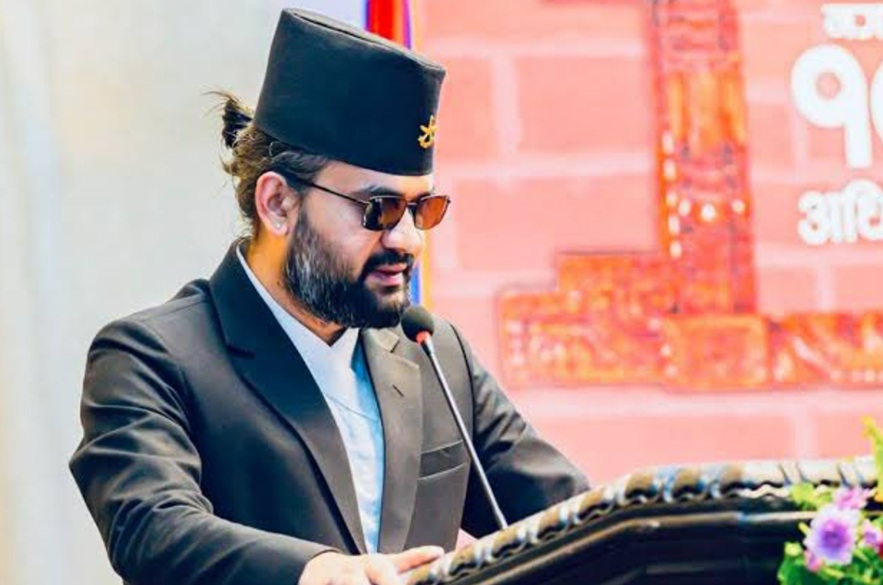
During the campaign, he became widely recognised for his signature appearance—often wearing a black blazer, black jeans and dark sunglasses. At just 33, he contested the election as an independent candidate and defeated several established political figures.
Shah became the first independent candidate to win the Kathmandu mayoral election, a position considered highly influential in Nepal’s political system. His rise quickly attracted global attention, and in 2023 he was featured in lists of influential global figures by major international publications.
For many residents along the India–Nepal border, the emergence of such a leader represents not just political change in Kathmandu but a development that could shape the future of cross-border relations, trade and cultural connections for years to come.