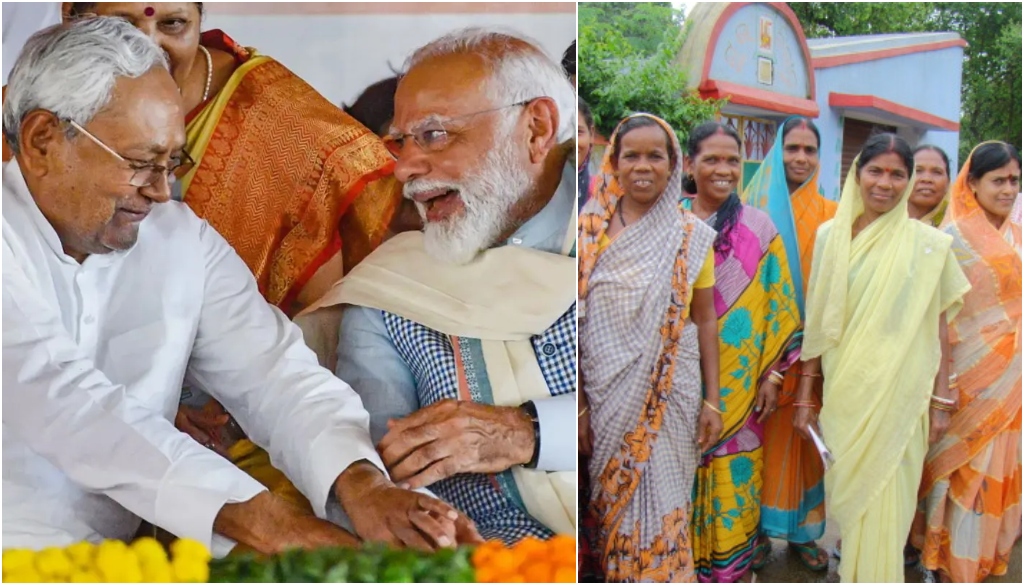
Patna/Kishanganj: Nitish Kumar may face criticism from many sections ahead of the 2025 Bihar Assembly elections, but among women voters—his most consistent and influential support base—the Chief Minister continues to command significant trust. Even as women across Patna and Kishanganj complain about inflation, poor implementation of prohibition, and lack of welfare benefits, most still credit Nitish for ensuring safety and empowerment.

This ground sentiment was evident in conversations across Bihar’s constituencies with the highest female voter ratios—Digha, Kumhrar, Bankipur (Patna), and Thakurganj (Kishanganj). Many women express discontent over unfulfilled promises, but when it comes to casting their vote, they say Nitish Kumar remains their preferred choice.
“Nothing has changed, but at least we feel safe”
In Patna’s Digha constituency, Mala Devi, a 37-year-old homemaker, summed up the paradox of Nitish Kumar’s appeal. “The government hasn’t given us a house or money, but my daughter can now go out freely. There’s no fear. Everything is safe now,” she said.

Her sister-in-law, Khushboo Devi, voiced frustration over the failure of prohibition enforcement. “Liquor and ganja are still easily available. But Nitish is at least working on development,” she added.
Krishna Devi, who runs a small shop in the area, said she would still vote for Nitish. “He helped women like me earn a living. I got 10,000 rupees under a livelihood scheme. He builds roads and gives us facilities.”
Anger in the slums, but loyalty remains
In Jeev Nagar’s slum area, where most residents belong to the Musahar community, resentment runs deeper. Kusum Devi said, “We’ve lived here for 50 years. No government help, no gas, no house. They only come for votes.”
Despite her anger, many in the area still recall Nitish’s efforts for women’s security and education. Yet, for daily wage earners, the struggle for basic facilities continues.
Kumhrar: Inflation a major concern
At Dawood Bigha in Kumhrar, 60-year-old Durgavati said inflation has made life unbearable. “With 500 rupees, we can’t buy enough vegetables. My son has cancer; we can’t even afford proper treatment,” she said. Younger women like Seema Kumari and Kamala Devi also echoed the same grievances, adding that corruption and lack of clean drinking water have worsened the situation.
Despite these hardships, Nitish still enjoys cautious support. “We are angry, but we know he has done more than others,” said Seema.
Bankipur: “We’ll vote for Nitish, but hope he doesn’t switch sides”
In Bankipur, women’s priorities center on safety and stability. Sharda Devi, a temple worker, said, “Prices are high, gas is costly, but at least roads and bridges have been built. There’s security now.”
Ruku Kumari, another resident, added, “Nitish should focus on jobs and food security. We’ll support him, but we fear he might change alliances again.”
Young women training for police recruitment at Gandhi Maidan credit Nitish for creating a safe environment. “We practice early in the morning. It’s dark, but there’s no fear,” said 21-year-old Priyanka.
Thakurganj: Muslim women back Nitish for Jeevika benefits
In Thakurganj, one of the Muslim-majority constituencies, the picture is similar. Women like Arjuna and Najma said they lacked gas connections and housing, yet praised the Jeevika scheme. “Nitish gave 10,000 rupees for small businesses. We will vote for him; he is helping everyone,” said Arjuna.
Najma added, “We’ve liked Nitish Kumar since childhood. Modi hasn’t given us anything.”
Experts: Women likely to back Nitish again
Senior journalist Rachna says, “Nitish has given women a sense of security and mobility. We used to be home by 6 p.m.; now girls can go out even at 10. His work has changed Bihar’s social environment.”
Political analyst Priyadarshan Ranjan agrees, calling it Nitish’s “silent revolution.” “Through 50% reservation in Panchayati Raj, prohibition, and Jeevika, Nitish created an emotional connection with women. Despite policy gaps, that bond remains strong,” he said.
With women making up nearly half of Bihar’s electorate and consistently voting in higher numbers than men, Nitish Kumar’s political survival may once again rest on this silent yet powerful constituency.