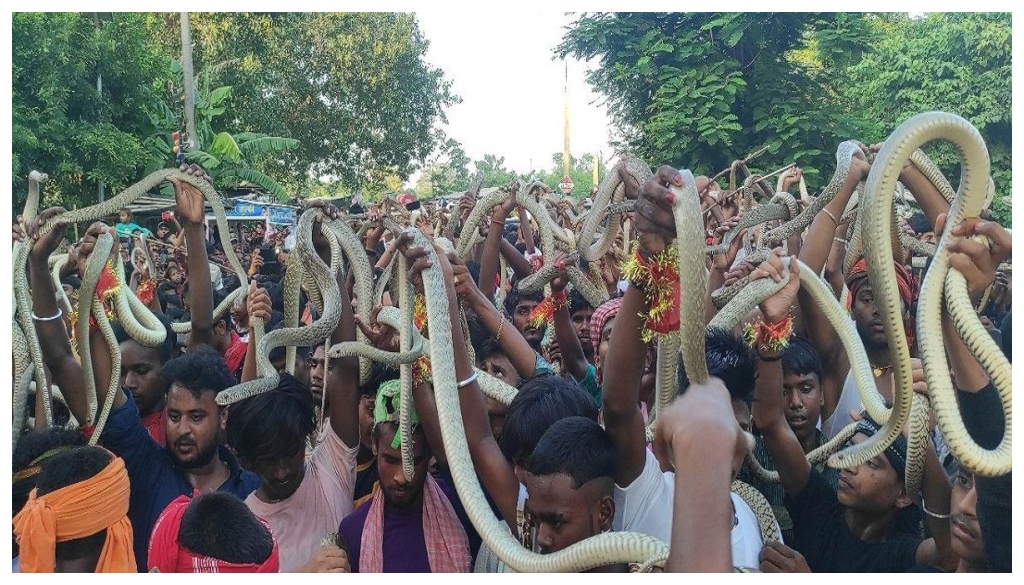


Samastipur: In a significant move aimed at upholding wildlife protection laws, the district administration in Samastipur, Bihar has imposed a strict ban on the traditional snake fair held annually at Scindia Ghat on the occasion of Nag Panchami. This marks one of the strongest administrative actions taken against a cultural event that had, for years, seen people publicly display and handle venomous snakes.
The fair, held roughly 23 kilometres from Samastipur town, has long drawn locals and visitors who participate in or witness acts where snakes are worn around necks, draped over arms, or even held in mouths. This year, Nag Panchami fell on July 17, and despite long-standing traditions, the administration has initiated legal proceedings against several individuals under the Wildlife Protection Act, 1972.
The district magistrate, Roshan Kushwaha, has issued clear directives to all sub-divisional officers, police officials, block development officers, and circle officers to identify and take legal action against organisers and participants of such events. A meeting of the Sub-Divisional Officer, Block Development Officer, Circle Officer and local police also resulted in a coordinated effort to prevent any future unauthorised processions or gatherings involving the use of wild animals.
A statement from the District Public Relations Department confirmed that all future events of this nature will be strictly monitored, and no permission will be granted for any activity involving wildlife. Officials were also instructed to take preemptive action to prevent similar gatherings in the future.
Traditionally, locals begin capturing snakes from forests and agricultural fields months in advance in preparation for the fair. However, the scenes at Scindia Ghat during the festival have often raised alarm among animal welfare advocates and authorities, with public handling of snakes viewed as both unsafe and unlawful.
This is the first time the district administration has responded with such severity. While cultural sentiment surrounding the fair remains strong among local communities, authorities say the use of protected species for public display and religious rituals directly contravenes the Wildlife Protection Act.