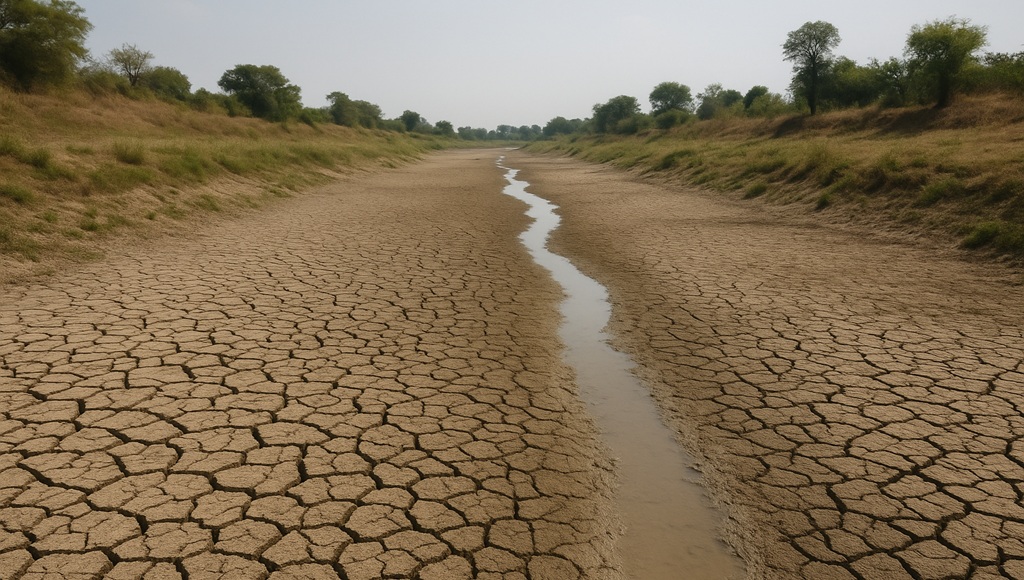
Muzaffarpur: At a time when rivers in North Bihar are usually brimming with floodwaters during the month of Saavan, many of them now lie dry and cracked, raising serious environmental concerns. The lack of monsoon rainfall, coupled with human interventions like unchecked diversions and absence of dredging, has turned the once-mighty rivers into fading memories of their former selves.

There are 85 small and large rivers flowing through the districts of North Bihar. Until a few years ago, barring some seasonal streams, most of these water bodies flowed year-round. Today, the scene is grim—half of them have either dried up completely or are reduced to shallow, stagnant pools.
Drought-like Conditions in River Networks
In Madhubani district alone, over a dozen rivers across various blocks have dried up. The Kamla River, once notorious for causing floods during July, now carries barely a trickle. The five rivers in Benipatti block—Dhauns, Khiroi, Budhanad, Thumhani, and Bachhraja—have little or no water. The Bachhraja River, once perennial, now holds only knee-deep water.

Similar distress is reported from West Champaran, where most rivers in Bagaha subdivision have dried. In Sitamarhi, the Bagmati, Lakhandei, and several rivers from the Adhawaara group like Goga, Singyahi, and Budhanad are nearly dry or carrying minimal water.
In East Champaran, rivers like Gandak and Budhi Gandak that normally flood during July are flowing below normal levels. Even in traditionally flood-prone areas like Samastipur and Darbhanga, major rivers such as Kosi and Kamla-Balan are showing unusually low water levels.
Monsoon Failure Adds to Crisis
Meteorologists say the monsoon in Bihar has been highly deficient this season. Once receiving over 1,200 mm of annual rainfall, parts of the state are now witnessing less than 800 mm. The scarcity has severely affected the recharge capacity of rivers and underground aquifers.
Professor Vidyanath Jha, a hydrologist and environmentalist, blames the accumulation of silt in riverbeds and ponds for reducing their water-holding capacity. “Earlier, rainwater would replenish the rivers, but now these water bodies are choked. They need urgent desilting and deepening,” he said.
Diversions and Embankments: A Man-Made Disaster?
Narayanji Chaudhary, a river conservation activist, pointed to the extensive diversion of water for flood control as a key reason behind the drying rivers. “From Jhanjharpur to Darbhanga Airport, there are 11 branches of the Kamla River. Ten of them have been blocked in the name of flood control. As a result, water gets trapped inside embankments and does not reach the fields and pastures like it used to,” he said.
Chaudhary called for a comprehensive study on traditional water flow systems like baha, soti, nala, and phodi and recommended controlled water release into them during the rainy season.
Silent Streams, Dying Ecosystems
The drying rivers are not just a threat to agriculture and water availability—they are endangering entire ecosystems. With water sources vanishing, aquatic life and biodiversity are under stress. Local communities, too, are grappling with shrinking water sources for irrigation and daily use.
As half of Saavan has already passed, and with no major revival of the monsoon in sight, environmentalists are urging the government to act swiftly. Measures such as rejuvenation of river channels, sustainable water management, and reduced reliance on embankment-based flood control are being called for as immediate priorities.
If the current trend continues, Bihar’s rivers—once lifelines of the region—may soon turn into seasonal memories.