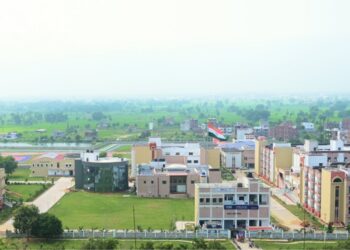
Patna: Patna has joined India’s growing network of high-performance computing hubs with the inauguration of Param Rudra, a state-of-the-art supercomputer installed under the National Supercomputing Mission (NSM). The system was formally launched on Friday at IIT Patna, in the presence of senior government officials and academic leaders.

Speaking at the event, Amitesh Kumar Sinha, additional secretary in the Ministry of Electronics and Information Technology, said the installation reflected the steady expansion of India’s supercomputing ecosystem. Under the NSM, he noted, 37 supercomputers have already been deployed nationwide, delivering a combined computing capacity of around 39 petaflops and serving more than 12,000 researchers. A further 10 systems are expected to be installed soon, taking the country’s total capacity beyond 100 petaflops.
The National Supercomputing Mission is a joint initiative of the Ministry of Electronics and Information Technology and the Department of Science and Technology, aimed at building indigenous capability in high-performance computing. Officials said the programme is also driving the development of domestic technologies, including processors, servers, cooling systems, interconnects, software stacks and data storage, in line with the government’s “Make in India” push.


Professor T N Singh, director of IIT Patna, described the launch as a “historic achievement” for the region. He said the facility would be transformative for Bihar and neighbouring Purvanchal in eastern Uttar Pradesh, enabling students, teachers and researchers to tackle complex problems in science, engineering and data-intensive fields that were previously out of reach.
Param Rudra has been established through a memorandum of understanding between IIT Patna and the Centre for Development of Advanced Computing (C-DAC). The 838-teraflops system uses largely indigenous components and runs on an Indian-developed software stack created by C-DAC. In keeping with NSM guidelines, a portion of its computing capacity will be shared with nearby academic and research institutions, extending its impact beyond the host campus.
Supercomputing performance is measured in floating-point operations per second, or FLOPS, a unit that captures how many complex calculations a machine can perform every second. At this scale, systems such as Param Rudra are designed not for everyday computing, but for advanced research ranging from climate modelling and materials science to artificial intelligence and large-scale simulations.
Officials and academics alike said the Patna installation would strengthen India’s research infrastructure while helping institutions in the east of the country compete more confidently on the global scientific stage.