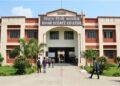
Patna: The Indira Gandhi Institute of Medical Sciences (IGIMS) has reported a broad expansion across academics, research and hospital services in 2025, marking what officials describe as one of the most productive years in the institute’s recent history.

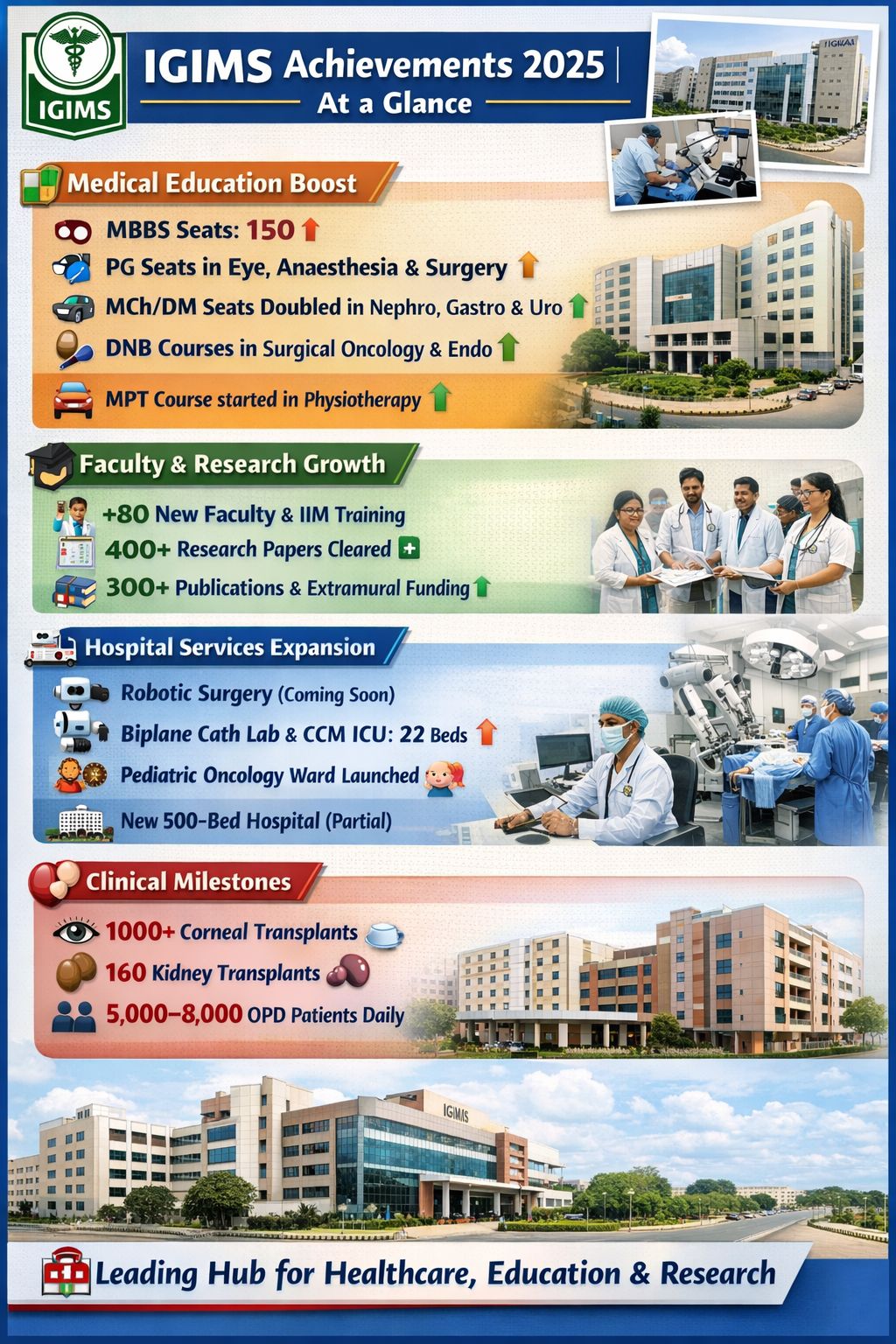
In medical education, the institute increased its undergraduate intake, with MBBS seats rising from 100 to 150. Postgraduate capacity was also expanded, with additional seats introduced in specialties including ophthalmology, anaesthesia and surgery. In super-speciality education, MCh and DM seats were doubled in nephrology, gastroenterology and urology. New academic programmes were added, including an MPT course in the physiotherapy department and DNB courses in surgical oncology and endocrinology.
Faculty strength also saw a significant boost. Around 80 new faculty members were appointed across speciality and super-speciality departments, while several new appointments and promotions were made in the IGIMS College of Nursing. In a move aimed at strengthening institutional governance, all faculty members underwent hospital management training at IIM Bodh Gaya. Soft skills training was also introduced for postgraduate students.

Research activity at IGIMS expanded substantially during the year. The institute’s ethics committee granted clearance to more than 400 research papers and projects, while over 300 academic publications were produced across departments. Researchers secured extramural funding from agencies including the Indian Council of Medical Research, CSIR and the Department of Biotechnology.
Training and academic capacity-building were scaled up through regular seminars, lectures and workshops for faculty and students. More than 1,000 doctors from Bihar and other states received training in NAILS, ATLS and BLS programmes, while medical education technology training was extended to faculty from within and outside the state. A state-of-the-art skill centre is currently under development to support hands-on clinical training.
Hospital services also saw major upgrades. IGIMS enhanced its critical care capacity by expanding the CCM ICU to 22 beds and commissioned a biplane cardiovascular catheterisation laboratory. Modular operation theatres were made operational at the State Cancer Institute, alongside the launch of a molecular pharmacology laboratory and a paediatric oncology ward.
Infrastructure expansion continued with a new eye and regional institute of ophthalmology building becoming functional, adding 160 beds and an eye trauma unit within the emergency department. A new 500-bed hospital has been made partially operational, with work underway on 12 modular operation theatres. Robotic services are in the final stages of preparation and are expected to begin early next year, while robotic physiotherapy services have already started.
Clinically, the institute reported more than 1,000 corneal transplants and 160 kidney transplants to date. Patient load remains high, with approximately 5,000 to 8,000 patients visiting various IGIMS outpatient departments each day.
Officials said the combined academic, research and clinical expansion reflects IGIMS’s growing role as a tertiary healthcare and teaching hub for Bihar and neighbouring states.