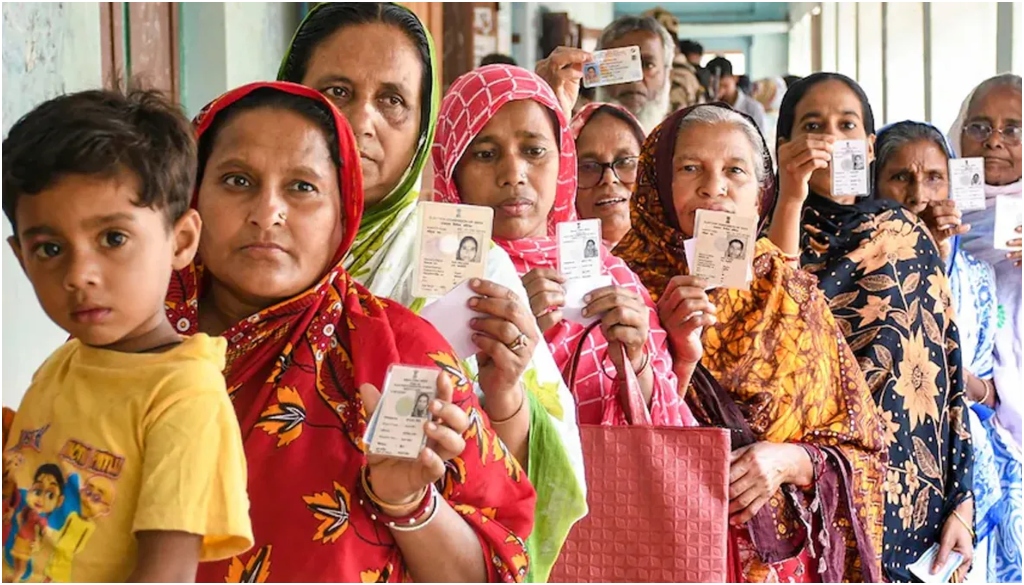
Patna: Bihar is set to hold its next panchayat elections in 2026 on the basis of delimitation carried out nearly three decades ago, even as major changes in the reservation roster and voting technology are expected. Elections will be conducted for 2,55,379 posts across the state, with the State Election Commission preparing for large-scale logistical and administrative arrangements.

One of the key changes in the upcoming panchayat polls will be the revision of the reservation roster. This means seats currently reserved for Scheduled Castes (SC), Scheduled Tribes (ST) or other categories may shift to the general category, while existing general seats may become reserved. The revised roster will be applied as per provisions of the Bihar Panchayat Raj Act.
To conduct the elections, the state will procure more than 32,000 new M-3 electronic voting machines (EVMs) at a cost exceeding Rs 64 crore. Unlike the 2021 panchayat elections, which were held in 11 phases over nearly two and a half months, the 2026 polls are expected to be conducted in fewer phases.

What is panchayat delimitation?
Like Lok Sabha and Assembly constituencies, panchayats also have defined territorial boundaries. Panchayat delimitation is the process through which the geographical limits of gram panchayats, panchayat samitis, wards and district councils are determined. According to the State Election Commission, delimitation is carried out to ensure that each elected representative represents roughly an equal population.
Why delimitation is required
Population patterns change over time, making periodic delimitation necessary. If the population of a panchayat increases significantly, it may be divided to form new gram panchayats. Similarly, the number and boundaries of wards within a panchayat are decided based on population size and geographical factors.
However, the process has remained stalled in Bihar due to the absence of a fresh census. While it was earlier expected that the 2026 panchayat elections would be held on the basis of a new delimitation exercise, the 2021 Census has not been conducted so far. As a result, updated population data is not available. The last census was carried out in 2011, and using this data now would mean relying on figures that are nearly 15 years old.
Delimitation last conducted in mid-1990s
According to the State Election Commission, panchayat delimitation in Bihar was last carried out in 1994–95 on the basis of the 1991 Census. Panchayat elections were held in 2001 following that exercise. Although a census was conducted in 2011, delimitation was not undertaken thereafter. Panchayat elections were held in 2011, 2016 and 2021 with only minor adjustments, even as several rural areas were brought under urban local bodies during this period.
Reservation roster to change in 2026
A new reservation roster will come into effect for the 2026 panchayat elections. As per the Bihar Panchayat Raj Act, the reservation roster is revised after every two consecutive elections. The existing roster was applicable in the 2016 and 2021 elections.
Under the new system, seats currently reserved may become unreserved, while general seats may be allocated to reserved categories such as SC, ST and Extremely Backward Classes (EBC). Reservation will remain capped at 50 percent of the total seats.
Women continue to enjoy 50 percent reservation in panchayati raj institutions. This includes reservation within reservation, meaning half of the seats reserved for any category will be earmarked for women from that category.
How reservation is calculated
Reservation for SC and ST candidates is determined in proportion to their population in a panchayat. For instance, if SC or ST communities constitute 25 percent of a panchayat’s population, 25 percent of the posts will be reserved for them. Around 20 percent of seats are reserved for the EBC category, subject to the overall 50 percent cap.
District magistrates are responsible for finalising reservations as per the rules. Reservation for ward members is based on the total number of ward seats in a gram panchayat. The reservation of the mukhiya post depends on the number of gram panchayats within a panchayat samiti. Similarly, reservation for panchayat samiti members, block pramukhs and district council chairpersons is decided on the basis of the total number of seats at each level.
Why reservation rosters are rotated
Officials said the rotation of reservation rosters is aimed at giving leadership opportunities to all sections of society. If a post remains reserved for the same category for long periods, candidates from other communities in that area would never get a chance to contest that position.
M-3 EVMs to be used, Rs 64 crore for procurement
For the first time, Bihar will conduct panchayat elections entirely using EVMs. Elections for all six posts — mukhiya, ward member, panchayat samiti member, district council member, sarpanch and panch — will be held using M-3, or third-generation, EVMs.
More than 32,000 machines will be procured from Bengaluru-based Electronics Corporation of India Limited (ECIL). Each M-3 EVM costs around Rs 20,000, taking the total procurement cost beyond Rs 64 crore. The state government has approved an overall expenditure of Rs 200 crore for the panchayat elections.
The M-3 EVM can support up to 24 ballot units, allowing voting for as many as 384 candidates, including NOTA. During polling, one control unit will be connected to six ballot units, one for each post. The State Election Commission has decided not to use VVPAT machines and will instead continue with the use of totalisers, which display the total number of votes polled.
How M-3 EVMs differ from earlier models
An EVM consists of a control unit and a ballot unit, while VVPAT is used in some elections to allow voters to verify their vote. Earlier M-2 EVMs allowed a maximum of four ballot units, enabling voting for up to 64 candidates. The newer M-3 EVMs significantly increase this capacity, making them suitable for large panchayat contests with multiple candidates.
Fewer phases, more technology in 2026
According to the State Election Commission, the 2026 panchayat elections will be held in fewer phases than in 2021. Technology will be used more extensively to ensure transparency, including real-time reporting and 100 percent webcasting from polling booths to counting centres.
In 2021, the panchayat elections were notified on August 24 and conducted in 11 phases between September 24 and December 12, stretching the polling process over nearly two and a half months.