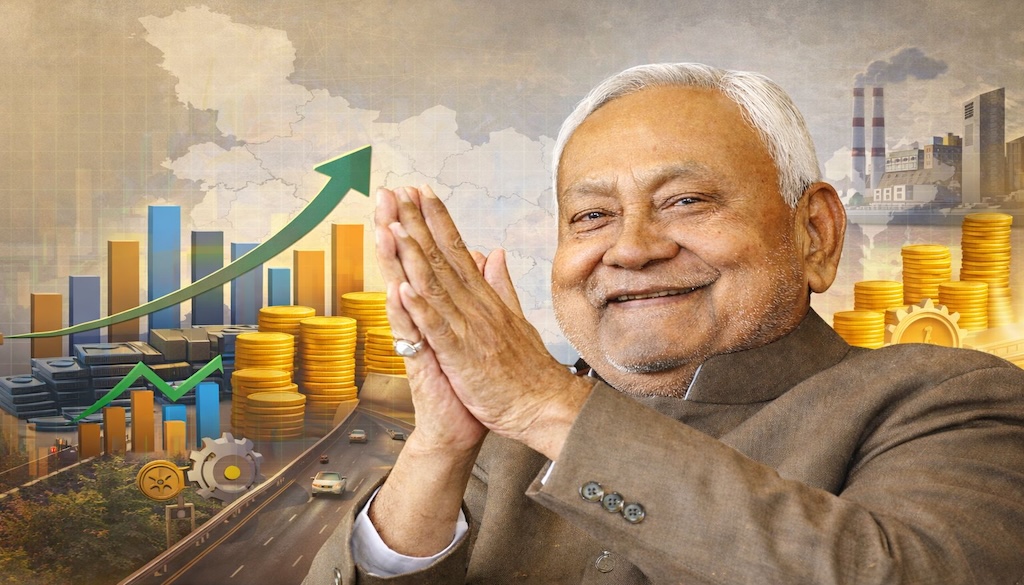
Patna: Bihar’s economy grew at a robust pace in 2024–25, outperforming the national average and signalling a gradual structural shift towards industry, infrastructure and services, according to the 20th edition of the Bihar Economic Survey presented for the fiscal year 2024–25.

The survey estimates that Bihar’s Gross State Domestic Product (GSDP) expanded by 8.6% in real terms and 13.1% at current prices, taking the state’s economy to nearly Rs 10 lakh crore. This compares favourably with India’s GDP growth of 6.5% at constant prices, placing Bihar among the faster-growing large states.
Structural shift in the economy

One of the most notable trends highlighted in the survey is the rising share of the secondary sector. Between 2020–21 and 2024–25, industry and construction increased their contribution to Gross State Value Added from 21.1% to 26.8%, driven largely by construction activity and infrastructure spending. The primary sector’s share declined to 18.3%, while services remained dominant at 54.8%, reflecting gradual diversification of the state’s economic base.
Per capita income also continued to rise. At current prices, per capita GSDP increased from Rs 46,412 in 2020–21 to Rs 76,490 in 2024–25, while real per capita income grew to Rs 40,973, pointing to steady gains in average incomes.
Strong public finances and investment push
The survey underlines a marked shift in the state’s spending priorities. Total government expenditure rose from Rs 1.66 lakh crore in 2020–21 to Rs 2.82 lakh crore in 2024–25, with capital expenditure increasing sharply to 22.3% of total spending. This reflects a stronger emphasis on asset creation and long-term growth.
Revenue mobilisation improved, with tax receipts now accounting for 84% of total revenue, reducing dependence on central grants. Developmental expenditure remained consistently high at around two-thirds of the budget, focused on education, health, roads, irrigation and energy.
Agriculture gains, allied sectors expand
Agriculture and allied activities continued to play a crucial role, contributing over 23% to GSVA. Foodgrain output showed steady growth, with rice, wheat and maize production rising, while horticulture output crossed 230 lakh tonnes. Milk, egg and fish production also posted healthy increases.
The survey highlights policy innovations such as Bihar becoming the first state to offer paid home delivery of seeds to farmers, and a near doubling of electricity subsidies for agriculture. Investments in irrigation rose sharply, and climate-resilient agriculture programmes were expanded to 30 districts.
Enterprises, investment and jobs
Industrial productivity indicators improved, with fixed capital per worker and labour productivity rising significantly. Bihar attracted over Rs 1.11 lakh crore in proposed investments over the past decade, while applications under state entrepreneurship schemes surged in 2024–25.
Tourism emerged as a fast-growing sector, with budget allocations more than doubling in two years. COMFED’s first exports to North America under the “Local to Global” initiative were cited as a milestone for value-added agri-exports.
On employment, the survey notes a large expansion in government recruitment advertisements and welfare spending for construction workers, alongside continued dominance of self-employment in the labour market.
Infrastructure surge: roads, rail, air and water
Infrastructure development remains a central pillar of Bihar’s growth strategy. Over the past 15 years, Rs 70,560 crore has been invested in roads, with transport growing at over 13% annually. The state now ranks among the top states in vehicle registrations.
Aviation has expanded rapidly, with four operational airports and 13 more in development, while water transport has gained momentum under the Jal Marg Vikas Project. A proposed Urban Water Metro in Patna, estimated at Rs 1,200 crore, signals future integration of river transport into urban mobility.
Digital governance and power sector reforms
The survey points to significant progress in e-governance, including near-universal digital access at the panchayat level, the launch of the Bihar AI Mission, and improvements in emergency response and land dispute resolution through online platforms.
Power sector reforms have reduced distribution losses to 15.5%, while per capita electricity consumption has nearly tripled since 2011–12. Installed capacity has crossed 11,700 MW, with solar emerging as a major renewable source.
Human development and social outcomes
Spending on health, education and social services has risen sharply over the past two decades. Life expectancy, maternal and infant mortality indicators have improved steadily, while school dropout rates—especially among girls—have fallen sharply.
Urban and rural development programmes expanded housing, sanitation, drainage and transport infrastructure, including continued progress on the Patna Metro project.
Outlook
Overall, the Bihar Economic Survey 2024–25 presents a forward-looking assessment of a state economy on a high-growth path, supported by rising public investment, improving fiscal metrics and gradual structural change. While challenges remain in job creation and private manufacturing, the survey suggests that sustained focus on infrastructure, human capital and governance reforms could consolidate Bihar’s growth momentum in the coming years.