Patna: In Bihar’s capital, Patna, Holi was once more than a festival of colour. The celebration of Phagua carried a distinct cultural character, marked by satire, music and collective rituals that brought neighbourhoods together. Central to this tradition were the Mahamoorkh Sammelans – or Grand Fools’ Conferences – humorous gatherings that drew crowds and turned public spaces into arenas of playful mockery and verse.

The Mahamoorkh Sammelan tradition began in 1954 and grew steadily over the decades, supported by literary and cultural organisations across the city. Over time, however, these events faded. What once served as a platform for satire and community bonding has gradually disappeared, residents say, replaced by more private and fragmented celebrations.
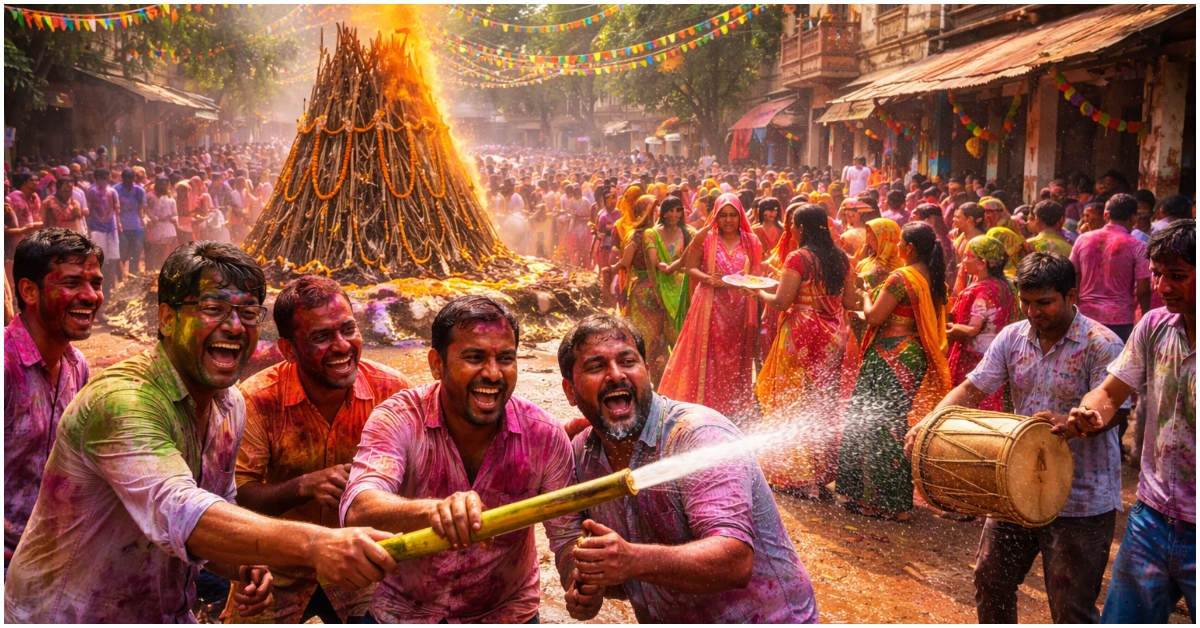
Preparations for Holika Dahan would begin as early as Vasant Panchami. Families and neighbours collectively gathered wood, stacking it at designated sites across the city. Arun Agarwal, a former president of the Bihar Industries Association, recalls that 30 to 40 years ago Holi preparations were deeply community-driven. At major intersections, Holika was worshipped with rituals led by local groups, including the Marwari community, with women participating in large numbers. “It was about meeting people and celebrating together,” he says, adding that the population was smaller and social ties stronger.

Professor Santosh Kumar remembers a Holi marked by exuberance rather than precision. Teachers and students alike would join in singing – often off-key but enthusiastically – while applying colours to one another regardless of religion or background. He traces his earliest memories to Domchanch village in Koderma, where tribal communities gathered on platforms to sing and dance for hours. In Patna, he says, the day followed a rhythm: mud in the morning, colour in the afternoon and gulal in the evening.
Ashok Kumar Sinha, additional director of the Bihar Museum, associates Holi with rural ingenuity. In villages where money was scarce, children fashioned water guns from bamboo cut from nearby groves. Those who could afford brass pichkaris bought them from the market, but many relied on handmade versions. The day would end with groups moving door to door, singing traditional songs to the accompaniment of dhol, jhal and harmonium – a celebration shared by elders, youth and children alike.
Today, while Holi continues to be celebrated with enthusiasm, many in Patna say the collective warmth of earlier decades – shaped by shared labour, satire and song – has slowly given way to a quieter, more individualised festival.