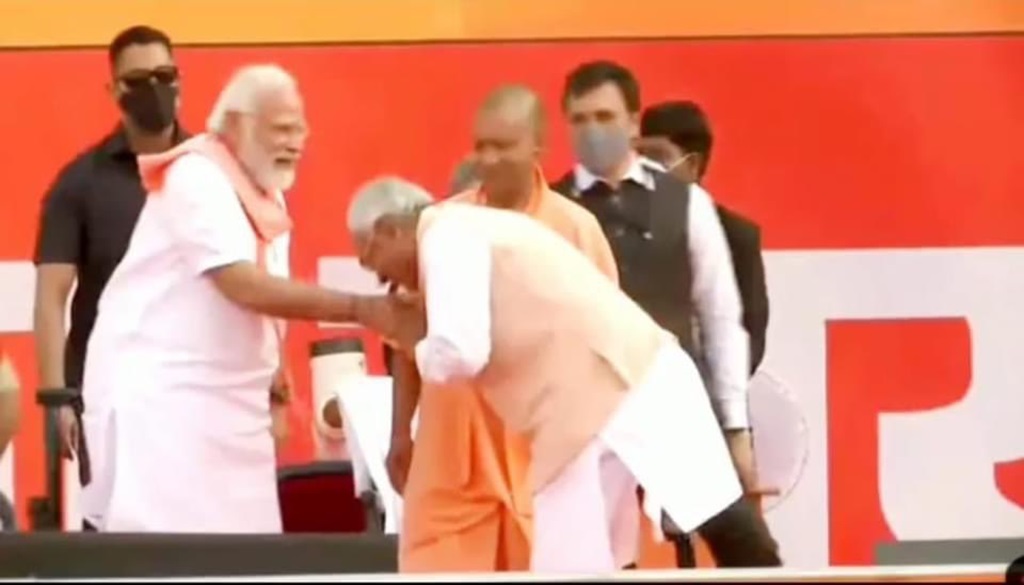
Patna: Bihar politics appears to be entering a new phase following chief minister Nitish Kumar’s decision to seek a seat in the Rajya Sabha, a move that has reignited debate about the shifting balance of power within the National Democratic Alliance (NDA) in the state.

The alliance between the Bharatiya Janata Party (BJP) and the Janata Dal (United) is not new to Bihar politics. The partnership dates back more than three decades, when Nitish Kumar joined hands with the BJP to build a political alternative to the dominance of Lalu Prasad in the 1990s. At the time, Nitish’s Samata Party — and later the JD(U) — was widely seen as the driving force behind the alliance in the state.
Political analysts say the situation has gradually changed over the years. While the NDA in Bihar was once clearly led by the JD(U), the BJP’s role has steadily strengthened, and many now view it as the senior partner in the alliance.

The Era Of JD(U)’s Dominance
The shift becomes clearer when examining Bihar’s electoral history. In the October 2005 assembly elections, which brought the NDA to power in the state for the first time under Nitish Kumar’s leadership, the JD(U) won 88 seats while the BJP secured 55. At that time the JD(U) was widely regarded as the dominant force within the coalition.
Nitish Kumar’s political stature reached its peak during the 2010 assembly elections, when the JD(U) won 115 seats while the BJP secured 91. The results reinforced the perception that Nitish was the undisputed leader of the NDA in Bihar.
The Turning Point: Break With BJP In 2013
The political equation began to change in 2013 when the BJP named Narendra Modi as its prime ministerial candidate. Unhappy with the decision, Nitish broke ties with the BJP and later formed a grand alliance with the Rashtriya Janata Dal (RJD) and Congress.
The 2014 Lok Sabha elections proved to be a turning point. The BJP performed strongly in Bihar while the JD(U) was reduced to just two seats. For the first time, it became evident that the BJP had developed an independent and substantial support base in the state.
BJP’s Steady Rise In Bihar Politics
In the 2015 assembly elections, Nitish Kumar returned to power through the grand alliance with the RJD and Congress. Yet the BJP continued to demonstrate its electoral strength, securing 24.4% of the vote share — higher than any other single party.
Nitish Kumar returned to the NDA in 2017, but by then the political balance within the alliance had shifted. The BJP’s organisational strength and electoral influence had grown significantly, giving it greater bargaining power in the coalition.
2020 Elections And A Changed NDA Equation
The 2020 assembly elections marked another milestone in the changing equation. The BJP won 74 seats, significantly ahead of the JD(U)’s 43. Although Nitish continued as chief minister, the BJP had clearly emerged as the larger partner within the NDA.
The 2024 Lok Sabha elections saw both parties winning 12 seats each in Bihar, suggesting an emerging parity within the alliance. In the subsequent 2025 assembly elections, however, the BJP again emerged as the largest party with 89 seats, while the JD(U) secured 85.
For the first time in Bihar’s NDA politics, the two parties contested an equal number of assembly seats — 101 each — reflecting a more balanced electoral arrangement.
Changing Social And Electoral Base
Political analysts attribute the BJP’s rise to its stable core vote base and organisational strength. While the JD(U)’s support has fluctuated due to shifting alliances and anti-incumbency, the BJP’s voter base has remained relatively consistent.
Since 2014, the BJP has also expanded its reach in rural Bihar and among Extremely Backward Classes (EBCs), a social constituency that had traditionally been considered Nitish Kumar’s political stronghold.
What Nitish Kumar’s Rajya Sabha Move Means
Against this backdrop, Nitish’s decision to move to the Rajya Sabha has intensified speculation about the future leadership structure within the NDA in Bihar.
“There was a time when the JD(U) played the decisive role in Bihar’s NDA politics,” said one political analyst. “Now, on the strength of its organisation and vote bank, the BJP appears to be steadily moving into the position of senior partner.”
With Nitish potentially shifting to national politics, the evolving power dynamics within the BJP–JD(U) alliance could shape the next chapter of Bihar’s political landscape.