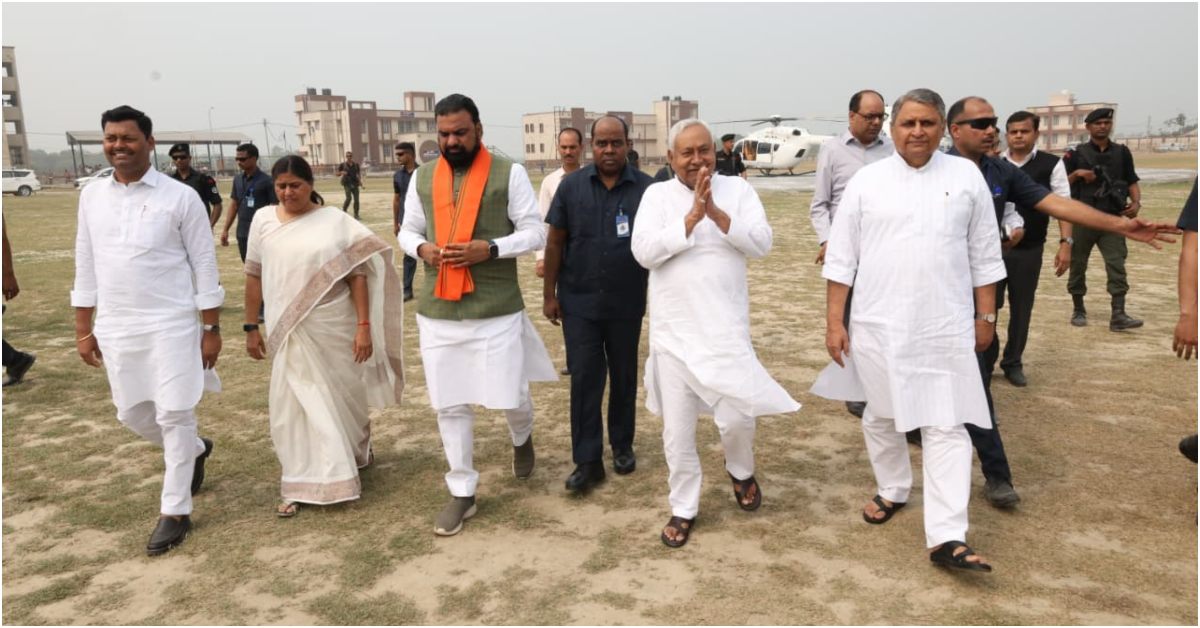
Araria: Bihar Chief Minister Nitish Kumar visited Araria on Wednesday as part of his ongoing Samriddhi Yatra, where he announced the recruitment of 45,000 new teachers through the BPSC, a move aimed at strengthening the state’s education system.

Speaking at the event, he reflected on the state’s condition prior to his tenure as chief minister in 2005, criticising the previous Lalu-Rabri government. “Before November 24, 2005, law and order in Bihar was extremely poor. People were afraid to step out after dark, and health, education, and infrastructure were in dismal condition,” he said.
Highlighting his government’s initiatives over the years, he cited the promotion of girl child education, the bicycle scheme, and various steps to improve educational infrastructure. The number of government teachers in Bihar has now reached 524,000, and the addition of 45,000 new posts through BPSC recruitment is expected to further enhance educational outreach across the state.

On healthcare, CM said the system was “in a very poor state” before 2006, with limited access to treatment. Since then, his government has introduced free medical care in hospitals, expanded medical colleges from six to twelve, and improved facilities at institutions including Patna’s PMCH, now housing 5,403 beds, and IGIMS.
He also outlined progress in infrastructure and agriculture. Large-scale road and bridge construction has reduced travel times to Patna from remote districts to just five hours. Fish production has more than doubled, and initiatives under the fourth agricultural roadmap have boosted farming across the state.
The chief minister highlighted women-focused initiatives under the Saat Nischay programmes, including free electricity, describing these measures as significant steps in women’s empowerment.
During his visit, he also inaugurated and inspected the administrative building of the new Araria police station, launched various development schemes remotely, and oversaw projects under the Kosi Milk Project in Purnia. He interacted with students at the GNM hostel and the Jananayak Karpuri Thakur Hostel, along with other hostels run by the Welfare Department, emphasising the government’s commitment to both education and local development.