
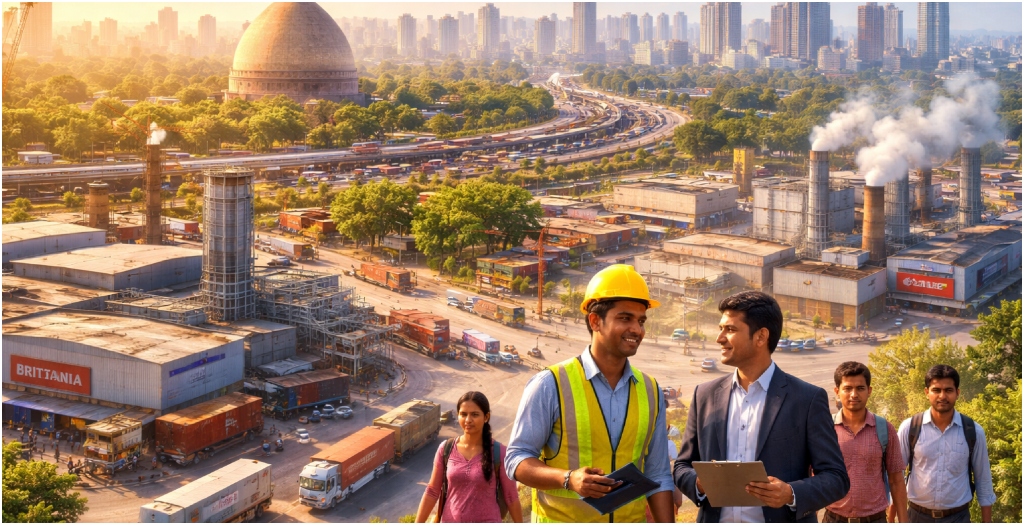
Patna: Over the past decade, Patna has witnessed a steady and visible transformation, emerging as the leading industrial centre of Bihar. What was once primarily known as an administrative capital is now becoming a hub for manufacturing, trade and investment. This shift has been driven by improved roads, better rail connectivity, reliable electricity and policies aimed at attracting businesses. As industries expand in and around the city, the benefits are spreading to nearby districts, creating a wider economic impact.

One of the most significant outcomes of this industrial growth has been the rise in employment opportunities. Local youth, who earlier migrated to other states in search of work, are now finding jobs closer to home. Factories, warehouses and production units are not only creating direct employment but are also supporting a network of small businesses. These include suppliers, transport services and local enterprises that depend on industrial activity. Government schemes offering financial help for small businesses have further encouraged self-employment, especially in rural and semi-urban areas.
A major reason behind this growth has been the improvement in power supply. In the past, industries struggled due to frequent electricity shortages, making it difficult to operate efficiently. However, new thermal power plants in places like Barh, Kahalgaon, Nabinagar and Kanti have changed the situation. With more stable electricity, industries are now able to run smoothly, which has increased confidence among investors and encouraged companies to set up operations in the state.

Several well-known companies have already established their presence in the region. Firms such as Britannia Industries and Parle Products have set up production units near Patna, boosting local employment and strengthening supply chains. At the same time, areas like Bihta and Fatuha are emerging as new industrial zones, attracting fresh investments. Sectors such as food processing, FMCG, packaging and beverages are growing rapidly, supported by better transport and logistics facilities.
Government efforts have also played a key role in this transformation. Investor summits and business-friendly policies have helped bring in new proposals and investments. According to ASSOCHAM, Bihar is gradually shifting from being only a consumer market to becoming a production hub. Data from India Brand Equity Foundation shows that the state’s economy is growing steadily, with rising income levels reflecting the impact of industrial development.
Land availability has further supported this expansion. The Bihar Industrial Area Development Authority has allocated large areas for industrial use, and more land is being prepared for future projects. Policies aimed at freeing unused land and making it available to investors are expected to speed up industrial growth in the coming years. This ensures that new businesses have the space they need to set up operations without major delays.
Exports from Bihar are also increasing gradually, with products like petroleum goods, rice and other food grains being sent to different markets. Improved infrastructure, including better highways and the expansion of Darbhanga Airport, has made transportation easier and faster. These developments are helping businesses connect with national and international markets more efficiently.
Overall, the rapid industrial growth in Patna and nearby areas is reshaping Bihar’s economy. The state is slowly moving away from its dependence on migration and is building a stronger base for local employment and business. While challenges still remain, the ongoing changes indicate a positive direction, with Patna leading the way as Bihar’s new industrial powerhouse.