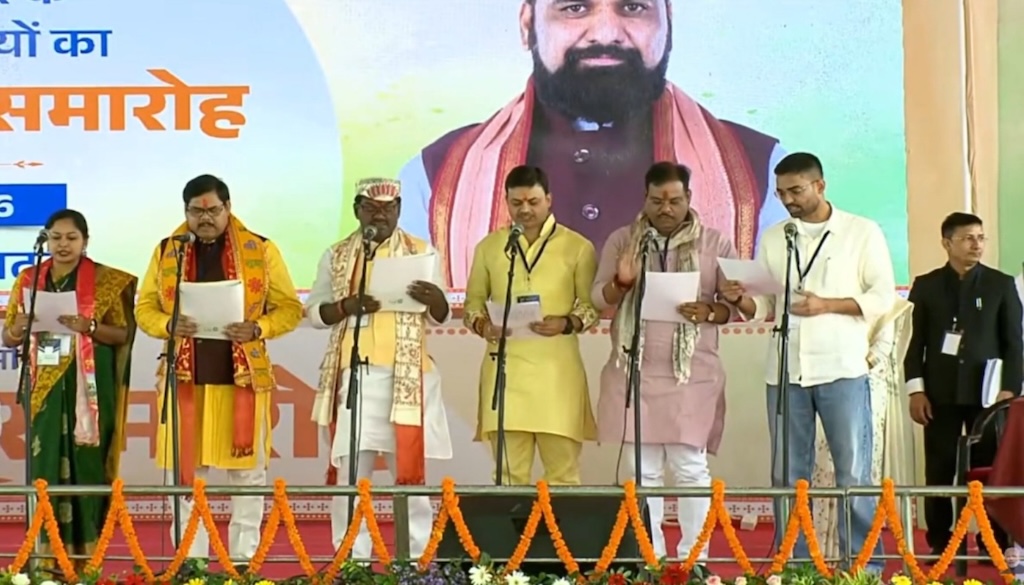
Patna: Twenty-two days after taking oath as the Chief Minister of Bihar, Samrat Choudhary on Thursday expanded his cabinet, forming a 35-member council of ministers — the first full cabinet under a BJP Chief Minister in the state.

The cabinet expansion has triggered a major reshuffle in departmental allocations, with Chief Minister Samrat Choudhary retaining control over several influential and financially significant departments. Political observers say the new arrangement reflects a clear consolidation of power within the BJP-led government.
Apart from ensuring ministerial berths for leaders considered close to him, Samrat Choudhary has also increased the representation of the Ang region in the cabinet. At the same time, Tirhut and Mithilanchal have emerged as dominant regions in the new power structure, while the influence of Shahabad and Magadh appears to have reduced compared to the previous Nitish Kumar-led government.

Regional Balance Shifts in New Cabinet
The regional composition of the cabinet has changed significantly after the leadership transition in Bihar.
While the previous Nitish Kumar cabinet reportedly had stronger representation from Magadh and Shahabad regions, the new Samrat Choudhary cabinet is dominated by leaders from Mithilanchal, Ang and Tirhut.
Mithilanchal has received the highest representation with seven ministers, followed by Tirhut and Ang regions with six ministers each. Magadh has five ministers, while Shahabad has only two representatives in the cabinet.
Political analysts attribute this shift to the NDA’s strong electoral performance in these regions during the 2025 Assembly elections.
In Mithilanchal, the NDA won 40 out of 46 seats — around 87% of the total seats in the region — which was 10 seats more than its 2020 tally.
Similarly, the NDA secured 55 out of 64 seats in the Tirhut region, nearly 86% of the total seats there, registering a gain of 19 seats compared to the previous Assembly election.
The Ang region delivered one of the strongest mandates for the NDA, where the alliance won 24 out of 25 seats, almost 99% of the region’s total Assembly seats.
13 Districts Get No Representation
The cabinet does not include a single minister from 13 districts — Saran, Sheikhpura, Arwal, Aurangabad, Rohtas, Buxar, Siwan, Banka, Khagaria, Katihar, Araria, Sitamarhi and East Champaran.
Over 70% Ministers From OBC, EBC and Dalit Communities
The new cabinet appears to focus heavily on caste balance and social representation.
Along with Chief Minister Samrat Choudhary and Deputy Chief Ministers Vijay Choudhary and Bijendra Yadav, the 35-member cabinet includes more than 70% ministers from Other Backward Classes (OBC), Extremely Backward Classes (EBC) and Scheduled Castes (SC).
The cabinet includes 11 OBC ministers, seven EBC ministers and seven ministers from Scheduled Caste communities. Both BJP and JD(U) have included one Yadav leader each in their quota.
JD(U)’s Jama Khan is the only Muslim minister in the cabinet.
Among upper-caste communities, BJP has inducted two Bhumihar leaders and JD(U) one. Rajputs have the highest upper-caste representation with four ministers — two from BJP, one from JD(U) and one from Chirag Paswan-led Lok Janshakti Party (Ram Vilas). BJP has also included two Brahmin faces in the cabinet.
The caste composition broadly mirrors the social representation in the Bihar Assembly, where OBC legislators form the largest bloc with 83 MLAs, followed by 72 upper-caste MLAs, 40 SC-ST legislators and 37 EBC MLAs.
The Samrat Choudhary government has also included five women ministers, reportedly the highest ever representation for women in a Bihar cabinet.
Push for New Leadership
The cabinet expansion is also being seen as an attempt by both BJP and JD(U) to promote a new generation of leaders across caste groups.
BJP has elevated leaders such as Sanjay Tiger and Shreyasi Singh from the Rajput community, Engineer Shailendra from the Bhumihar community, Lakhindra Paswan and Nand Kishore Ram from Dalit communities, and Rama Nishad from the Mallah community.
Within JD(U), the cabinet expansion is being viewed as the beginning of a leadership transition phase associated with Nishant Kumar’s emergence in state politics. Rashtriya Lok Morcha chief Upendra Kushwaha is also seen initiating a political power transition towards the next generation by promoting his son.
BJP Retains Control Over Key Ministries
The departmental allocation reflects a significant transfer of administrative and financial control towards the BJP.
Of the total departments, BJP ministers now control 26 portfolios, while JD(U) leaders have been allotted 20 departments.
The BJP has retained charge of key ministries linked to governance, finance and infrastructure. The Education Department, one of the state’s highest-budget ministries, has shifted from JD(U) to BJP control. The BJP has also kept departments related to industries, employment generation, urban development and road construction.
According to the Bihar Budget 2026-27, the state’s top spending departments include Education, Health, Home, Urban Development, Energy and Rural Development.
While Health, Rural Works, Energy and Rural Development have gone to JD(U), BJP has retained Education, Urban Development and Road Construction.
Chief Minister Samrat Choudhary has also kept the Home Department, which gives him direct control over law and order and the transfer-posting mechanism of IAS and IPS officers. He has additionally retained the Cabinet Secretariat and Civil Aviation departments.
First-Time Ministers Get Major Departments
Several first-time ministers have been entrusted with major responsibilities in the new cabinet.
Nishant Kumar, who has become a minister for the first time, has been given the Health Department, while Mithilesh Tiwari has been assigned the Education portfolio.
Shreyasi Singh has been entrusted with the Industries Department, while first-time minister Engineer Shailendra has received the crucial Road Construction Department.
At the same time, portfolios of senior leaders Vijay Sinha and Ramkripal Yadav have been changed, with both receiving departments considered less influential compared to their previous assignments. Vijay Sinha has been given the Agriculture Department, while Ramkripal Yadav will handle the Cooperative Department.
Within JD(U), senior leader Ashok Choudhary has been assigned the Food and Consumer Affairs Department, while Lesi Singh has received the Building Construction portfolio. Sunil Singh has been shifted from Education to the Rural Works Department, considered one of the state’s major infrastructure-focused ministries.