Patna: Bihar is moving ahead with plans to introduce a Regional Rapid Transit System (RRTS) similar to the network operating in the National Capital Region (NCR), with four proposed high-speed corridors radiating from Patna.

The state Cabinet has approved the preparation of a Detailed Project Report (DPR) for the project. If implemented, the network will connect Patna with Muzaffarpur, Begusarai, Ara and Gaya through dedicated rapid rail corridors designed for trains capable of running at speeds of up to 160 kmph.
Here is what the project involves and why it is considered significant.

What Is The Rapid Rail Transit System?
The RRTS is a high-speed regional rail network designed to connect major cities and suburban centres over medium distances.
Unlike conventional rail services, rapid rail systems use dedicated tracks and operate at much higher frequencies, allowing commuters to travel quickly between cities.
The model is based on the NCR network, where the Delhi–Meerut Rapid Rail corridor is already operational.
You may like to read this article as well:
Bihar Cabinet Clears 22 Proposals, Approves New Kendriya Vidyalayas And Regional Rapid Transit Plan
Which Routes Have Been Proposed?
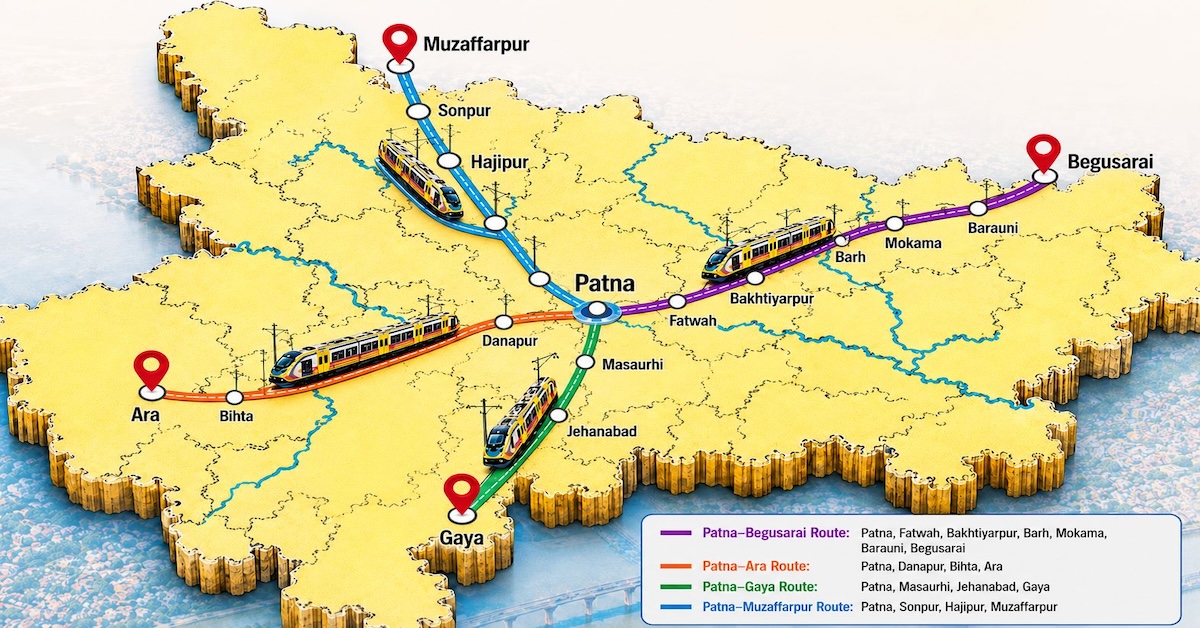
The Bihar government has proposed four corridors connecting Patna with neighbouring cities:
- Patna–Muzaffarpur via Sonepur and Hajipur
- Patna–Begusarai via Fatuha, Bakhtiyarpur, Barh, Mokama and Barauni
- Patna–Ara via Danapur and Bihta
- Patna–Gaya via Masaurhi and Jehanabad
Together, these routes are expected to connect 16 cities and towns across eight districts:
- Patna
- Muzaffarpur
- Begusarai
- Vaishali
- Saran
- Jehanabad
- Gaya
- Bhojpur
What Has The Government Approved?
The Cabinet has approved the preparation of a Detailed Project Report for the four proposed corridors.
The work has been assigned to the National Capital Region Transport Corporation (NCRTC), the agency responsible for developing and operating the Delhi–Meerut RRTS.
The DPR will determine the technical feasibility, alignment, station locations, passenger demand, project cost and implementation strategy.
It does not mean construction has begun.
You may like to read this article as well:
Why Are Dedicated Tracks Needed?
According to the proposal, rapid trains are expected to operate at speeds of around 160 kmph.
To support such speeds and maintain service reliability, separate tracks will be constructed instead of sharing existing railway infrastructure.
The DPR will also examine daily commuter demand between Patna and surrounding cities before finalising station locations.
How Could The Project Benefit Bihar?
The proposed corridors are intended to improve connectivity between Patna and neighbouring urban centres.
A large number of people travel daily to the capital for work, education, healthcare and government services. Faster regional rail could reduce travel times and make daily commuting more practical.
The government also expects the project to support planned satellite townships around Patna, Gaya, Sonpur and Muzaffarpur by improving transport links.
Officials believe better connectivity could attract investment, generate employment and encourage more balanced urban development across the region.
How Frequently Will Trains Run?
The frequency of services in Bihar will be decided after the DPR is completed.
However, on the Delhi–Meerut RRTS, trains operate every 10 to 15 minutes during regular service, providing metro-like frequency over much longer distances.
The Bihar government has indicated that the proposed network is being planned on similar lines.
What Happens Next?
The immediate next step is the preparation of the Detailed Project Report.
The DPR will identify:
- final route alignments
- station locations
- passenger demand
- engineering requirements
- integration with road networks
- connectivity to industrial areas and proposed satellite townships
- project cost and implementation schedule
Only after the DPR is completed and approved will decisions be taken on funding, construction timelines and execution.
If implemented, the Rapid Rail Transit System would become Bihar’s first high-speed regional rail network and one of the state’s largest public transport infrastructure projects.